US stock futures rose, indicating the market is poised to rebound as dip buyers scoop up beaten down technology shares.
Futures tied to the S&P 500 Index were up 1.6% as of 8:36 a.m. in New York, while Nasdaq 100 futures advanced 2.3%, pointing to a strong start as markets reopen from Thursday’s holiday. Trading will end early at 1 p.m. in New York on Friday.
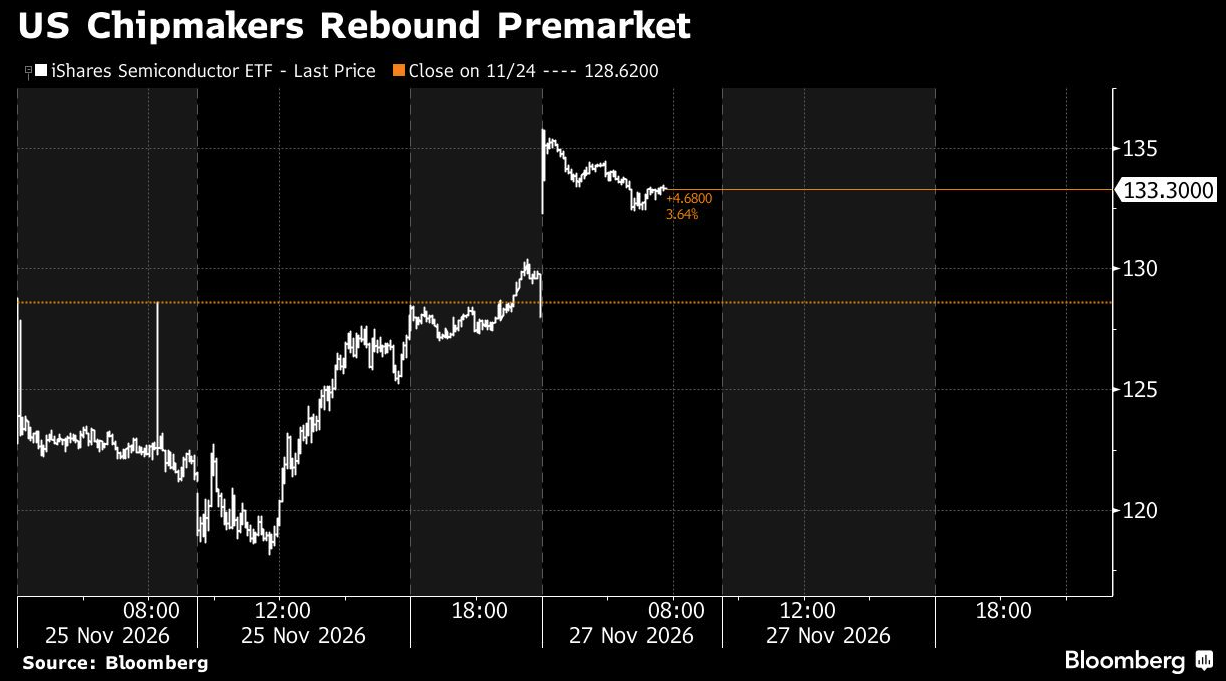
AI hyperscalers Alphabet Inc. and Amazon.com Inc. both rose more than 2% premarket while Microsoft Corp. climbed by 1.8%. Meta Platforms Inc. gained 3.3% and Oracle Corp. advanced 4.2%. An exchange-traded fund tracking chipmakers jumped 4.1%, after sliding more than 40% since its June peak. Neocloud firms CoreWeave Inc. and Nebius Group NV advanced 5.9% and 7.5%, respectively.
Stocks have swung sharply this week, with Jensen Huang’s return as Nvidia Corp.’s chief executive officer and Anthropic PBC’s brief fall below its IPO price adding to volatility across the AI trade. A key gauge of market turbulence — the Cboe Volatility Index, or VIX — fell to 25 after briefly spiking to nearly 35 on Wednesday, when markets tumbled early in the session before clawing back the losses.
“Having a break with US markets closed on Thankgiving was helpful since it gave everyone a break after a few days of wild swings to reassess equity positoning,” said Michael Antonelli, market strategist at Baird. “There’s still fierce debate over whether the AI trade is over or not. Institutions will have to make decisions in the next few weeks over how to move forward and that will set the tone heading into 2027.”

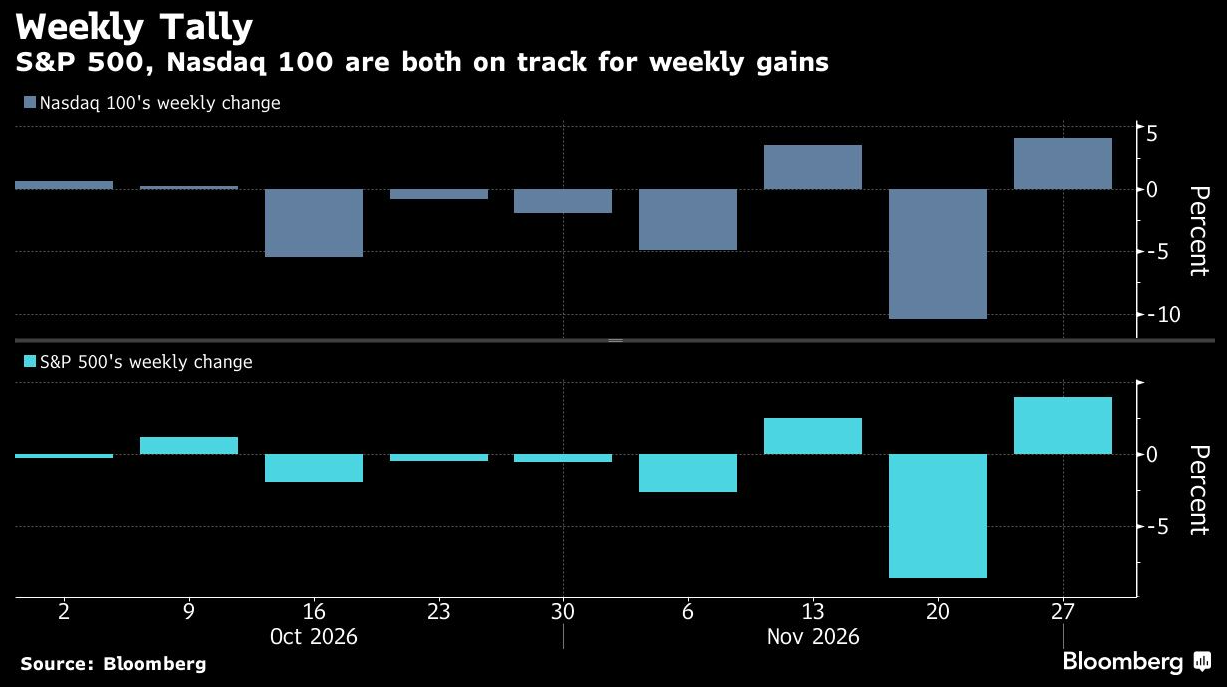
Despite Friday’s rebound in tech stocks, the S&P 500 is still heading for its worst November since the height of the 2008 financial crisis as the market is dragged down by concerns about the sustainability of the AI boom, elevated inflation and expectations that the Federal Reserve will resume raising interest rates next month.
See more: AI Worries Outweigh Strong Economic Data
Swap traders are almost fully pricing in a quarter-point rate hike in December after data this week showed the US economy grew much faster than initially estimated in the third quarter and inflation accelerated in October.
President Donald Trump has also sowed uncertainty with tariff hikes planned on imports from China, Japan, the European Union and other trading partners. Key events to watch next week include Huang’s congressional testimony following his reinstatement at Nvidia and the November US jobs report.
Traders remained optimistic Friday, though, as strong profit outlooks during the crucial holiday season would present a much-needed tailwind. Estimates from the National Retail Federation imply a 4.2% growth in holiday retail sales in 2026 from a year ago, compared with 3.1% in 2025.
So far, earnings results from retail companies have been mixed. Earlier this week, Dollar Tree Inc.’s third-quarter adjusted earnings per share and comparable sales topped Wall Street expectations, while Best Buy Co. Inc. raised its guidance for the year on resilient demand for computing. Target Corp.’s sales beat estimates, while TJX Companies Inc. narrowed its earnings outlook.
More retailers will report earnings next week, including Macy’s Inc. and Dollar General Corp.
On Friday, defensive stocks that tend to have comparatively low valuations and offer robust dividends were slipping after outperforming earlier in the week, with Coca-Cola Co., Procter & Gamble Co. and Campbell’s Co. all lower premarket.
Investors had flocked to such consumer staples companies in the past few months, putting them on track for the best quarter since 2000. The advance has made valuations look stretched: the S&P 500 Consumer Staples Index is sitting at 24 times projected earnings, the most since the 1990s.
Elsewhere, Altria Group Inc. fell 2% premarket after news that the company is considering an offer for British cigarette maker Imperial Brands, potentially in partnership with Japan Tobacco.
Meanwhile, Vertex Pharmaceuticals Inc. slid nearly 8% ahead of the opening bell after the company said the FDA extended the target action date by up to three months for a license application for the use of povetacicept to treat a type of chronic kidney disease.
A message from Advisor Perspectives and VettaFi: Discover something new! Click here to register for our upcoming webcasts.
Bloomberg News provided this article. For more articles like this please visit
bloomberg.com.
Read more articles by Jessica Menton