When OPEC+ oil ministers gather at the end of this month to figure out how much crude to supply the world, they’ll face their most consequential decision of the year.
Saudi Arabia and its partners must plot a course for 2027, positioning themselves for the potential end of the Iran war while contending with strains inside the alliance. The United Arab Emirates has already quit after years of frustration with its production limits and Iraq has pushed for room to pump more.
Integral to the talks, ministers will have to digest the results of the most comprehensive external review yet of how much each member is capable of producing, a highly sensitive exercise whose findings have so far been kept closely guarded even within OPEC+.
The review, completed this month by Dallas-based consultants DeGolyer and MacNaughton Corp., seeks to put an independent number on one of the most contentious questions inside the alliance: each country’s maximum sustainable oil production capacity.
Those numbers matter because they will form a new starting point for countries’ future production targets. In simple terms, the greater the capacity assigned to a country, the stronger its claim to be allowed to pump more.
Yet even after the exercise concluded, members weren’t given the full picture. Countries received their own results, while OPEC+ didn’t circulate a list showing the capacity assigned to every member, according to delegates. That leaves governments heading into the meeting without knowing precisely how their capabilities stack up against their peers.
The meeting of the Organization of the Petroleum Exporting Countries and its allies comes at a time of extraordinary uncertainty in the market: Will the world pump more barrels of oil each day next year than it consumes, as organizations like the International Energy Agency predict? Will rivals such as the US and Guyana keep ramping up? Will demand hold up — or even snap back — in 2027 if the war is resolved? And will consumer governments seek to replenish stockpiles heavily depleted by the conflict?
“OPEC+ faces an extremely difficult call for 2027,” said Jorge Leon, head of geopolitical analysis at Rystad Energy who previously worked at the OPEC secretariat. “The group has to plan around huge uncertainty over the US-Iran war, the pace of recovery through the Strait of Hormuz, and the size of the surplus that could emerge once disrupted barrels return.”
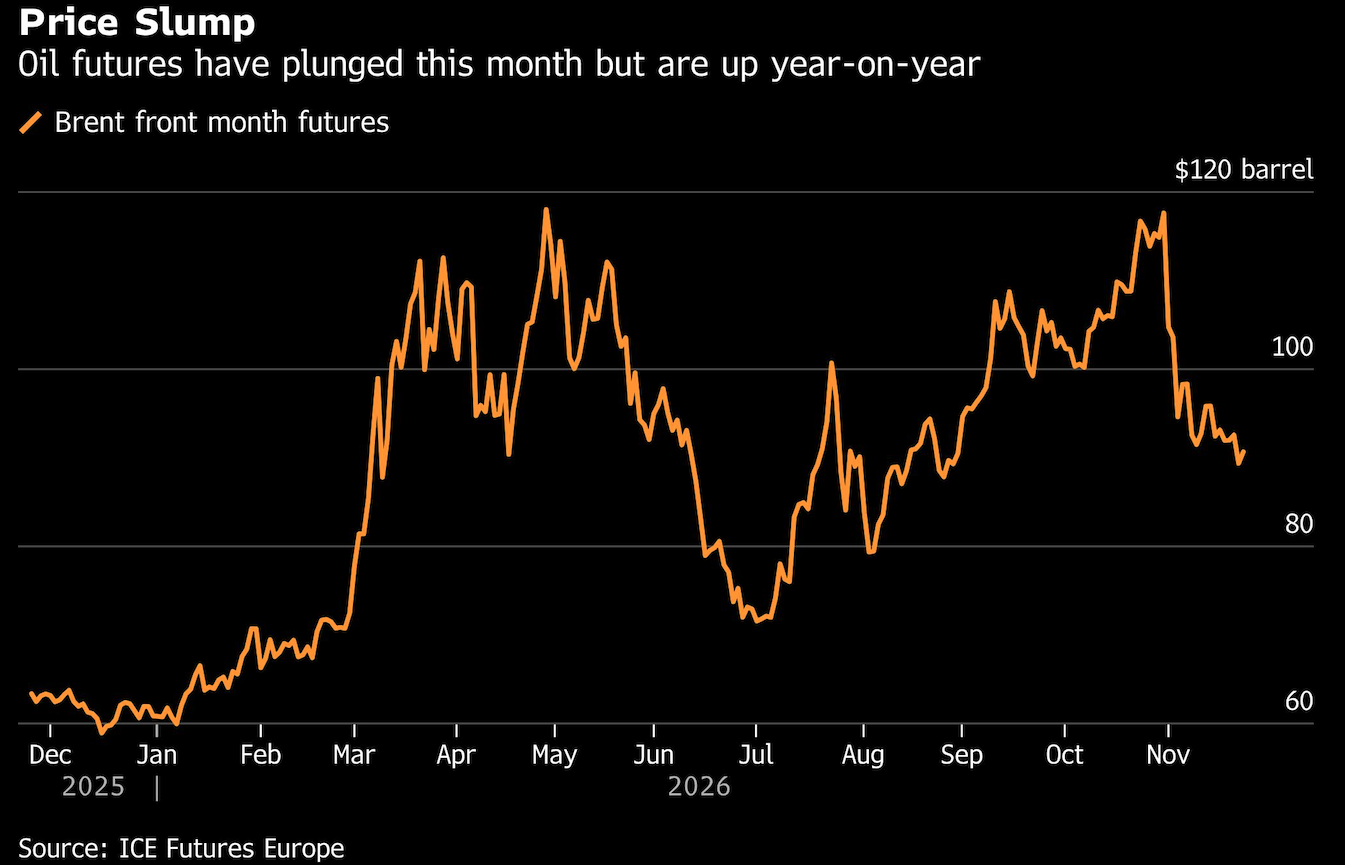
The most immediate stakes are oil prices. Brent futures have tumbled almost 25% this month as the Saudis and other Persian Gulf exporters managed to shift barrels out of the region at pre-war rates despite the ongoing hostilities. Physical markets look comfortably supplied and a renewed surplus next year could erode revenues for the petro-states that compose OPEC+.
While Sunday’s meeting will be consequential for the group’s overall production policy for 2027, the impact on the short-term supply of oil will probably be more modest. Despite this month’s plunge, prices are still up by about 40% compared with a year earlier, meaning there’s no clear oil price imperative to adjust output quotas meaningfully.
And even if some countries were to be assigned large new production ceilings during the audit, it’s unlikely OPEC+ will be pushing to release extra barrels onto the market.
In the run-up to the meeting, Riyadh and Baghdad both said their output had recovered from wartime losses to levels that exceeded their agreed OPEC+ quotas.
Before that, war-related disruption in Hormuz had forced Gulf nations to shutter output and rendered OPEC+ quotas something of a paper exercise. If the conflict flares anew, any quotas could once again become superfluous. But if the recent recovery in traffic endures, the numbers will become increasingly relevant.
New Targets
In addition to the uncertainties gripping the market, the audit will add an extra layer of complexity to Sunday’s decision-making process.
On Nov. 16, officials from OPEC’s secretariat in Vienna and representatives from several countries held an online session to mark the conclusion of the DeGolyer and MacNaughton audit, and nations received their own results.
These figures are to be used as the “baselines,” or starting points, for new production targets taking effect in January, though exactly how the new quotas will be calculated remains unclear, delegates said. They asked not to be identified as the process is private.
One delegate said the Nov. 16 meeting was short and didn’t give members much opportunity to debate the new capacity levels. They said they were surprised that the group didn’t share a list of every country’s new capacity figures.
OPEC’s secretariat in Vienna didn’t respond to a request for comment.
Between April 2025 and September 2026, a subgroup of OPEC+ members has formally restored two layers of output halted in 2023 through a series of monthly quota increases, which continued even when the Iran war rendered the hikes symbolic.
Stay or Go
That process still technically leaves offline a third tranche of output that was idled back in 2022, though factoring this into new targets for 2027 is further complicated by the deterioration of output capacity many members have experienced in the meantime, owing to issues like under-investment and sanctions.
In practice, the capacity review may ultimately allow only a handful of countries to boost production. Many members are already close to their limits, while others — most notably Saudi Arabia — are expected to retain spare capacity.
The country that has most intensely lobbied for a higher baseline, and the right to pump more, is Iraq.
In June, the nation’s oil ministry briefly warned it could decide “whether to remain in or withdraw” from the organization — founded in Baghdad more than six decades ago — if the results of its capacity assessment weren’t high enough.
While the country subsequently withdrew the threat, Baghdad has chafed for years at OPEC quotas while it seeks to rebuild its shattered economy. Baghdad is seeking a production baseline of 6 million barrels a day, people familiar with the matter said in September.
The warning carried extra weight because it came just weeks after the UAE announced its departure from the group after decades of stalwart membership, citing frustrations with limits on deploying supplies from new oil projects. Abu Dhabi’s production has subsequently reached new records of more than 5 million barrels a day, according to the IEA.
Previous reviews of how much members can pump have proved contentious. An assessment of Angola’s capacity in 2023 spurred the country to quit OPEC after 16 years of membership.
Ultimately, though, the fate of the war — rather than the outcome of the audit — may have the biggest influence of all on how much oil OPEC nations end up pumping in the coming year.
Oil flows have held up in recent weeks, despite a surge in attacks by Iran on vessels going through Hormuz. At the same time, the US is maintaining a strict blockade on Iran’s shipping, pressuring Tehran.
“Given Iran’s stated objective to break the blockade by any means necessary, the actual live fire in the region could still be more consequential in the near term than any rhetorical fireworks over production targets even with the recent rise in Hormuz transits,” said Helima Croft, an analyst at RBC Capital Markets.