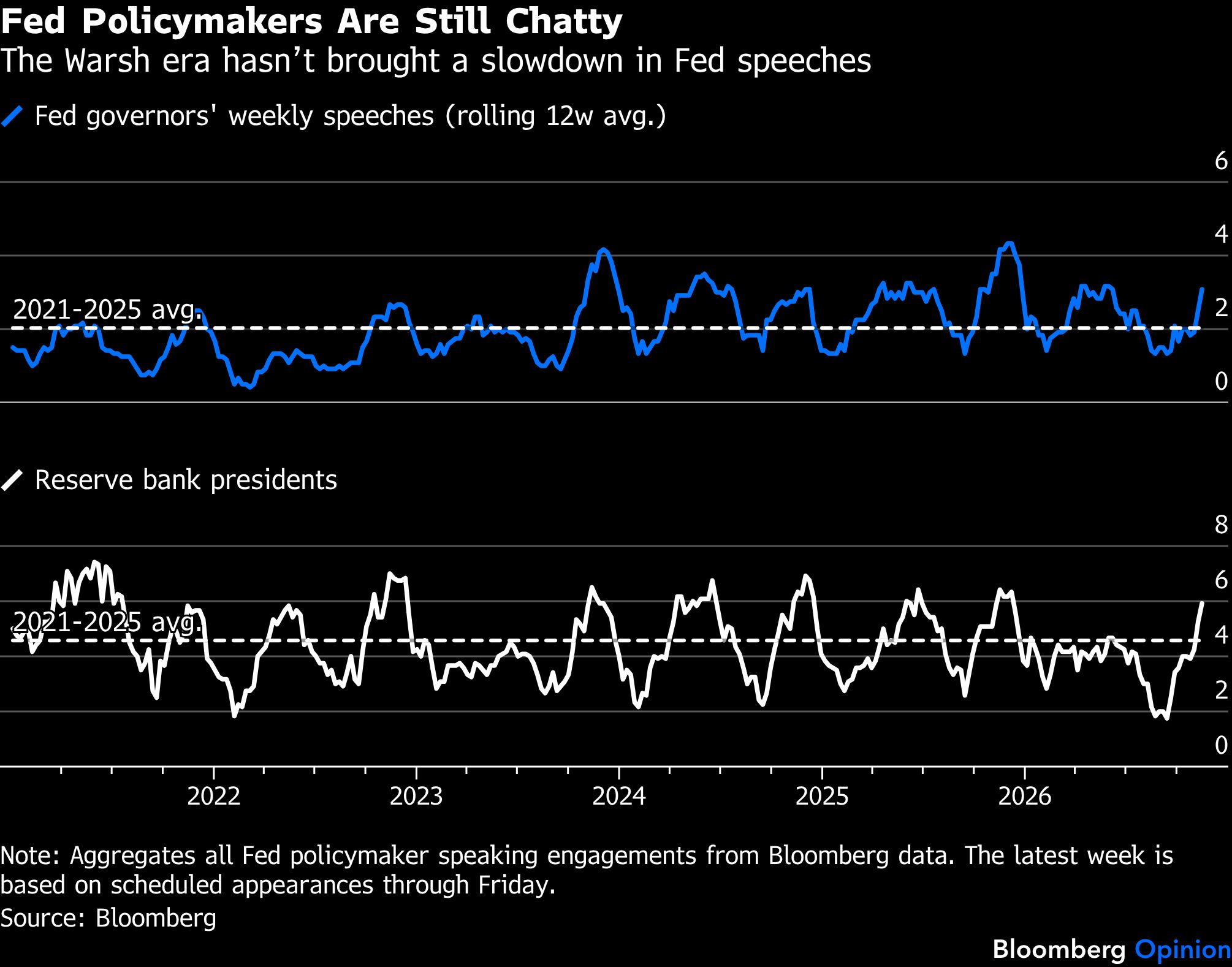
Upon becoming chair of the Federal Reserve in May, Kevin Warsh pledged to run a tight-lipped central bank, one where decisions about the future path of monetary policy are made amongst policymakers behind closed doors rather than providing so-called forward guidance in public. Six months later, Warsh seems to be having a tough time getting any of his fellow Fed colleagues to go along.
The philosophical divide has been on full display in recent weeks, as various Fed officials publicly staged a consequential debate about how fast to raise interest rates to combat inflation. Governor Christopher Waller took the lead in making the case for a half-point move, while Federal Reserve Bank of New York President John Williams argued against such “dramatic” measures. And Warsh? He has declined to engage, maintaining a stubborn commitment to his (apparently solo) quest for parsimony.
Warsh’s approach has fostered widespread confusion around monetary policy at the world’s most consequential central bank as well as a sense that he lacks the typical authority commanded by other central bank leaders. He’s giving up many of the benefits of transparency, such as trust and accountability from one of the most powerful institutions in our democracy, and getting next to nothing in return.
According to Warsh, the Fed’s tendency to overcommunicate led it to make promises it couldn’t keep and look foolish when its guidance ultimately missed the mark, making it less nimble than it should have been when serious inflation appeared in 2021 for the first time in decades. He also argued that the financial markets have relied too heavily on guidance from the Fed instead of reacting to economic conditions on their own, and that market moves unburdened by Fedspeak can provide useful signals to policymakers.
Warsh shortened the Fed’s official monetary policy statements to about 130 words (the fewest since 2008), reduced the length of post-meeting press conferences to under 40 minutes (down from around 51 minutes under former Chair Jerome Powell) and refrained from participating in policymakers’ quarterly Summary of Economic Projections (which could be ended as part of a broad strategy review ordered by Warsh). Warsh also introduced a plan to cut the number of policy meetings, and used his last speaking engagement to ask chin-stroking questions about artificial intelligence, rather than address the current stance of monetary policy.
But is Warsh’s caginess achieving what he intended, or just making Fed communication messier?
Fed governors and presidents are speaking publicly just as frequently as they have over the past five years. If you squint hard at the data below, you’ll perceive a brief slowdown in public appearances after Warsh took the helm, perhaps because his colleagues were feeling him out. But any such caution seems to have been abandoned by October or so, after a renewed energy spike and persistent underlying inflation led to the first rate increase in three years, giving way to debate about how much higher to go and how quickly.
Fed communication, in essence, is a solemn responsibility to the American people who have endowed the institution with tremendous operating power and independence. It’s also a tool in the Fed’s management of the economy. By avoiding forward guidance of any kind, Warsh is hamstringing himself in the fight against inflation, a point that even some of his colleagues appear concerned about. “I’ve been in this game a long time,” Waller said on CNBC last week, “and all the academic literature and everything I know about central banking for 30 years is you want to use communication as one of your tools.”
While the Fed’s policy rate is a blunt instrument, nuanced communication can help the central bank bend financial markets and, by extension, the economy in subtler ways to achieve its policy goals. That includes influencing mortgage markets, other long-term borrowing costs and the behaviors of companies and consumers that the Fed’s main target rate for overnight loans between banks can’t address directly.
Beyond Waller, there were other signs that Warsh’s ideas on communications were exacerbating tension among policymakers. Minutes released Wednesday from the Fed’s last policy meeting in October suggest that “a few” officials who backed raising rates “could have supported no change in the federal funds rate provided that it was clearly understood by market participants that further tightening was likely.”
In a world without clear signaling from the chair’s podium, the belief is that policymakers may have to move rates more frequently and potentially in greater increments than they might otherwise, to compensate. That amounts to Warsh conducting monetary policy with one hand tied behind his back. He may not have liked the chorus of Fedspeak that was common long before he arrived, but now there is no conductor, the din is more cacophonous than ever. And the execution of policy is less effective.