It wasn’t immediately clear whether I was stepping into the past or the future when I got a peek at a computer that took up an entire room. But, as in quantum mechanics, it felt as if two possibilities could exist at once.
At a research facility on the outskirts of Tokyo, I donned a hair net, blue plastic coverings over my shoes and a lab coat before entering an air-shower chamber to blast off residual dust. Then, I got to gawk at the massive collection of neatly organized cords, lasers housed in thick metal boxes and giant tanks of helium that make up one of Japan’s most powerful quantum computers.
Dubbed Reimei, using the Japanese characters for dawn, the machine is part of a collaboration between RIKEN, the country’s largest national lab, and Quantinuum Inc., a US-headquartered quantum-computing company. I joined representatives from Japan’s Cabinet Office, the US Embassy, SoftBank Corp. and Nvidia Corp. for a ceremony marking a major upgrade to 56 qubits from 20 qubits — the basic units of information in a quantum computer — vastly expanding the computational space Reimei can work with.
While classical computers process information in bits, represented as 0s or 1s, quantum computers use qubits that can exist in a superposition of both at the same time. In theory, they can be used to solve certain problems exponentially faster. Don’t worry if you’re confused. “If you think you can understand quantum mechanics, you don’t understand quantum mechanics,” US Deputy Chief of Mission Aaron D. Snipe said at the event, paraphrasing the famous quote from American physicist Richard Feynman.
But the real focus was on how to take this mind-boggling hardware out of the lab and into the economy. Japan’s quantum dawn has arrived — now it has to figure out what to do with the daylight.
The technology has been largely overshadowed by the artificial intelligence mania. Both share a similar curse: hype often outruns the science. Like AI, big quantum breakthroughs have often been picked apart by the few people capable of understanding them.
See more: The New Gold Rush: Quantum Computing and the Battle for the Metals That Will Power It
Still, Quantinuum Chief Executive Officer Rajeeb “Raj” Hazra told me he sees the two tech races as complementing each other. “AI helps build better quantum computers, quantum computers then help AI become more intelligent,” he said. Advanced algorithms can assist to correct error rates, one of the biggest challenges for fragile qubits. Quantum computers, meanwhile, can help AI with chemistry and physical systems that lack language-based training data.
So what can these complex machines actually do? That’s the big question for the industry that has perpetually seemed five years away from usefulness. Solving it first is a goldrush. McKinsey & Co. estimates the value for quantum technology to be between $1.3 trillion to $2.7 trillion by 2035. Potential applications span energy, transportation, financial services, pharmaceuticals and material science. Hazra says a misconception is that it’s just about doing existing tasks faster. In his view, it’s about imagining things that classical machines could never do.
Cracking this is Japan’s challenge. It has a long history of producing world-leading research — from batteries to memory chips — only to watch others build dominant businesses. A Softbank representative said they’re exploring how quantum computers might eventually integrate with data centers, an intriguing if premature idea. RIKEN has also connected it to its classical Fugaku supercomputer.
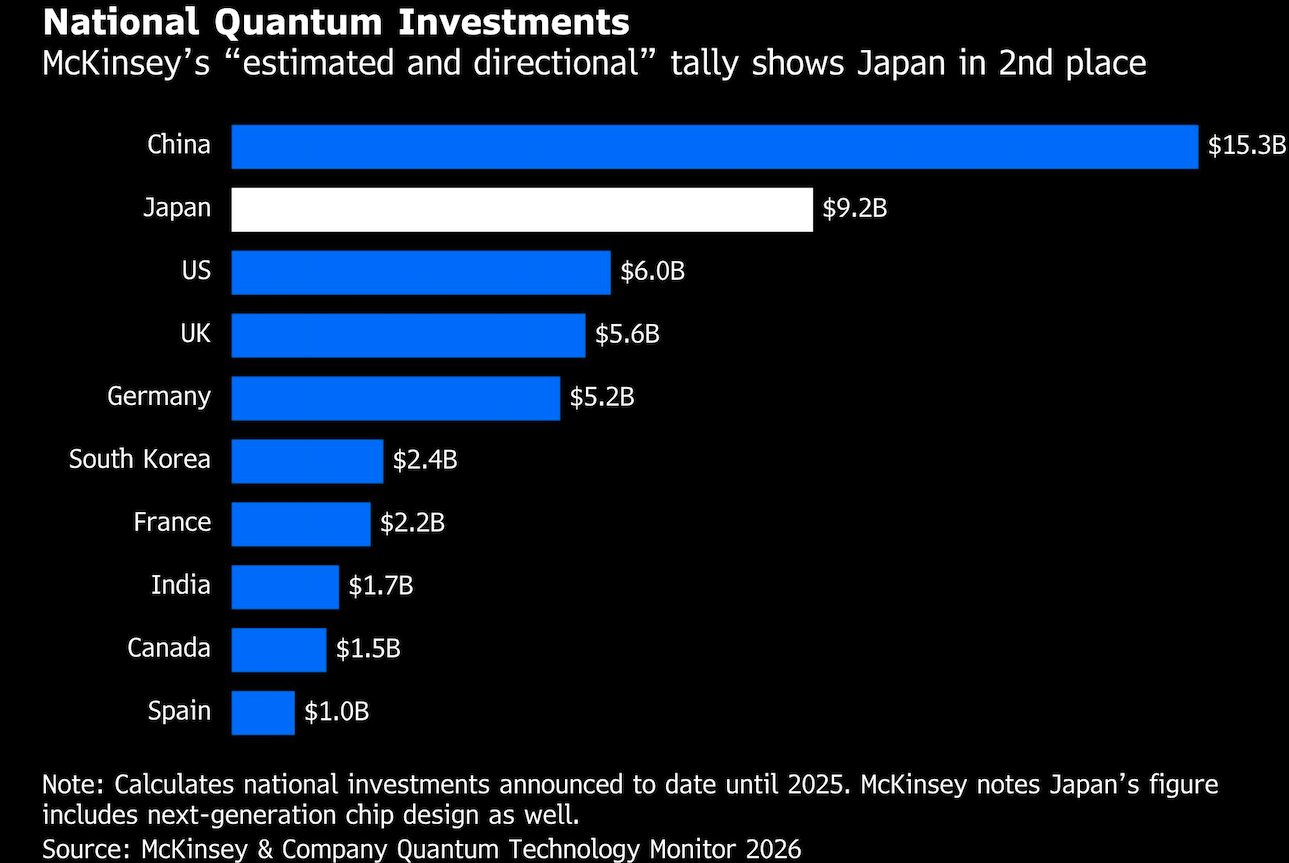
While some have been anxious about Japan being caught flat-footed by AI, it has a healthy head start here it can’t afford to squander. It currently ranks second in quantum-computing patents granted between 2000 and 2024, behind only the US, according to McKinsey’s 2026 Quantum Technology Monitor. Its tally of announced investments also puts it behind only China, though the analysts acknowledge that the figures include next-generation chip design as well.

Even as China outspends, however, Beijing is largely going it alone amid a widening tech cold war. Japan can tap into international expertise through partnerships, such as with Quantinuum, and even industry pioneer IBM, which installed one of its first quantum computers outside the US in Kobe via a collaboration with RIKEN. Prime Minister Sanae Takaichi included quantum in her centerpiece 17-field growth strategy. SMBC Nikko analysts have said that it’s “crucial to national security.” One of the biggest risks stems from Shor’s algorithm, a quantum method that could allow a machine to break much of the encryption used by banks and governments, spawning a cyber nightmare.
Japan is wise to expand relationships with domestic companies to help tackle commercialization. It should also work with colleges and inspire startup founders to think bigger, envisioning ideas with global impact that can spread beyond its borders. The OECD has pointed to weak links between universities and businesses as an innovation barrier.
But don’t expect a ChatGPT moment for quantum, when millions of consumers got their hands on the technology. It will be more akin to the cloud, Hazra said, digital infrastructure that revolutionized our internet without anyone noticing. In other words, it will sneak up. When I asked him about the ever-moving industry forecasts for the tipping point, he pushed back. “It’s not five years away,” he said. “It is now.”
That may prove optimistic. Still, most people didn’t care much about AI before they tried ChatGPT. By the time a tech boom feels inevitable, winning advantages may already be locked in. I’ll check back in 2031.
A message from Advisor Perspectives and VettaFi: Discover something new! Click here to register for our upcoming webcasts.
Bloomberg News provided this article. For more articles like this please visit
bloomberg.com.
Read more articles by Catherine Thorbecke