Ever since the US attacked Iran, the world has been needlessly worrying about a looming food crisis. For many it has been a question of when, rather than if. In the blogosphere and in far-left corners of academia, the talk was about something far more calamitous: famine. All very scary — and all completely wrong.
For reasons that escape me, many looked at the US-Iran war through the same lens as the Russia-Ukraine war. The latter, pitting two of the world’s breadbasket nations, did trigger a big increase in the cost of some farm commodities in 2022. But the Middle East doesn’t have the fertile land of the Black Sea region where Kyiv and Moscow fight. Quite the opposite.
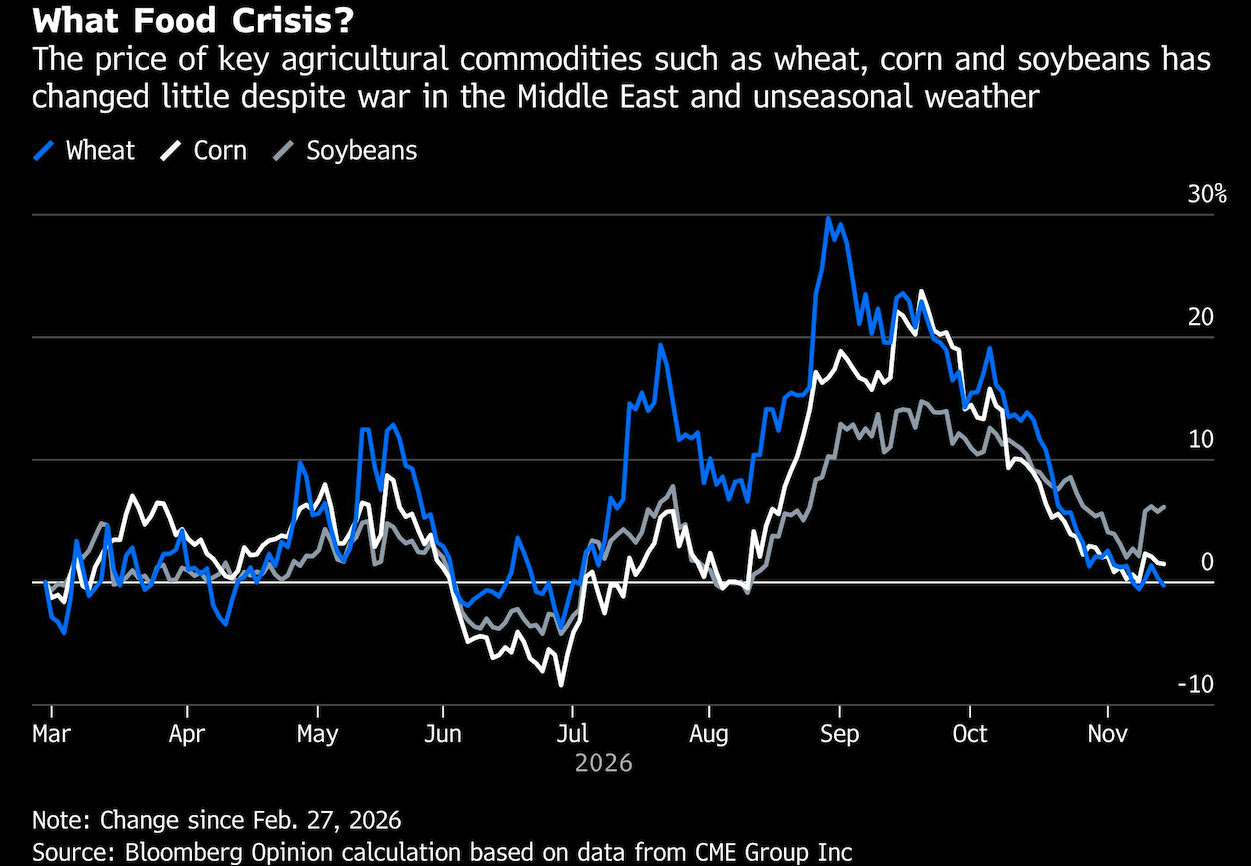
The reality? Nine months into the war, and despite plenty of unseasonal weather due to the El Niño phenomenon, the world is enjoying a period of relatively low food inflation.
Look, for example, at continental Europe. Overall inflation there is rising at an annual rate of 4% due to expensive transportation and heating fuels. But food inflation, including alcoholic beverages and tobacco, has an annual rate of just 1.6%. In the UK, headline inflation is running at 3.6%, but food and non-alcoholic beverages inflation is only 1.3%. The trend, with local variations, is similar elsewhere. For central bankers worrying about rising fuel costs, it’s a welcome difference. The stability in farming offers an important reprieve on inflation.
Of course, the world still faces an enormous challenge with hunger, mainly due to extreme poverty in Africa and portions of Asia; 700 million people, or about 8% of the world's population, went hungry in 2025, the latest year with data available. That percentage has changed little over the last 15 years, suggesting the world is failing to solve the hunger problem.
But the truest sign of an inflation crisis — food rioting in emerging nations — is nowhere to be seen. Usual caveats about the unpredictability of war and the weather apply, but for now let’s stop talking about a looming crisis in crop prices; it isn’t coming.
At worst, the world faces some food inflation into 2027 as rising transportation and packaging costs filter through the supply chain. Can the price of a bag of potatoes go up on the back of higher diesel costs for trucking? Sure. If you buy lots of processed foods and “ready-to-eat” packaged meals, yes, you may pay more for them next year. The cost of beef remains high, too, due to factors predating the war. But a costlier weekly shopping basket doesn’t make a crisis.
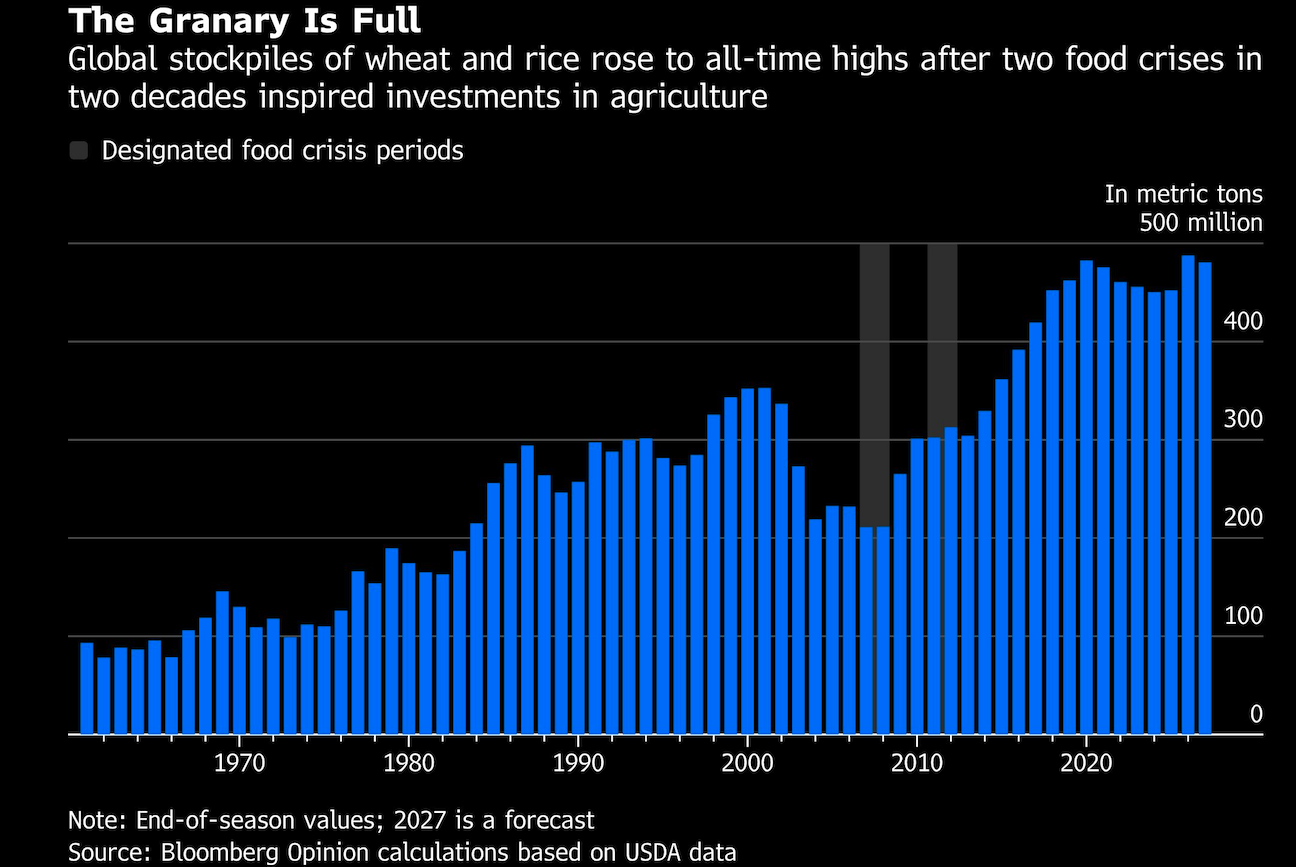
Food crises typically develop over the years, and the clear sign of trouble is always the same: disappearing stockpiles. This time around, thanks to the lessons of previous crises, the world entered 2026 with its granaries full, particularly with two of the most critical staples for global food security: wheat and rice. And prices for most major crops aren’t much higher than before the Iran war began.
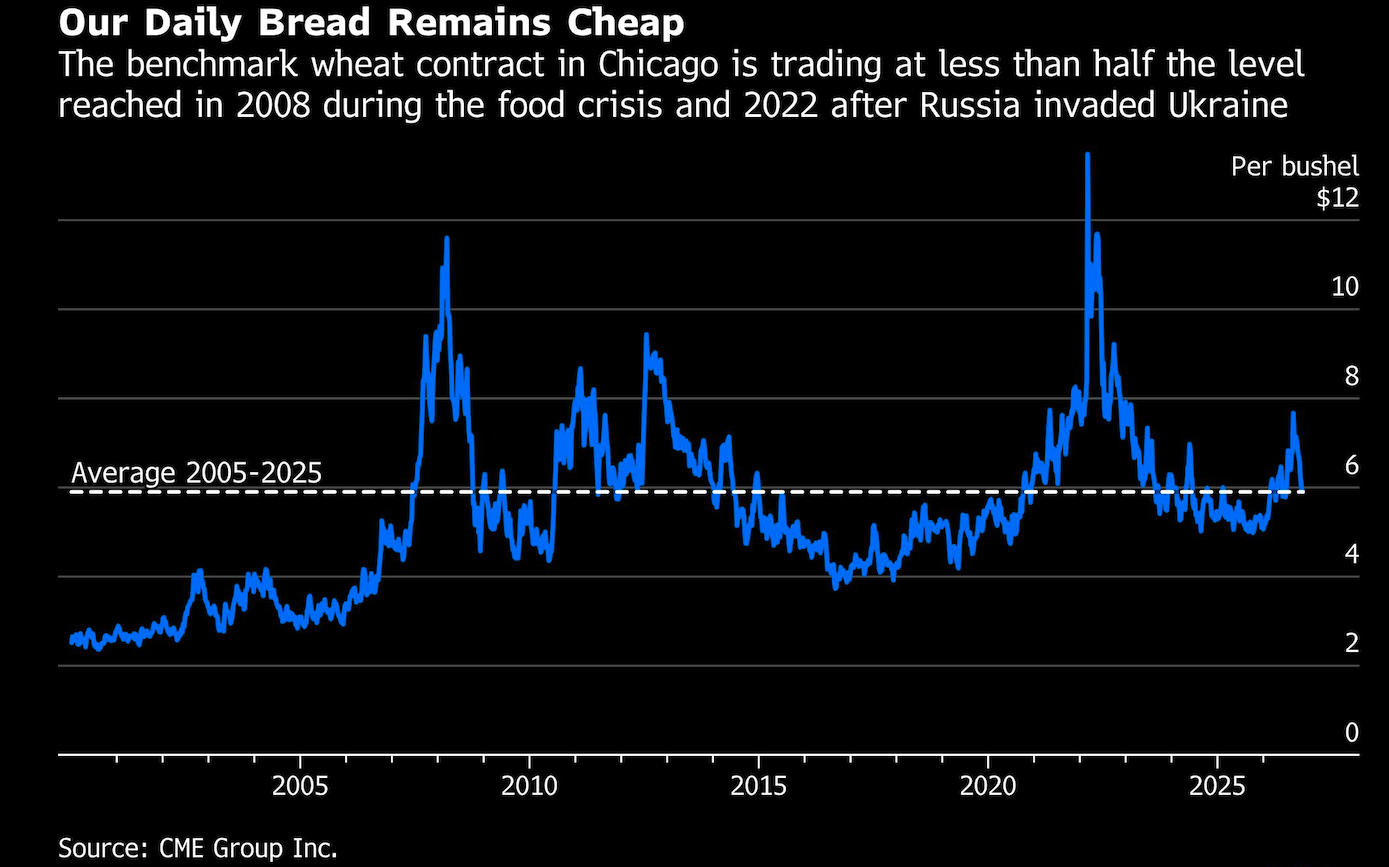
In the wholesale market, where the price of wheat spiked to an all-time high of $14 per bushel in 2022 after Russia invaded Ukraine, the commodity today trades below $6 per bushel, even though Ukraine and Russia are still attacking each other’s grain export routes. Since the war started, wheat is down — yes, down! — about 1%.
Corn today costs less than $4.50 a bushel, up 1.5% from late February but well below the all-time high of $8.31 per bushel set four years ago. The price of palm oil, the world’s most used cooking oil, is the same today as it was nine months ago. Prices for soybeans, key for fattening cattle, have also changed little since the war in Iran began.
Rice, the only major crop with a significant price increase this year, is up nearly 30% since late February due to a poor monsoon in the Indian subcontinent. Still, the benchmark contract is changing hands at about $510 per metric ton, less than half of where it traded in 2008 at a record high of more than $1,100 a ton.
The overall stability in commodities may surprise the armchair farmers that spent months talking about how rising prices for urea fertilizer were going to wreak havoc. I’m afraid the pundits were — ahem — full of manure. The cost of urea did increase early in the Iran conflict as the war disrupted fertilizer and natural gas output in the Middle East. But other producing nations quickly responded, rebalancing the market.
Today, nitrogen fertilizer is about 10% cheaper than it was in February. The cost of phosphate fertilizer has increased due to more expensive sulfur, a byproduct of the war’s disruptions of the Middle East chemical industry. But overall, a basket of fertilizers including urea, phosphate and potash is only 5% more expensive than nine months ago; again, hardly a crisis.
One could excuse the blogosphere for getting worked up. But policymakers, including those at the United Nations, have a deeper responsibility to forecast correctly. The job of the UN Food and Agriculture Organization, the World Food Programme and the International Fund for Agricultural Development is to provide nuanced, levelheaded analysis, with words such as “crisis” and “shock” used very carefully. That’s because those kinds of warnings could prompt governments to embark on beggar-thy-neighbor economic policies, with trade restrictions capable of creating a self-fulfilling crisis. Thankfully, that hasn’t happened, despite the aggressive alarm bells raised by UN officials.
The world learned the lessons of the 2007-08 and 2011-12 food crises, along with the scare of 2022, and encouraged trade while investing in agriculture. From India and China to Morocco and Brazil, billions of dollars got poured into irrigation, storage, farming machinery and credit tools for rural economies. That strategy is paying dividends today. We should double down.