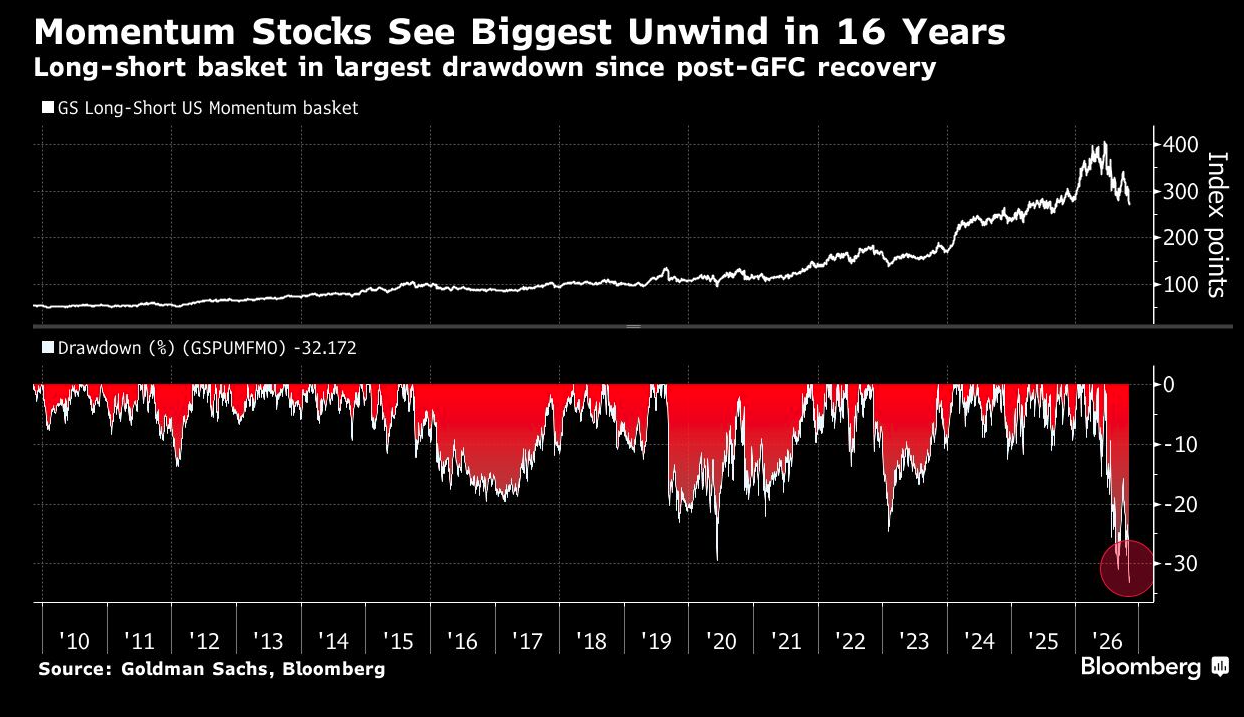
Hedge funds dumped technology stocks at one of the fastest paces on record last week, and the momentum crash that followed was the biggest in about 40 years. Even so, few on Wall Street are ready to call time on the AI boom.
Goldman Sachs Group Inc. noted that hedge fund disposals of global technology stocks roughly matched the highest on record in figures going back to 2016. Tech was by far the most heavily net-sold sector globally and in the US, driving the biggest wave of single-stock net selling in four months, according to the bank’s prime brokerage data as of Nov. 6.
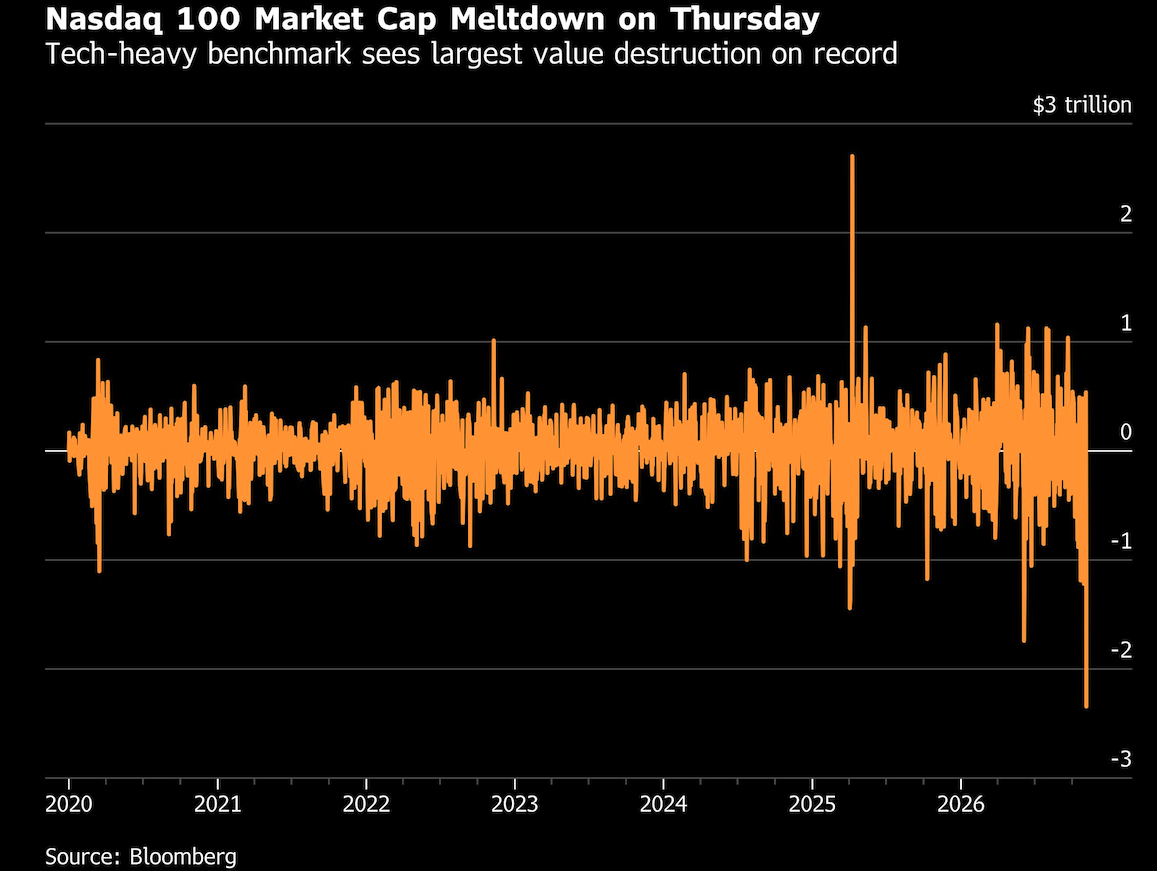
The trigger was the Democratic sweep in the US midterm elections, which raised concerns about tighter AI regulation and about how much data center capacity will actually get built. The Nasdaq 100 posted the deepest plunge since the Covid pandemic on Thursday, wiping $2.3 trillion off its value in a day. The S&P 500 notched its heaviest weekly loss since April 2025.

Meanwhile, the sharp deterioration in momentum that played out in equities last week may have pushed investor pessimism close to peak levels, according to JPMorgan Chase & Co. strategists.
“There are increasing signs of investor capitulation after the largest unwind of Long Momentum against the market in about 40 years,” said the team led by Dubravko Lakos-Bujas. Deleveraging metrics are back to “Liberation Day” levels, and investor sentiment has swung from bullish in June to bearish, they said.
See more: AI Is Building Better Systems for Trust Officers & Their Clients
There were already signs of stabilization by Friday, when hedge funds finished the week as net buyers in Goldman’s equity trading desk data. The purchases were largely attributed to moves to cover macro positions such as indexes and exchange-traded funds.
Even as the recent turmoil prompts greater caution among market participants, calls to turn outright negative are sparse, with the bright outlook for US corporate profits the key argument. Earnings per share for S&P 500 members are forecast to grow about 30% in 2026, and 20% in 2027, according to data compiled by Bloomberg Intelligence. The S&P 500 gained 1.8% on Monday morning, while the Nasdaq 100 jumped 2.6%.
Still, the optimism among strategists is no guaranteed indicator of gains. Forecasters and trading desks were caught off guard by Thursday’s rout after telling clients to pile back into the market after the election.
Morgan Stanley strategist Michael Wilson said a correction in US stocks was now in its final phase and the S&P 500 is nearing his downside target range of 7,100-7,300 points, from where it should rebound into a year-end rally.
“Rather than waiting for a perfect low, we recommend adding exposure over the next few weeks to quality cyclicals that have de-rated materially and are exhibiting strong EPS,” he wrote. His team sees the risk to post-midterm data center deployment as limited.
HSBC Holdings Plc’s Max Kettner, the strategist who correctly turned cautious ahead of the midterms, is dipping back into the market. After cutting his max overweight in equities two weeks ago, he’s using last week’s pullback to increase exposure tactically again. He said Anthropic PBC’s planned initial public offering may prove a more decisive event for markets than the US midterms.
Over at Citigroup Inc., strategists led by Beata Manthey downgraded US stocks and global tech to neutral as a result of the selloff, saying positioning could reset lower into net-short territory on indexes such as the Nasdaq 100.
“We remain constructive on AI over the medium-term but would look for cleaner positioning and more stable AI sentiment (along with steady EPS revisions) before reestablishing our overweight call,” they wrote in a note.
JPMorgan’s Lakos-Bujas also flagged near-term uncertainty around potential trillion-dollar IPOs, a data center permit review by grid operator Electric Reliability Council of Texas, and the path of geopolitics and oil, which could affect the December Fed decision.
Fundamentals for equities still look supportive, he said. Earnings revisions are positive, high double-digit growth is expected to extend into 2027 and 2028, and third-quarter results showed the capex cycle still running strong, with hyperscalers committed to AI spending. He maintains a year-end S&P 500 target of 8,000 points, implying about 8.5% upside from Friday’s close.
“While the pullback has been painful for markets, we see this largely as a deleveraging event,” Lakos-Bujas said. “Given the constant skepticism that the AI cycle has faced and the market penalizing excesses fairly rapidly, this should ultimately support the durability of the AI supercycle.”
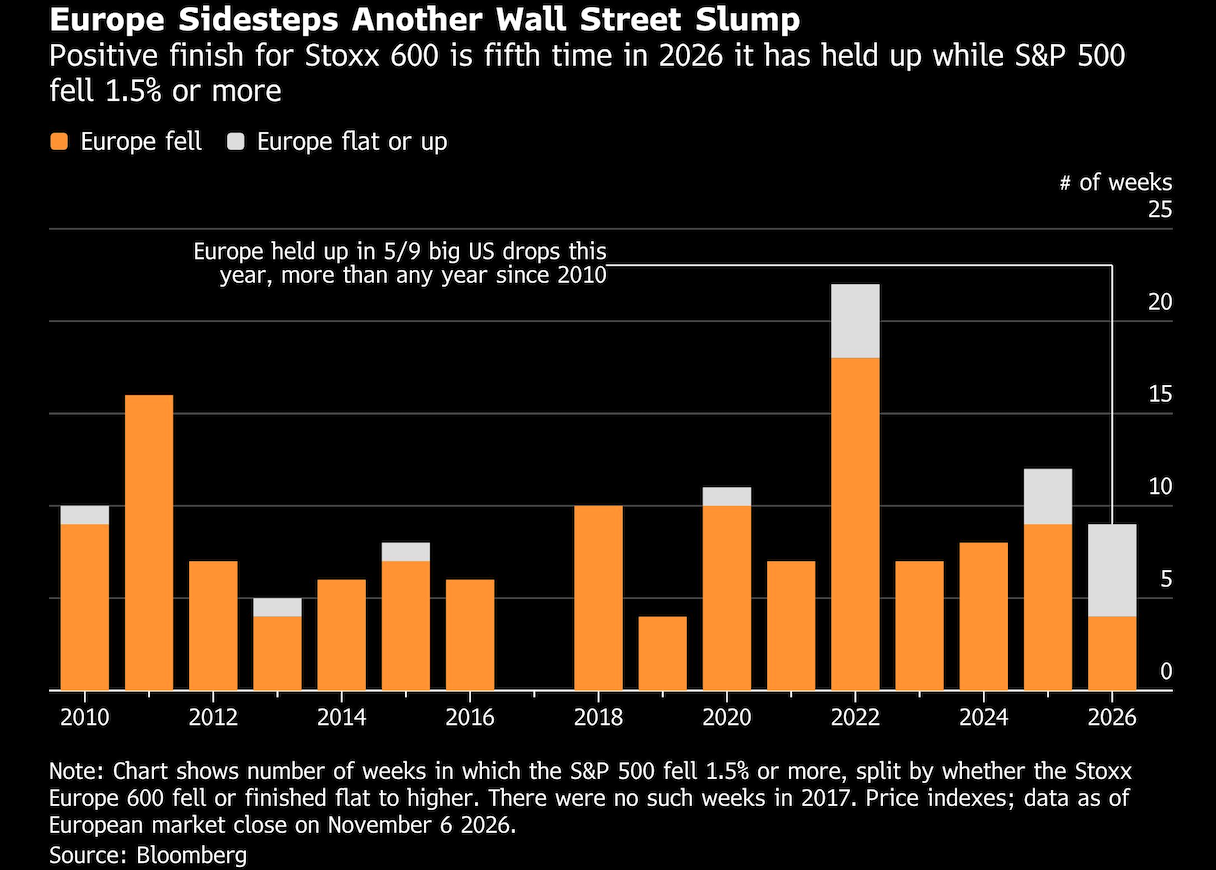
In the meantime, Europe is emerging as a beneficiary of turbulence in the AI trade.
While the US market sold off last week, the Stoxx 600 was up 0.2%. Citi upgraded Europe excluding the UK to overweight, citing the region’s lower exposure to tech risks and greater benefit from falling oil prices.
Separately, Goldman strategists including Guillaume Jaisson said AI infrastructure is about 15% of the Stoxx 600 and less than a quarter of its expected 9% earnings growth in 2027, compared with some 40% of the S&P 500 and more than two-thirds of its projected growth.
“Across the eight largest AI-led selloffs since 2023, Europe outperformed the US every time,” Jaisson and his colleagues said.
A message from Advisor Perspectives and VettaFi: Discover something new! Click here to register for our upcoming webcasts.
Bloomberg News provided this article. For more articles like this please visit
bloomberg.com.
More Innovative ETFs Topics >