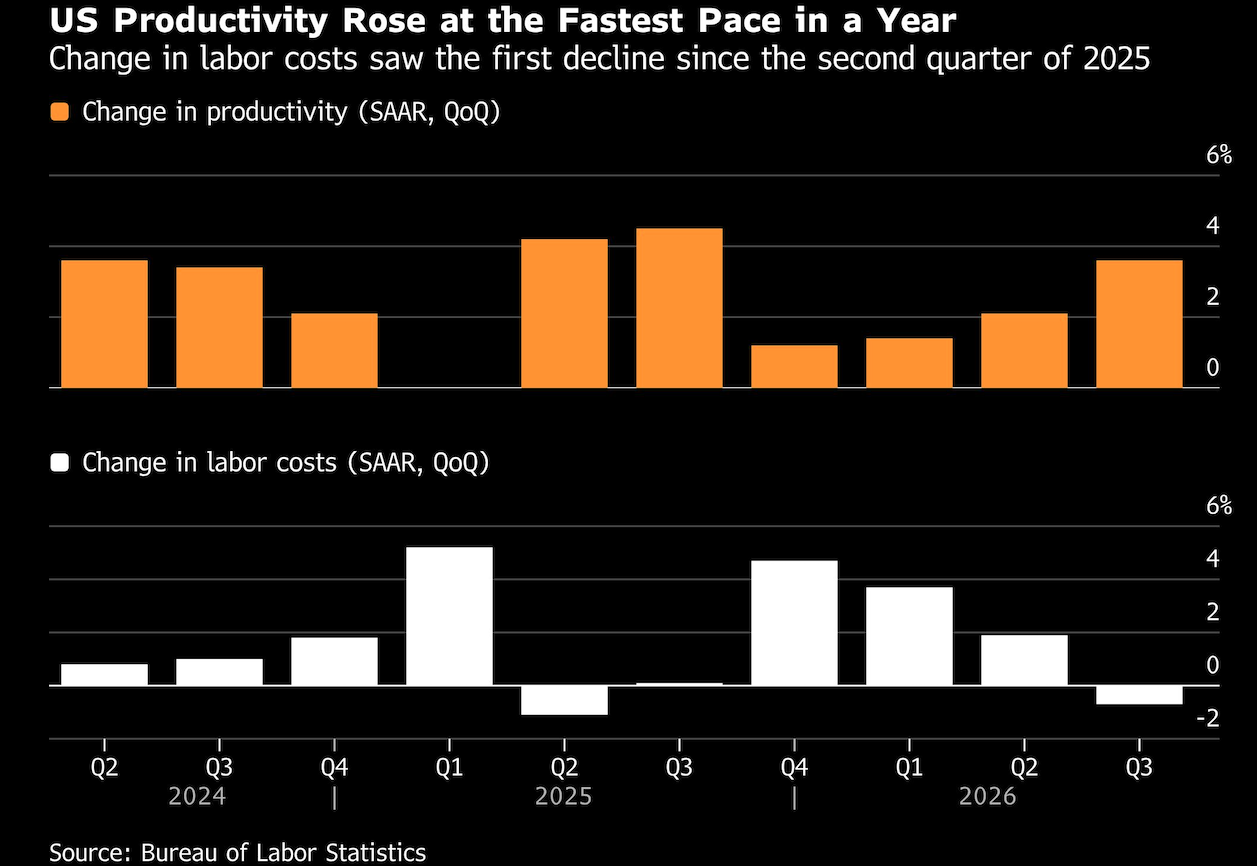
US labor productivity accelerated in the third quarter at the fastest pace in a year, suggesting a capital spending boom is translating into greater efficiency at a time when input costs have soared.
Productivity, or nonfarm business output per hour, increased at a 3.6% annualized rate after an upwardly revised 2.1% pace in the prior quarter, data from the Bureau of Labor Statistics showed Thursday.
Unit labor costs — what businesses pay employees to produce one unit of output — fell 0.7%, the first decline since the second quarter of 2025.

Labor costs are the biggest expense for many businesses, so companies invest in new technology and equipment to allow their workers to become more efficient. Productivity growth can help firms limit price hikes for consumers and other businesses.
Companies have poured massive amounts of money into artificial intelligence, software and equipment — investment that businesses anticipate will allow them to generate more output with the same amount of labor.
US economic growth accelerated in the third quarter amid vibrant business investment and resilient consumer spending. Economists generally expect efficiency gains to continue this year amid the AI rush.
See more: Above-Average Returns: Why The Next Decade Differs
After their October meeting, Federal Reserve officials described productivity growth as “strong” even as inflation remained elevated. Chairman Kevin Warsh has said technological advances should ultimately ease price pressures, while cautioning that any AI-driven productivity payoff will gradually emerge.
“Quarterly productivity growth remains volatile but the rebound after the relative slump in recent quarters shows the strong story remains intact,” Oren Klachkin, an economist at Nationwide, said in a note. “Maybe AI is contributing to this, but our view is only on the margin. It’s more the result of businesses consistently looking for ways to do more with less to squeeze out efficiency gains and keep costs down.”
Another government report out Thursday showed initial applications for unemployment benefits declined last week to match the lowest level since 1969, highlighting a stable job market.
The productivity report showed third-quarter nonfarm business output, which excludes the impact of government spending, increased an annualized 3.7% — the fastest pace in a year.
Hours worked rose 0.1%, while hourly compensation, unadjusted for inflation, increased an annualized 2.9%. After adjusting for inflation, worker compensation rose 1.1%.
The labor share of income, the portion of output that goes to workers in the form of compensation, was 53% in the third quarter of 2026, the lowest level in data back to 1947.
What Bloomberg Economics Says...
“The 3Q report could bolster markets after an AI wobble, but also makes election-driven constraints on data-center investment a macroeconomic risk rather than a narrow sector issue. The record-low labor share means firms may see better margins, while workers see pay improve less than output, which could heighten local resistance to the buildout.”
— Andrew Sacher, economist
Separate figures out Thursday from Challenger, Gray & Christmas showed layoff announcements were the lowest for any October in three years.
A message from Advisor Perspectives and VettaFi: Discover something new! Click here to register for our upcoming webcasts.
Bloomberg News provided this article. For more articles like this please visit
bloomberg.com.
More Innovative ETFs Topics >