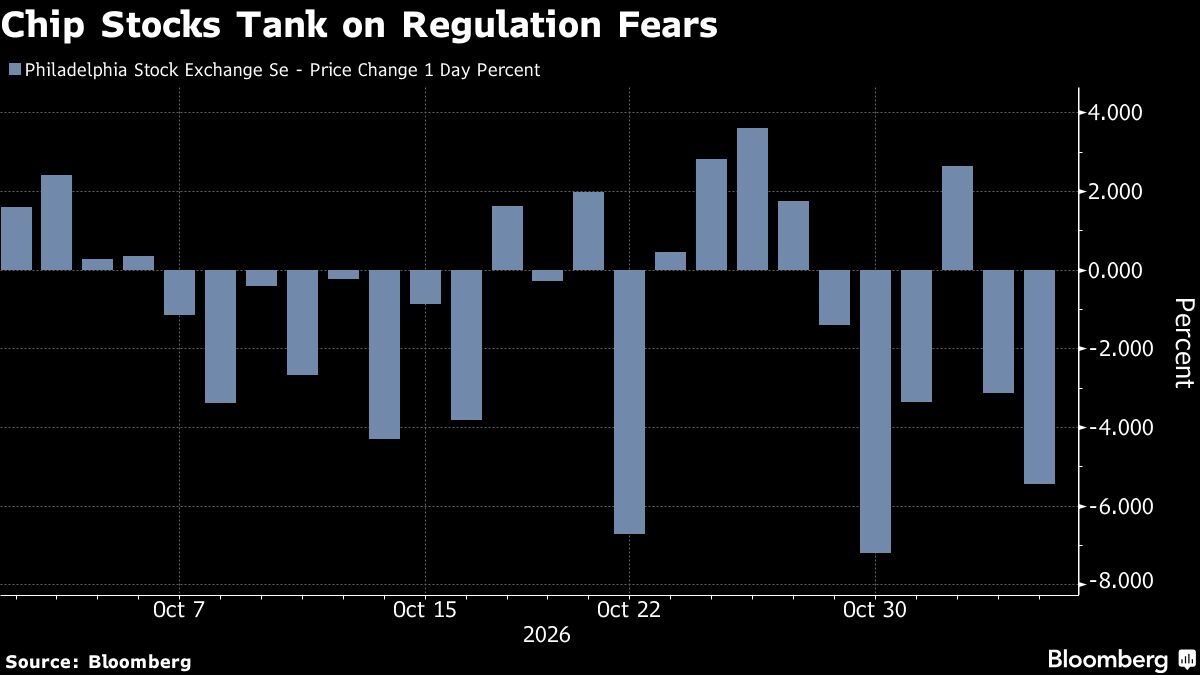
US equities plunged Thursday as a rotation out of chipmakers deepened and investors looked past the initial relief rally following the US midterm elections.
The S&P 500 Index fell 1.7%, while Nasdaq 100 fell 3.8%. An exchange-traded fund tracking US-listed semiconductor stocks dropped more than 7.2%, extending losses from Wednesday. The Dow Jones Industrial Average also declined 0.8%.
Chipmakers and memory stocks remained under pressure amid concerns that a Democratic sweep of Congress could bring tighter regulation of US data centers and weigh on semiconductor demand. Disappointing reactions to earnings from Arm Holdings Plc and Qualcomm Inc. added to the selling pressure. Meanwhile, defensive sectors like consumer staples, utilities and healthcare advanced.
See more: AI ETFs: Beyond Chips & Hyperscalers
“The rotation out of chipmakers reflects growing concern about the pace and funding of AI spending due to the risk of more regulations after the blue wave, even as earnings remain resilient and valuations have reset sharply,” wrote Chris Murphy, co-head of derivatives strategy at Susquehanna International Group.
Investors are buying early-2027 call spreads in Nvidia Corp., Taiwan Semiconductor Manufacturing Co., Advanced Micro Devices Inc. and Micron Technology Inc., suggesting they see recovery potential but want more time for confidence to return, according to Murphy.

Traders cautioned against interpreting the broader market moves as a fundamental shift in investor preferences. To JPMorgan’s equity derivatives team, the rotation looks more like positioning-driven versus a true fundamental rotation.
“I am not seeing customers flipping long or chasing the laggards higher,” Christina Jones at JPMorgan wrote in a note. “To me, the only pocket of the market where there is some true rotation going on is within Technology, Media and Telecommunications.”
Jones added that there’s a clear propensity to own quality large caps, specifically those with clear access to financing and owners of compute, for instance, some of the hyperscalers.
On the economic front, weekly jobless claims fell below all estimates, Labor Department data show. Investors will be looking to the US payrolls report on Friday for more clues on the path for interest rates.
Federal Reserve Bank of Cleveland President Beth Hammack said Thursday rates need to be restrictive to bring inflation to the central bank’s target, and more frequent moves can reduce the risk that policy falls behind.
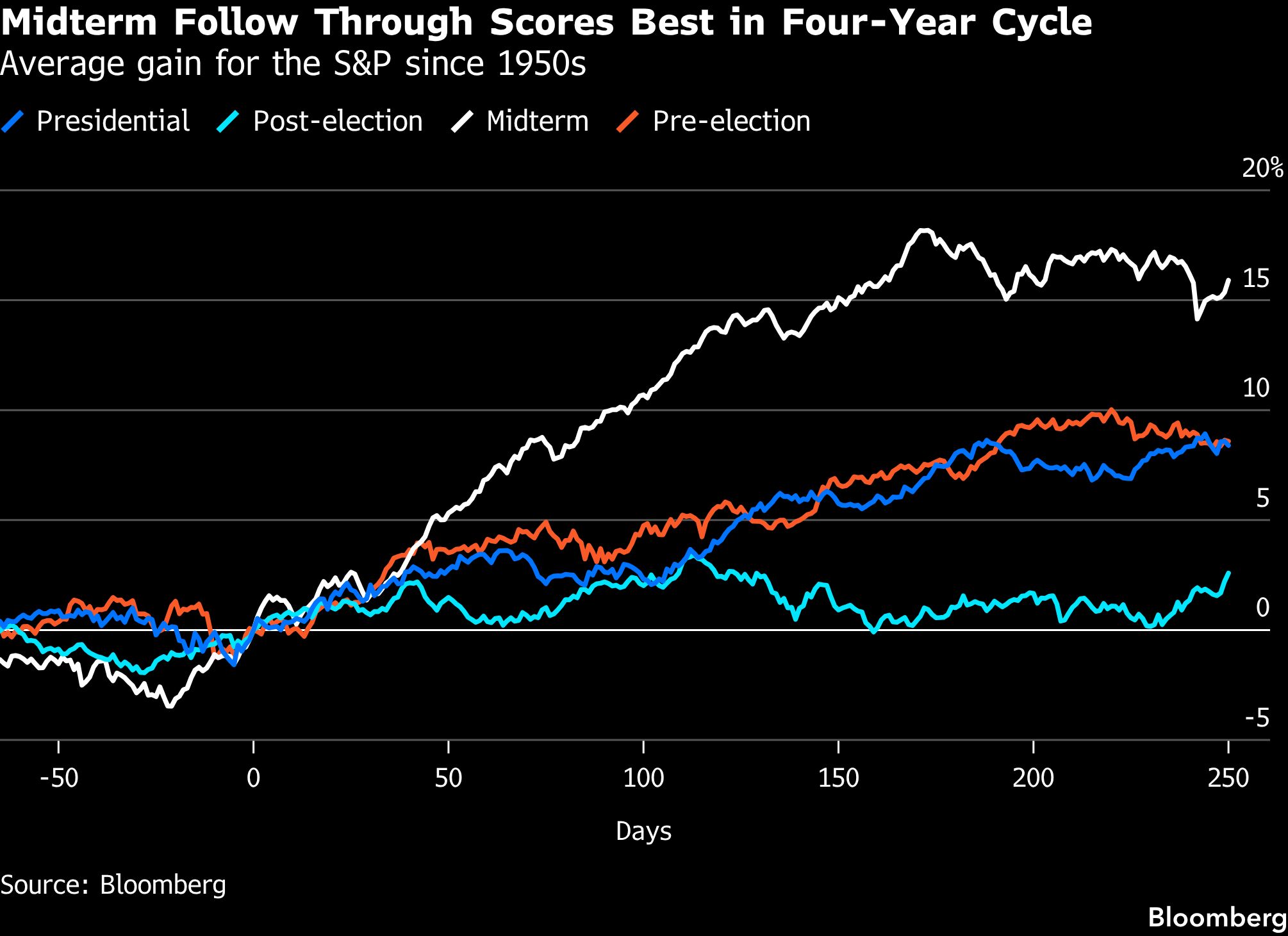
Meanwhile, the broader market may find support from favorable seasonal trends following the midterm elections. The S&P 500 has averaged a 15.5% price gain in the 12 months following outcomes since 1954, rising in every one of the 18 instances, according to Goldman Sachs Group Inc.
“Since 1952, the 12 months after a midterm election have been the strongest stretch over the four-year cycle for the S&P 500,” Goldman strategist Ioannis Blekos wrote in a note.
In fact, trading desks across Wall Street are encouraging investors to boost their exposure to US stocks on bets of a year-end rally post midterm elections.
Earnings results have also been upbeat as the season approaches its final stretch, with about three-quarters of the S&P 500‘s market value having reported results. So far, 84% of companies have beaten earnings estimates, while 12% have missed.
In single stocks, Sunrun Inc. shares rose 7.1% after the solar company reported third-quarter revenue that beat the average analyst estimate. Cava Group Inc. sank 10% on concern the Mediterranean chain’s momentum is slowing despite the popularity of new dishes such as salmon bowls and barbecue pita chips. AppLovin Corp. shares soared 32% after the mobile-app marketing company’s third-quarter results beat expectations and it gave an outlook that is above the analyst consensus estimate.
A message from Advisor Perspectives and VettaFi: Discover something new! Click here to register for our upcoming webcasts.
Bloomberg News provided this article. For more articles like this please visit
bloomberg.com.
More Fixed Income Topics >