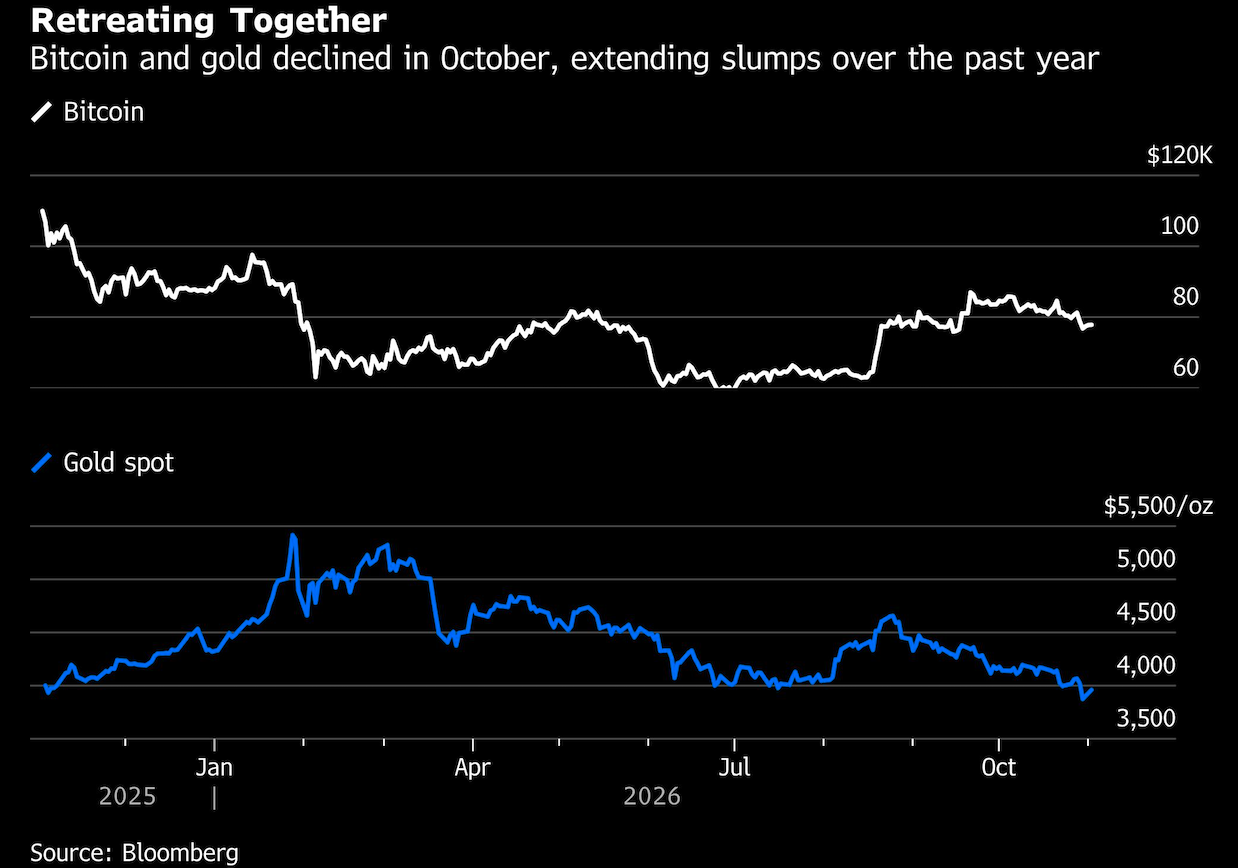
The world remains in a volatile situation: There’s unrest in France over its deteriorating finances, and big political changes are potentially afoot in the US and Israel. Then there’s the ongoing war with Iran, including increased attacks on tankers in the Strait of Hormuz and Houthi strikes against Saudi Arabia. Yet, in the contest for best haven asset, here’s the scoreboard for October:
- Gold -6.8%
- Bitcoin -7.4%
- Bloomberg Dollar Spot Index +0.3%
What happened to the idea that gold and Bitcoin were the new flight-to-quality beneficiaries? Maybe it’s time to declare the end of the faddish dollar debasement trade talked up by the likes of Bridgewater’s Ray Dalio and Citadel’s Ken Griffin, in which investors were supposedly jettisoning the greenback and flocking to substitutes.

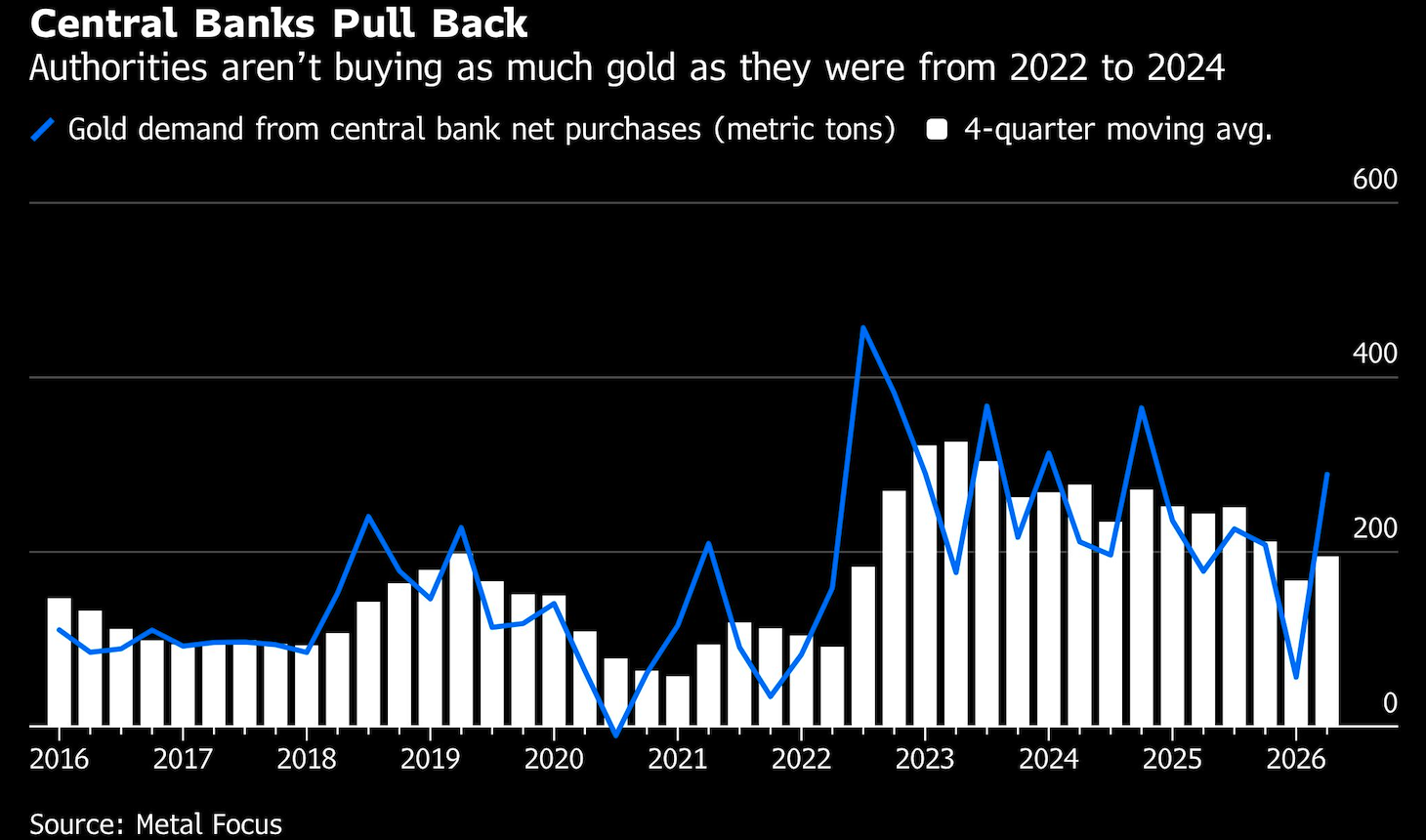
Bitcoin’s slide worsened Friday after hackers stole $6.3 billion from Binance in the biggest such heist in history, puncturing the idea that crypto is a reliable store of value. But the unraveling is broader than just one hack. Over the past year, Bitcoin’s slump has reaffirmed its not-so-secret identity as a leveraged play on the Nasdaq 100 Index (except, lately, it only tracks tech stocks on the way down, not up). In the gold market, retail investors have pulled billions of dollars out of exchange-traded funds tracking the precious metal, jewelry demand has plummeted to the lowest since 2020, and central banks have ceased to provide the ballast that they did from 2022 to 2024.
See more: What the Zero-Rate Era Left on Your Shelf
It was a little over a year ago when Griffin portrayed gold and crypto’s ascent as a warning. “We’re seeing substantial asset inflation away from the dollar as people are looking for ways to effectively de-dollarize or de-risk their portfolios vis-à-vis US sovereign risk,” he told an audience of institutional clients at a Citadel Securities conference in Manhattan. I wrote at the time that Griffin and the others had the gold and Bitcoin story wrong.
The run-up that saw gold surge from around $2,000 an ounce in early 2024 to more than $5,500 in January 2026 and Bitcoin from around $40,000 to more than $120,000 in a similar period was never really about safety or de-dollarization, but rather speculation — and the fever has broken. It’s true that foreign governments and central banks, fearing the dollar had become “weaponized” by the American government, feasted on gold after the US and its allies froze Russian funds following its invasion of Ukraine. But by the time Griffin and others embraced the thesis, that phenomenon had peaked and was beginning to fade. Last year’s “debasement trade” was just a meme — a reductive slogan for a complex marketplace. Its evangelists latched onto old central bank news to justify what was largely retail-driven momentum.
Since the Iran war started, the dollar has reasserted itself as the peerless heavyweight of global finance — a fact that I pointed out in the first weeks of the conflict and remains true today. It’s appreciated against 14 of 16 major global peers in the period, and the Bloomberg Dollar Spot Index recently hit a 17-month high. Though stubborn inflation has diminished the value of longer-term US Treasury securities — as it has on sovereign debt issued by most all nations — short-term debt has outperformed gold and Bitcoin.
Was there ever anything to the dollar worries? There were grains of truth, as with many fad investments. President Donald Trump has weaponized the Justice Department to attack the independent Federal Reserve and continued to run unsustainable 6% fiscal deficits. For a few sessions after his April 2025 “Liberation Day” tariff announcement, faith in the US currency did take a hit in the eyes of global investors. But that didn’t mean that gold was a better alternative, much less Bitcoin. And much has happened in the interim to allay the public’s concerns, including Supreme Court decisions against the administration’s tariffs and its meddling in the central bank’s affairs — signs that America’s checks and balances still work.
That’s fed waning interest in gold as a hedge against dollar doom, and rightfully so. As for Bitcoin, skeptics have always loved to mock its “digital gold” label, but it’s turned out to have partial merit. It actually is performing a lot like the precious metal, just not in the way that Bitcoiners hoped and imagined: Its value is plummeting just when geopolitical uncertainty is near a peak.
A message from Advisor Perspectives and VettaFi: Discover something new! Click here to register for our upcoming webcasts.
Bloomberg News provided this article. For more articles like this please visit
bloomberg.com.
More Innovative ETFs Topics >