Advisor Perspectives welcomes guest contributions. The views presented here do not necessarily represent those of Advisor Perspectives.
This article was written with the assistance of artificial intelligence. The underlying data, financial arguments, and strategic insights were authenticated by the author, who retains full accountability for the accuracy of the content.
In 1889, Germany created the world’s first national old-age pension. Benefits began at age 70, an age few workers of the era reached.
Social contracts are written for the population of their day, but while populations change, contracts rarely do. France is now the clearest case study of that collision.
The Squeeze From Both Ends
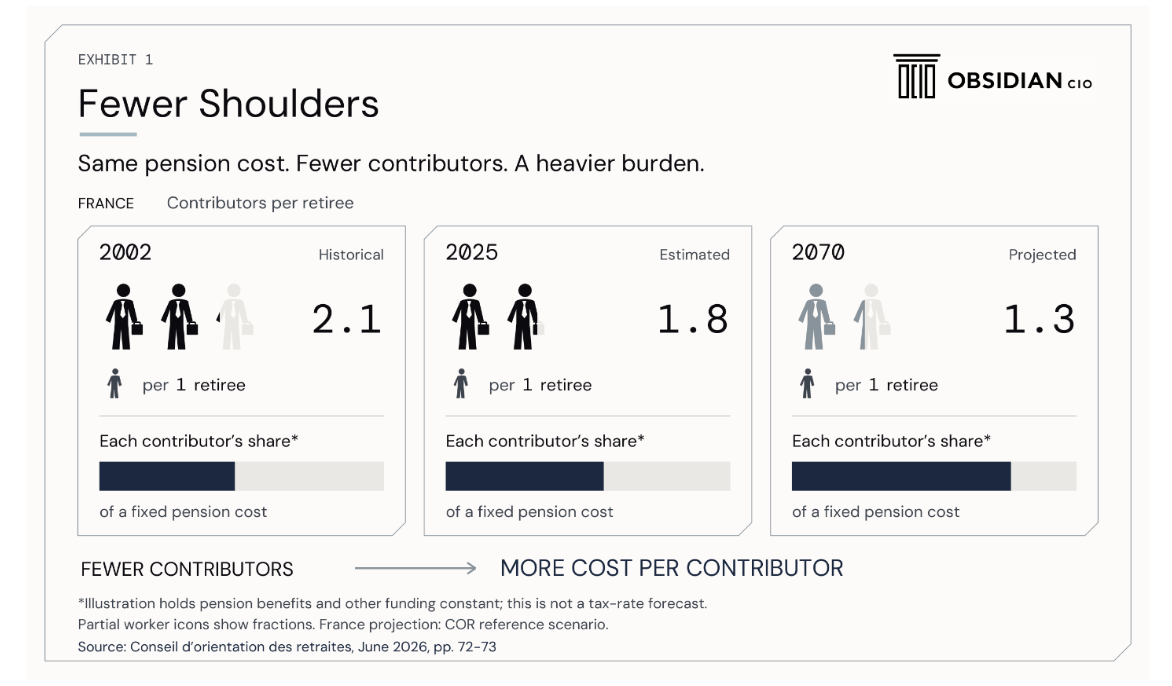
Like Social Security, France’s pension system is pay-as-you-go: Today’s workers fund today’s retirees. France has roughly 1.8 workers per retiree, on its way to about 1.3 by 2070, and in 2025 it recorded more deaths than births for the first time since World War II.
Every aging country eventually reaches the same choice as pension and health care costs climb: Raise revenue or cut spending. France has little room on either side. On revenue, its tax take is already the second-highest among developed countries (43.5% of GDP versus 25.6% in the U.S.), and growth has stalled, with just 0.4% expected for 2026.
On spending, the trouble is not how much France spends but what it spends on. Pensions alone consume about a quarter of public spending, and with healthcare added, age-related spending approaches 40%. These are the very costs driving the problem, and the ones voters defend most fiercely. That leaves the other 60% of the budget to absorb any cuts, and a growing share of it (defense and interest on the debt) is moving the other way.
Politics hasn’t helped. The 2023 reform raising the retirement age to 64 was suspended after two prime ministers in a row fell over budgets. Meanwhile, French households save about 17% of their income, up from 14% a decade ago. When people doubt a promise, they act as if it’s already been broken.
When the Market Decides
Politicians can postpone a decision. Lenders can’t be made to wait forever.
In November 2011, Italy paid about twice as much as France to borrow for 10 years. This September, France paid more than Italy, and its spread over German bunds hit its widest since 2012. As Britain learned in 2022, when an unfunded budget sent gilt yields soaring and ended Liz Truss’ tenure in seven weeks, lenders get a vote.
France’s annual interest bill is projected to rise from €78 billion in 2026 to €124 billion by 2030. That creates a dangerous loop: Interest crowds out other spending, lenders demand more as debt grows, and austerity slows growth, making the same debt look bigger.
No Printing Press
The U.S., the U.K., and Japan borrow in currencies they print. In a pinch, they can let inflation or a weaker currency quietly shrink what they owe. France gave up that option with the euro, which leaves it closer to an emerging-market borrower, as Greece discovered in 2012. The European Central Bank’s backstop is conditional, and any help would likely come with the very reforms France has been avoiding.
How Advisors Can Lead
None of this calls for panic. But the bill is arriving at an awkward moment: Global debt stands near $365 trillion, and long-term borrowing costs across major economies are at 15-year highs or more.
The U.S. isn’t immune. Since 1960, the number of workers per Social Security beneficiary has roughly halved. But America has more levers: relatively low taxes, steady demand from people who want to work here, the world’s reserve currency, and more than $51 trillion in invested retirement savings.
5 Takeaways for Financial Advisors
1. Treat Sovereign Yields as the Foundation Price
A government’s borrowing cost sits underneath mortgages, business loans, and stock valuations. When lenders demand a premium from the state, that premium works its way into every asset in that economy. Before evaluating a foreign holding, ask what its home government’s bond market is signaling.
2. Know How a Country Would Work Through a Debt Problem
Countries that borrow in their own currency rarely need to miss a payment, because they can inflate or devalue instead. That protects lenders on paper, but the workout is paid for in purchasing power: The checks clear, but in cheaper money. The U.S. has done this before (1933 and 1971) as a “soft default.”
Euro members can’t print money, so their stress shows up as credit risk instead: wider spreads, ratings pressure and, in the extreme, restructuring. Neither path is painless for bondholders. For clients with international bond exposure, knowing which kind of risk they hold belongs in the risk discussion, not the footnotes.
3. Watch Spreads, Not Just Yields
A 10-year yield alone tells you little. France’s widening premium over Germany and its flip above Italy reveal how the market’s view of the credit is changing. Spreads help separate a global rate move from a country-specific warning.
4. Diversify With Understanding
Diversification works best when you know which governments stand behind what you own and how much room each has to maneuver. On that score, I believe the U.S. remains better positioned than most, though that’s a judgment about fiscal flexibility.
5. Use the Headlines To Start a Planning Conversation
When clients ask about France, use this framing: “Stories like this are a reminder that debt, politics, and growth all feed into markets at once, and the answers are rarely simple. Our team follows these developments closely. It’s a good moment to revisit how your portfolio fits your goals and how much volatility your plan can absorb.” Then bridge to their own picture: Social Security assumptions, income needs, and time horizon.
Demographics set the bill, politics decides who pays it, and the bond market enforces the deadline. Advisors who explain that sequence early help their clients stay invested when it arrives.
Read more by Joe Halpern:
- On AI Bubbles & Keeping Clients Invested Without Ignoring Risk
- America's Tab: What 100% Debt-to-GDP Means for Advisors
- Tax Planning Isn't Enough: Where Advisors Are Still Falling Short
Joe Halpern is Managing Partner and CIO at Obsidian CIO, an outsourced chief investment office. You can connect with him on LinkedIn here.
A message from Advisor Perspectives and VettaFi: Discover something new! Click here to register for our upcoming webcasts.
More Municipal Bonds Topics >
 Advisor Perspectives welcomes guest contributions. The views presented here do not necessarily represent those of Advisor Perspectives.