Advisor Perspectives welcomes guest contributions. The views presented here do not necessarily represent those of Advisor Perspectives.
This article was written with the assistance of artificial intelligence. The underlying data, financial arguments, and strategic insights were authenticated by the author, who retains full accountability for the accuracy of the content.
Every major innovation cycle in history follows a familiar arc.
A genuine breakthrough appears. Capital rushes in. Excitement becomes conviction. Conviction becomes exuberance. Prices overshoot reality. A correction follows.
Then, after the speculative excess has been wrung out, the technology diffuses more broadly across the economy and the long arc of progress resumes. Railroads followed this path. So did electrification, automobiles, computing, and the internet. Artificial intelligence (AI) is likely following it as well.
That does not mean AI is a fad. Quite the opposite. AI is real, powerful, and almost certainly one of the most important general-purpose technologies of our lifetime.
The productivity gains are beginning to appear in software development, customer service, data analysis, logistics, research, and countless other areas. Over time, AI may lift margins, accelerate innovation, and change how entire industries operate. But the fact that a technology is real does not mean every investment attached to it is priced correctly. This distinction is crucial for advisors right now.
Echoes of the Dot-Com Era
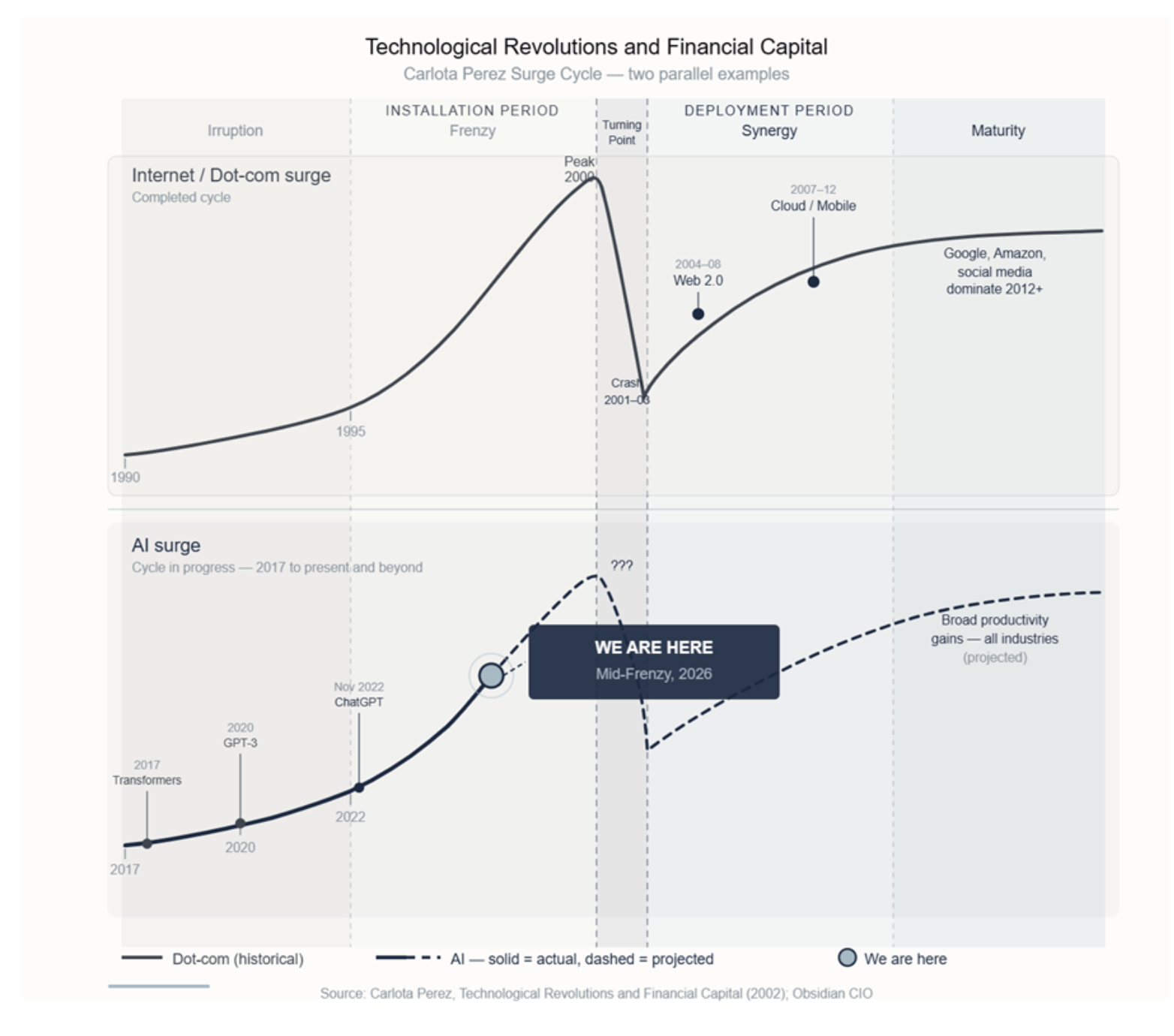
In the late 1990s, investors were not wrong that the internet would transform the world. They were wrong about the timing, prices, and many of the early winners. Cisco was a world-changing company, yet investors who bought at the peak waited more than two decades to recover their price.
The web reshaped commerce, media, advertising, software, and communication, but much of the durable value accrued to companies and business models that were not obvious in the frenzy. AI may rhyme with that history. We are seeing extraordinary capital commitments to chips, data centers, models, power infrastructure, and software.
Large technology companies are making enormous bets. Venture capital and public markets are rewarding anything credibly connected to the theme. The narrative is not irrational; it is increasingly demanding.
The Two Phases of Innovation
Carlota Perez’s framework for technological revolutions is useful here. She describes a frenzy phase, when financial capital floods into a new technology, followed by a deployment phase, when the gains become more broadly embedded across the economy.
McKinsey’s work on general-purpose technologies provides a similar lens: Adoption often comes before productivity. Companies first spend, experiment, reorganize, and absorb the technology. Only later do the broad economic gains appear.
That is very close to where we seem to be with AI. Many companies have adopted AI in some form, but the measurable bottom-line impact remains uneven. The technology is real, the opportunity is real, and the deployment is still at an early stage.
How Advisors Can Lead
That is an exciting combination of circumstances. It is also a dangerous one when valuations are priced as if the outcome is already known.
So what should advisors do?
One wrong answer is to turn every client review into a market-timing exercise. The other wrong answer is to dismiss valuation concerns because innovation is real. Advisors need to hold both truths at once: AI may be transformative, and the market may still be pricing too much certainty into an uncertain path.
This is where the advisor’s real value shows up.
Clients do not need us to predict whether the next 10% move is up or down. They need help staying invested in a way that matches their goals, their time horizon, and their actual tolerance for risk.
5 Takeaways for Financial Advisors
1. Separate the technology from the trade
Clients may hear “AI bubble” and assume it means AI is fake. That is not the point. Railroads, electrification, and the internet were all real. The bubbles were in the financing, the pricing, and the assumption that early enthusiasm would translate cleanly into investor returns.
A useful client conversation starts with this distinction: “We believe AI is real. We also believe price matters.”
This framing allows advisors to avoid sounding dismissive of innovation while still managing risk.
2. Do not use valuation as a timing tool
Valuation is a poor signal for what the market will do next month or next quarter. Expensive markets can become more expensive. Cheap markets can become cheaper. Advisors who try to make all-or-nothing allocation calls based on valuation alone often compound one mistake with another.
The better use of valuation is risk calibration. If the market is offering less compensation for uncertainty, portfolios should be reviewed for concentration, liquidity needs, and downside tolerance. That may mean rebalancing, diversifying, trimming overexposed positions, or revisiting the client’s financial plan. It most likely does not mean going to cash.
3. Own the deployment phase, not just the frenzy
One of the most important lessons from prior innovation cycles is that the biggest long-term beneficiaries are not always the companies that dominate the early narrative. The internet created value for search, advertising, retail, software, logistics, cloud infrastructure, and countless businesses that used connectivity to become more efficient.
AI may do the same. The value may accrue not only to model builders and chip companies, but also to healthcare, industrials, financial services, education, manufacturing, energy, and business services firms that use AI to improve productivity and margins.
That argues for broad exposure to the economy, not just concentrated exposure to the most obvious AI infrastructure names.
4. Prepare clients for volatility before it arrives
The best time to talk about a correction is before the correction. Advisors should use today’s enthusiasm to reset expectations.
A practical script might sound like this: “AI may be a major long-term growth driver, but every major innovation cycle has included painful corrections. We are not going to pretend we can predict the timing. What we can do is make sure your portfolio is built so that a correction does not force a bad decision.”
This conversation is more valuable than a forecast. It reminds clients that volatility is not a failure of the plan; it is one of the conditions the plan was built to withstand.
5. Help clients stay invested by connecting the portfolio to the plan
The most dangerous client behavior is not optimism. It is switching strategies under emotional pressure.
When markets rise, clients want more of what just worked. When markets fall, they want relief. The advisor’s role is to connect every allocation decision back to a purpose: retirement income, liquidity, estate planning, tax management, philanthropy, legacy, and lifestyle.
Staying invested is easier when clients understand what each part of the portfolio is designed to do.
The conversation should not be, “Do you think AI stocks are too high?” It should be, “Does your portfolio still reflect the life you are trying to fund and the risk you can actually live with?”
The long arc of innovation remains intact. AI may be another powerful chapter in that story, but the advisor’s job is not to cheerlead the story. It is to help clients participate in long-term progress without becoming hostages to short-term exuberance. While the future may be extraordinary, today’s price still matters.
Read more by Joe Halpern:
Joe Halpern, CIO and Managing Partner of Obsidian CIO, is the author of a recent White Paper, “How to Scale Your RIA to $1 Billion AUM and Beyond.”
A message from Advisor Perspectives and VettaFi: Discover something new! Click here to register for our upcoming webcasts.
Read more articles by Joe Halpern
 Advisor Perspectives welcomes guest contributions. The views presented here do not necessarily represent those of Advisor Perspectives.