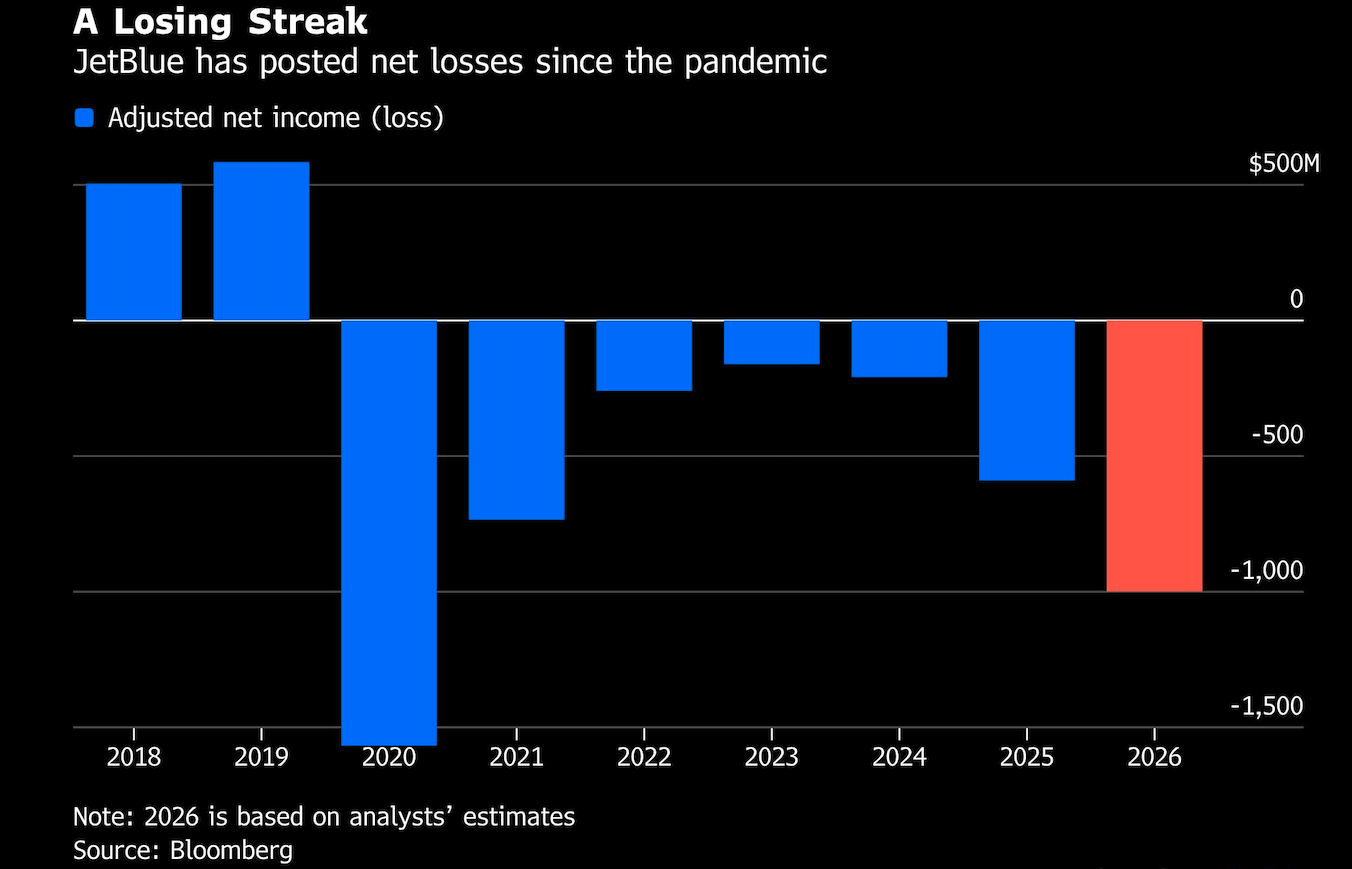
It’s extremely hard for a chief executive officer to get investors to turn positive about her company when it has posted annual net losses since 2020 and likely won’t make money until 2028. JetBlue Airways Corp.’s Joanna Geraghty made a good start on Tuesday.
Despite reporting a third-quarter loss, Geraghty engineered an 18% surge in JetBlue’s stock with her glass-half-full pitch. She emphasized revenue gains that outpaced competitors and a cash pile of nearly $1.3 billion along with an untapped $600 million credit line that will tide over the company until management turns things around. The stock was undoubtedly cheap after hitting a record low this week, but investors who piled in will need the stomach to withstand a turbulent ride for the next year and a half — with the very real risk of the shares turning to dust.
That risk starts with the airline’s $8.8 billion of long-term debt and lease obligations, which generate an interest cost of nearly $150 million a quarter. Working in the company’s favor is the maturity schedule. Two large chunks of debt amounting to almost $1.3 billion don’t mature until 2029, and another $2.07 billion isn’t due until 2031, giving the airline some breathing room. JetBlue also has about $2.8 billion of unencumbered aircraft and engine assets that can be tapped on relatively short notice through lease-back deals.
The concern isn’t so much that JetBlue will run out of cash but that the money-losing carrier’s debt burden will grow so big that interest payments suffocate its ability to continue investing to turn around the business.
Moody’s Ratings, Standard & Poor’s and Fitch Ratings all reduced their ratings on JetBlue’s debt by one notch earlier this year after fuel prices spiked. Fuel usually accounts for just less than 20% of airline operating costs, the second-highest expense after labor. Moody’s now has a Caa2 rating on JetBlue’s long-term debt, which is eight levels below investment grade and only four levels higher than a default.
A lot can go wrong from here. Fuel prices could remain high for longer than anticipated. As it is, jet fuel will rise to about $4.64 a gallon in the current quarter from $3.91 in the third quarter, JetBlue said. Passengers could balk at fare increases (to make up for those fuel costs) as inflation squeezes households, causing them to fly less.
An airfare war could break out if other airlines that are struggling financially resort to filling their planes by offering deeply discounted tickets. Frontier Group Holdings Inc., a low-cost carrier, and American Airlines Group Inc. are both losing money and are forecast to continue those losses into next year.
The larger airlines that are making money, including Delta Air Lines Inc., United Airlines Holding Inc. and Southwest Airlines Co., may decide to take advantage of their weaker competitors and move to steal market share. They can do this by lowering prices on seats at the back of the plane while leaning on more profitable business-class seating and premium products, including lucrative credit-card deals.
Crucial to a turnaround is the airline’s JetForward plan, under which it is adding flights to capture more passengers and offering more premium products such as new airport lounges and domestic flights with first-class seating, which becomes available in December. The plan is already bearing some fruit, with a big share of the 21% year-on-year jump in third-quarter revenue coming from flights added in Fort Lauderdale, Florida, to scoop up customers of Spirit Airlines, which stopped operating in May. Fare increases also helped.
JetBlue will need to see similar results from the 22 slots to fly in and out of LaGuardia Airport in New York City that it picked up from Spirit’s demise. These will strengthen its stronghold in New York, Boston and Florida and support the company’s ambition to become the premier leisure airline along the East Coast.
JetBlue has struggled, however, to transform into a more premium-product airline because it lacks the scale of its larger competitors and the ability to make big investments (Geraghty said capital expenditures will be kept below $1 billion for the next several years). The airline tried to form a ticketing and revenue-sharing partnership with American Airlines but was shot down in antitrust court in 2023. Its proposed acquisition of Spirit met the same legal fate in 2024. That lack of scale won’t change even if JetBlue can wiggle its way out of its long string of losses.
It’s possible that investors will look back on a chart of the airline’s share price several years from now and say, “If only I had taken the risk and snapped up JetBlue at the bottom.” Then again, those shares might not exist several years from now.