Welcome to open enrollment season, when millions of Americans are yet again wracked with anxiety over the sizable chunk of their paychecks being sucked up by healthcare costs.
If you’ve recently experienced sticker shock while reviewing your employer’s health plans, you’re probably wondering what’s gone so wrong in our system, who’s to blame, and, of course, whether any relief is coming. The answers are complicated — and will probably disappoint.
One problem is recency bias. The newest drivers of healthcare costs get much of the attention, while a gnarlier, long-term problem continues to fester. Decades of consolidation have reduced competition and given hospitals and other providers more power over prices, helping drive up the cost of care — and, ultimately, what employers and workers pay for coverage.
Read more: Healthcare: What a Mess
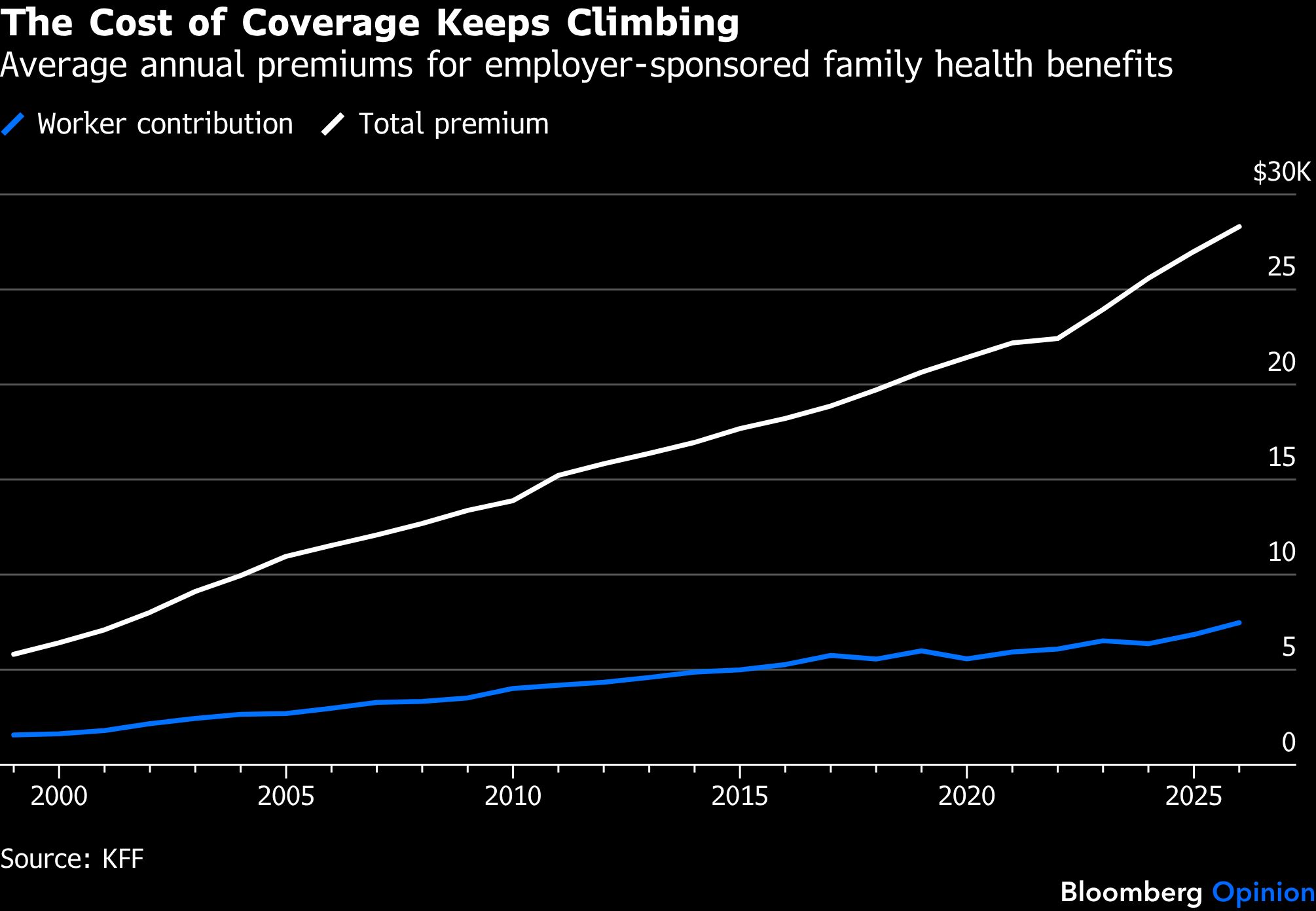
Fresh data from KFF shows that the average family this year will shell out $7,471 in premiums for their employer-sponsored plan, a 9% increase over what they paid in 2025. The situation is worse for people working for small companies, where family coverage now approaches $10,000.
And that’s just employees’ share of the bill. Add what their employers pay, and the average cost for a worker’s family plan now exceeds $28,300. Surveys show that it’ll only get worse next year, when companies are projecting the biggest hike in healthcare costs in more than 20 years. It’s no wonder a recent Gallup poll found fewer than half of Americans felt secure in their ability to afford healthcare.

When employers discuss spiraling costs, they tend to point to a few newer, more visible culprits. A recurring theme is the rise in prescription drug costs, particularly the widespread use of expensive GLP-1 medicines. More recently, they’ve cited artificial intelligence, which promises long-term healthcare savings but is now being used by hospitals to “upcode,” or inflate diagnoses to maximize billing.
Another increasingly common target is the No Surprises Act, legislation that took effect in 2022 to spare patients from being charged for out-of-network services provided during emergency room visits. Although the law was crafted with the goal of lowering costs overall, the process for settling payment disputes between insurers and hospitals has proven far more costly than anyone anticipated — to the tune of $22.4 billion between 2022 and 2025, according to a recent analysis by health policy experts at Georgetown University.
To be sure, all those cost pressures are real and worth tackling. And for employers and insurers, they are also at least somewhat controllable. Companies can pare back or even eliminate GLP-1 coverage, introduce more cost sharing for specialty medicines, switch pharmacy benefit management partners, and lobby to change egregious billing practices.
Where things get trickier, though, is addressing the effects of decades of consolidation in the healthcare industry. The modern wave began in the late 1990s with hospital mergers, but consolidation has since lassoed in everyone from insurers and pharmacy benefit managers to pharmacies, specialists and primary care doctors.
This vertical and horizontal integration drives up prices in several ways. One is by making it harder for health plans to negotiate with health systems and providers over prices for care.
Doctors and health systems have long bargained with insurers over prices in exchange for being included in a plan’s network. But insurers wield much less power where competition has dwindled, leaving them with little choice but to pay more — costs that are passed on to employers and, ultimately, their workers.
Health plans in large swaths of the country now find themselves in this challenging position. Some 21% of all hospitals “are effectively monopolies,” according to a recent analysis from Yale University health economists, which also found that nearly a quarter of providers have just one competitor. Meanwhile, the share of physicians employed by or connected to a hospital grew from less than 30% in 2012 to nearly 50% in 2024.
Yale researchers had previously used insurance claims data to show that monopoly hospitals charged privately insured patients 12.5% more for various procedures. Recent federal disclosure laws are allowing others to get more granular, understanding, for example, how healthcare consolidation can lead to big regional price differences for common procedures like knee replacement surgery.
Without policy solutions, the situation will only get worse. Health policy experts anticipate the players in the healthcare system will continue to become more intertwined. “Why? Because it is profitable,” Georgetown University researchers concluded in a 2025 report that examines how competing financial interests lead to higher healthcare spending.
One easy step, which has bipartisan support, is to strengthen price transparency laws that help illuminate the impact of these mergers. Exposing the most egregious price hikes won’t pull Americans out of this infinite open enrollment doom loop. But it would at least help focus policymakers’ attention on some solutions.
A message from Advisor Perspectives and VettaFi: Discover something new! Click here to register for our upcoming webcasts.
Bloomberg News provided this article. For more articles like this please visit
bloomberg.com.
More Artificial Intelligence Topics >