Companies have postponed more than $5 billion in US and European debt sales this month as investors grow increasingly alarmed about rising interest rates, resurgent inflation, and potential cracks in the artificial-intelligence boom.
The bond and loan sale delays have come from at least seven companies and mark the biggest spate of postponements this year. Just in the last week, AVI-SPL Inc., a seller of audio-visual equipment, abandoned its plan to raise $690 million in the US leveraged-loan market and Mesirow Financial postponed the sale of $175 million of bonds backed by the mortgage on a midtown Manhattan office tower.
That came after a $1.19 billion sale of collateralized loan obligations for Bridge Investment Group — a real estate company that was taken over by Apollo Global Management Inc. last year — was shelved earlier this month. Freddie Mac last week postponed the sale of more than $440 million of bonds tied to apartment-building mortgages after it couldn’t drum up demand at the price it was seeking. In Europe, Circet, a builder and maintainer of telecom networks, postponed a €3 billion ($3.37 billion) debt refinancing, slated to be in euros and dollars.
Read more: Will Higher Rates Increase Defaults?
The volume of US junk-bond sales, which totaled $51 billion in September, has tumbled to about $7 billion so far this month as companies balk at the higher yields being demanded by investors. Still, the market is usually open for higher quality, straightforward deals, as evidenced by both Walmart Inc. and Kimberly-Clark Corp.’s selling high-grade notes on Monday, in separate sales totaling about $8 billion.
“The biggest thing is rates,” said David Saitowitz, the head of US liquid credit at ICG, a money-management firm. “That alone is enough to put a cooling effect on the credit markets.”

Many of the debt sale postponements have been happening in the residential and commercial mortgage bond market, where rising yields can have a particularly big impact on bond prices. Morgan Stanley this month has struggled to attract demand for a $301 million commercial real estate bond tied to a data center in Kansas City.
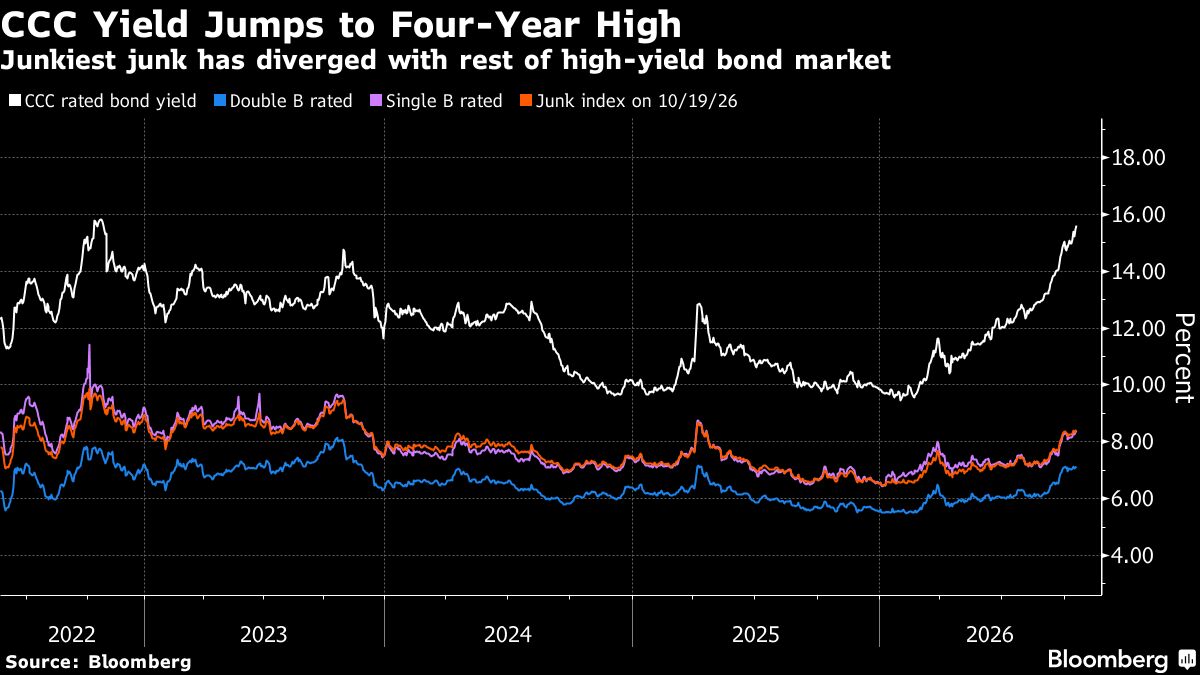
In the corporate bond market, yields for the B tier of junk notes — which is rated four to six notches below investment grade — hit a fresh 18-month high of 8.39% on Tuesday, while those on weaker CCC rated securities soared to a four-year high of 15.7%, according to data compiled by Bloomberg.
The jumps reflect the scale of the months-long selloff that has upended bond markets globally since President Donald Trump’s Iran war pushed up oil prices, rekindled inflation and helped drive the Federal Reserve to start raising rates for the first time since 2023.
Markets have been rattled by worries about rising distress periodically since the pandemic, only to recover when the fears turned out to be premature. But the sharp jump in yields is creating another big test as it drives up the interest bills of already struggling companies.
“There’s been a lot thrown at the leveraged finance markets from geopolitical conflicts to rising interest rates, and it’s been pretty resilient,” said John Puchalla, the head of US Leveraged Finance at Moody’s Ratings. “But an increase in rates does put more stress on highly-leveraged borrowers.”
That’s driving investors to demand higher compensation to offset the risks. Behind that has been simmering worries about companies like CoreWeave Inc. that have borrowed heavily to invest in data centers and other AI infrastructure. On Tuesday, measures of perceived credit risk on debt issued by Meta Platforms Inc. and Oracle Corp., two companies at the center of the AI buildout, hit a record high, reflecting concerns about whether the technology will be profitable enough to justify the massive investments.
Amid the difficulties in markets, companies have had to think harder about where to borrow. Radiology Partners Inc., a physician-owned radiology practice, pulled a $485 million leveraged loan offering to help fund an acquisition, and is planning to sell junk bonds instead now.
Isaiah Toback, the deputy co-chief investment officer at Castlelake, said he sees the recent pullback from risk as a healthy adjustment. “You’re letting some air out of the bag before there’s a real disruption,” he said.
A message from Advisor Perspectives and VettaFi: Discover something new! Click here to register for our upcoming webcasts.
Bloomberg News provided this article. For more articles like this please visit
bloomberg.com.
More Innovative ETFs Topics >