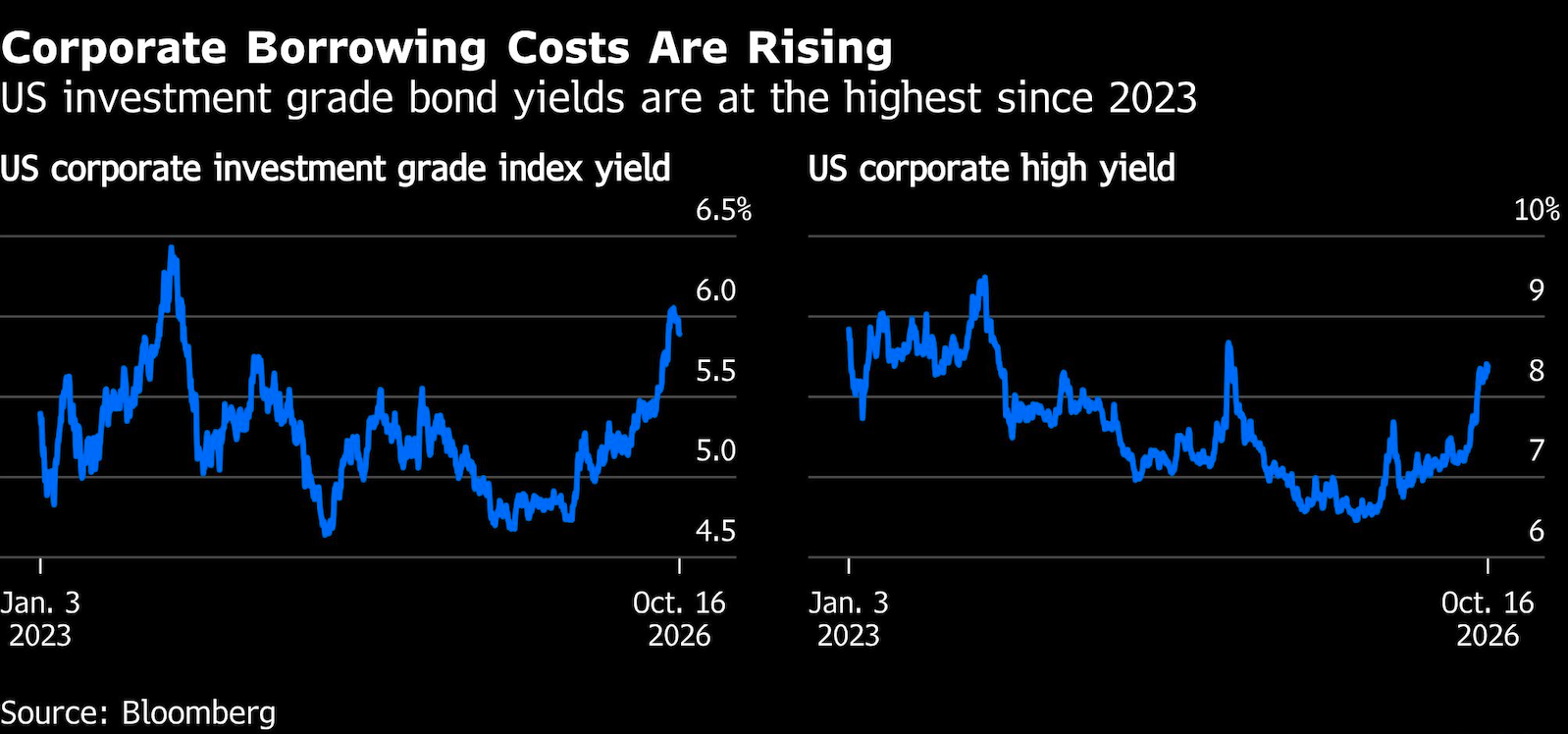
Corporate credit, monetary policy’s sleeping giant, is finally stirring. Cloud computing service provider CoreWeave Inc.’s bonds dropped this month, sending yields on its 2032 notes as high as 15%. Yields for junk and investment-grade debt reached the highest since 2025 and 2023, respectively. The implication is that the cost of corporate credit, a key channel through which central banks tap the economy’s brakes to cool inflation, may start to weigh on growth.
This has been a long time coming. US corporations have, until now, surprised investors and economists with their resilience in the face of soaring interest rates. Ultra-low borrowing costs, locked in during the Covid-19 pandemic, meant that many companies were minimally affected when the Federal Reserve started raising rates in 2022 and subsequently took them to the highest in decades. While companies and their investors delighted in years of unrestrained profit growth, the Fed essentially lost its ability to fight inflation by making financing conditions pricier.
The transmission mechanism is now cranking back into action, and it will influence future investment decisions as well as stock valuations. Policymakers, who restarted rate hikes in September, need to move slowly to avoid creating a negative spiral.
See more: Why Securitized Assets Deserve a Larger Role in Advisor Portfolios

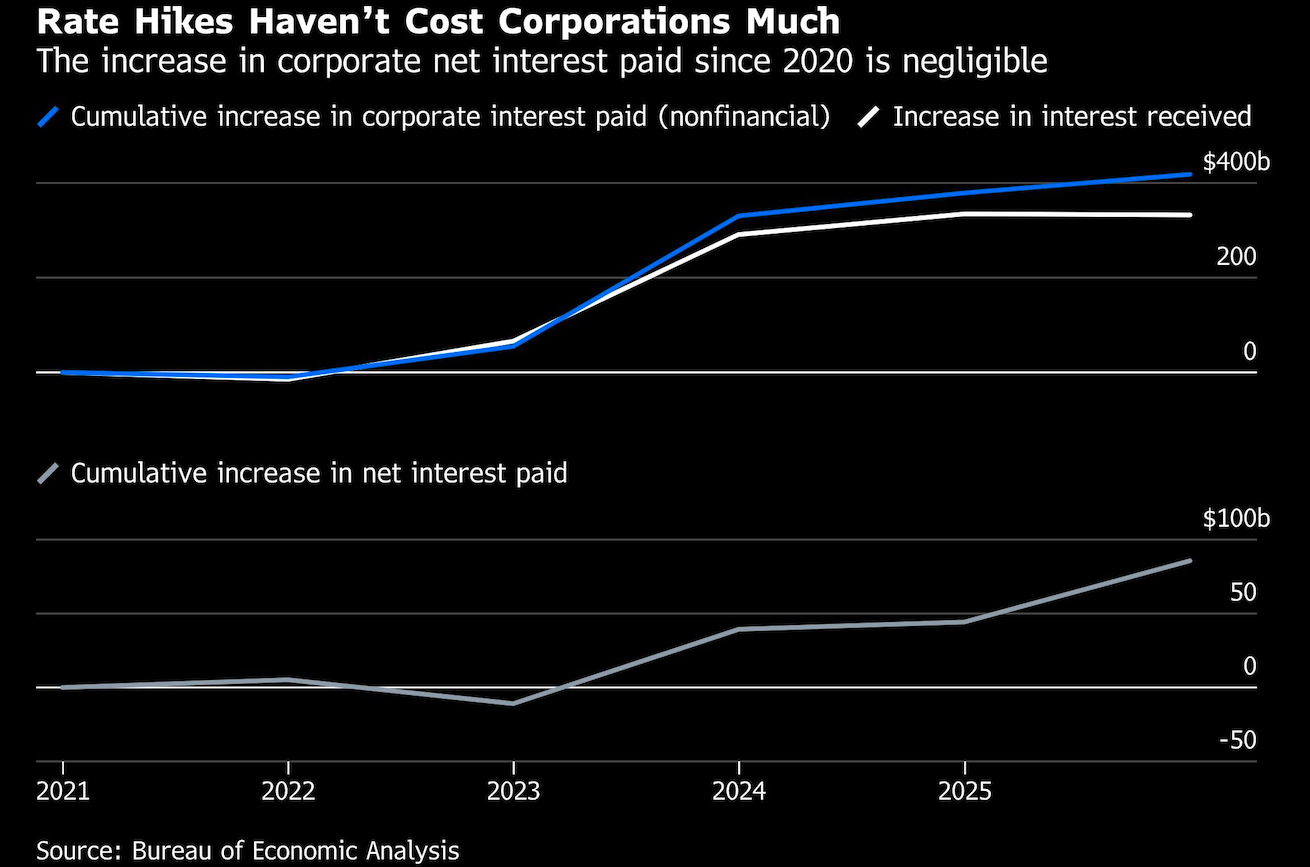
Companies interact with interest rates through both liabilities and assets. While borrowing costs have repriced slowly as old bonds matured and loans came due, the returns on corporate cash stockpiles jumped almost immediately when the Fed first hiked rates in 2022.
It’s hard to believe, but companies were actually net beneficiaries of expectations around rate hikes from the beginning of 2021 through the end of 2022, according to Bureau of Economic Analysis data. And though net interest paid began increasing slowly thereafter, the bite has been negligible; net costs rose around $86 billion over five years while nonfinancial corporate profits boomed by about $1.2 trillion in the same period to around $2.7 trillion before taxes.
This broke a key link in the chain of monetary policy transmission, in which higher costs of capital are thought to disincentivize business investment and hiring. It was the corporate version of the great mortgage lock-in story affecting 14 million borrowers who refinanced home loans when rates were 2% to 3%.
Now, somewhat suddenly, interest expense is set to become a factor again.
CoreWeave can be considered the tip of the credit spear, since its business model relies on continual access to debt markets. The company’s growth is premised on the idea that it can regularly borrow at reasonable rates to buy more AI chips and build more data centers, which it can then rent out through long-term contracts, generating returns higher than its cost of capital. The up-front borrowing is essential to fulfill the promise of the cash flows later.
CoreWeave’s bonds, and its stock price, collapsed last week without an obvious catalyst except for the general rise in long-term government bond yields. Also exacerbating poor sentiment was a note from market research firm Gartner Inc., which said that AI revenue might not justify the scope of the data center investment.
While CoreWeave is an extreme example, it has sent concern rippling through the broader market. Oracle Corp., Alphabet Inc. and Meta Platforms Inc. are among those seeing their borrowing costs increase due to rising US Treasury yields and investors demanding greater compensation for credit risk. And with fiscal deficits around 6% of gross domestic product and expected to hover there, it’s hard to imagine Treasury yields, which influence other borrowing costs, dropping a lot anytime soon.
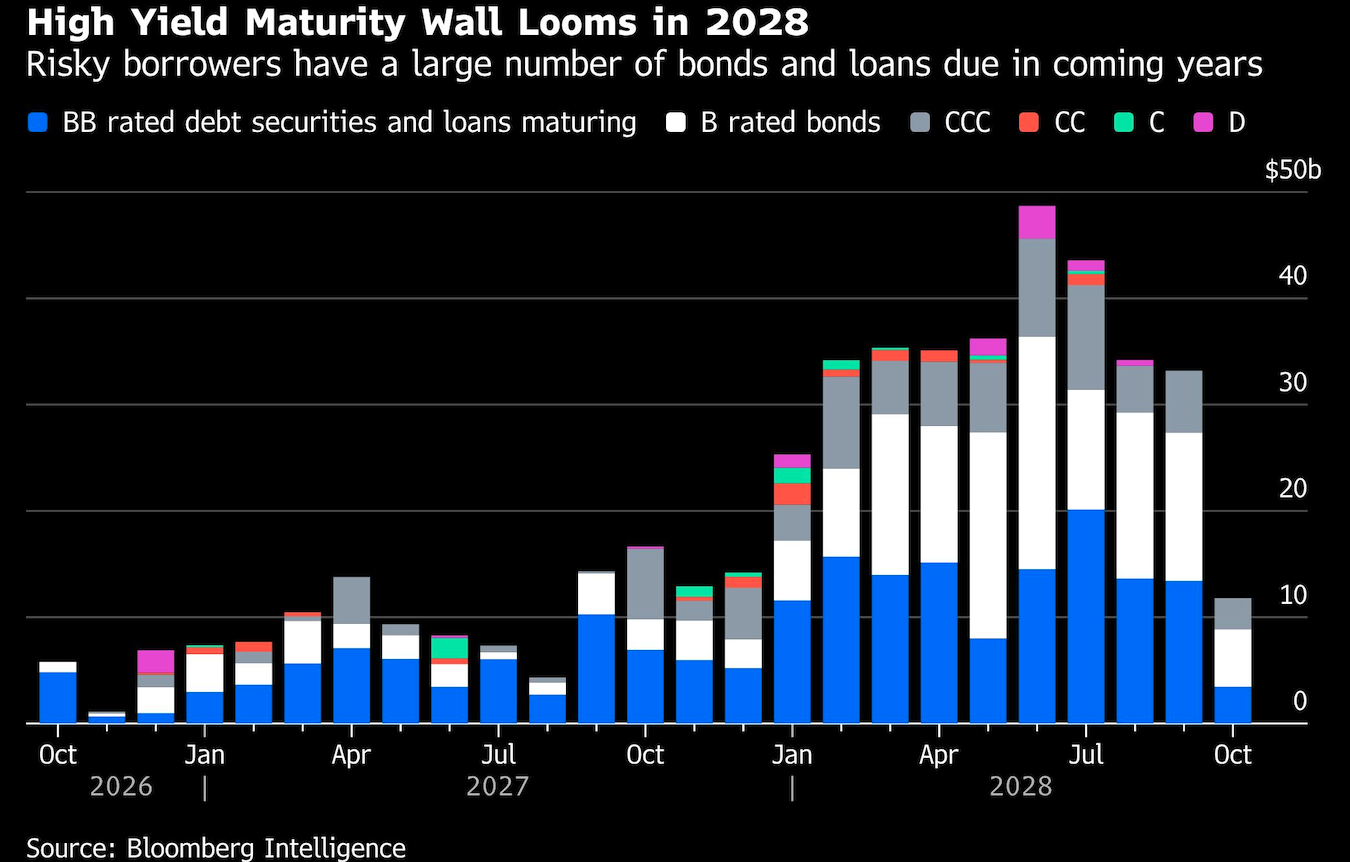
Around a quarter of constituents on the Bloomberg US High Yield index have bonds coming due in the next one to three years, near the highest on record. Elevated yields will be particularly hard to swallow in 2028, when the maturity wall looks most daunting.
Among high-grade issuers, the borrowing-cost adjustment looks more manageable. There, it’s a question of how much companies might pare investment plans. AI projects with a 50% annual return potential, for instance, will no doubt proceed, irrespective of whether investment grade yields are 5% or 6%. Less profitable and more uncertain undertakings will probably have to wait if high borrowing costs are sustained.
Monetary policy has always operated with “long and variable lags,” as Milton Friedman put it, but rarely this long. First, the corporate credit channel hasn’t looked broken for such a sustained period for decades. Second, this is occurring in the context of other distortionary impacts on the effects of monetary policy: A generational equity-market rally has generated $78 trillion in additional household net wealth since 2019 and bolstered consumer buying power, and war-time-style fiscal deficits have further cushioned growth.
Isn’t this rise in corporate yields what the Fed wanted and has been waiting for since 2022? In a sense. But that doesn’t mean that policymakers, under new Chair Kevin Warsh, have full control over the outcome.
A benign tightening that slows the AI capital expenditures boom while supply shortages in semiconductors and other data center components catch up might be just what the US economy needs to return inflation to the Fed’s 2% target after nearly six long years of missing it. What isn’t desirable is a disorderly widening of credit spreads that moves the 2028 maturity wall from challenging to downright unmanageable, triggering a wave of bankruptcies and unemployment. A further risk is that such an event would undo much of the household wealth accumulation in short order. We don’t know which outcome we will get.
That’s why policymakers should proceed slowly with further rate hikes, holding rates at 3.75%-4% at their October meeting and weighing the December decision carefully. Now that CoreWeave has awakened the sleeping giant that is the credit market, it’s hard to know how it will react in the months ahead.
A message from Advisor Perspectives and VettaFi: Discover something new! Click here to register for our upcoming webcasts.
Bloomberg News provided this article. For more articles like this please visit
bloomberg.com.
More Financial Planning Topics >