High-grade investors, including T. Rowe Price Associates Inc. and Invesco, are looking at dipping into the least risky corner of junk debt after a broader selloff pushed valuations lower.
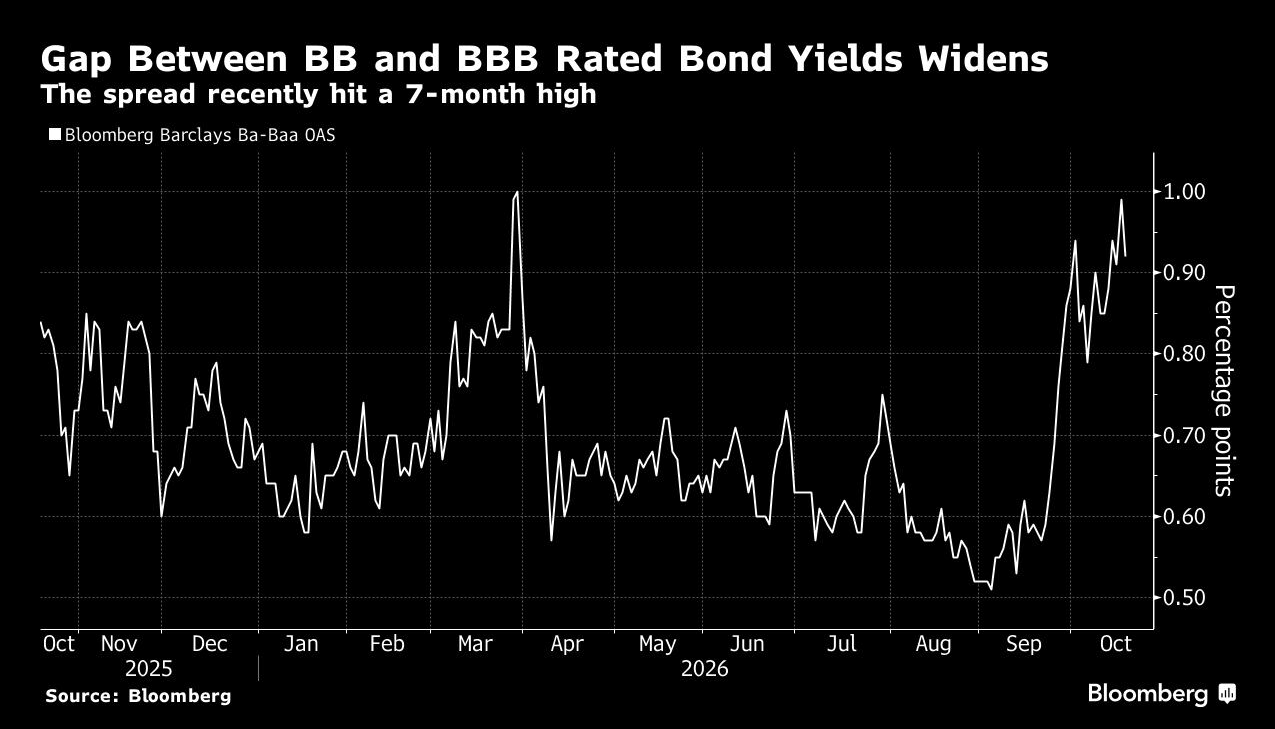
They’re considering buying high-yield bonds rated in the BB tier that in recent weeks have reached their cheapest levels since March. It’s a bet on the health of US companies, even as artificial intelligence and global wars threaten to pressure the weakest borrowers.
A robust macroeconomic backdrop is providing a strong safety net for these higher-quality junk bonds, said Steven Boothe, head of global investment grade at T. Rowe Price.
“When I think about the underlying fundamental health of corporate America and the higher quality segments of the high-yield market, this remains an attractive component of the market to deploy risk,” Boothe said.
Fears about the riskiest high-yield debt have been ramping up for months. Many junk bond holders have been shedding the lowest-rated securities in the market, those in the CCC tier and below, pushing risk premiums on those notes to an average of more than 10 percentage points, a level often seen as signaling distress.
A chunk of the money was poured into BB bonds instead. Demand from junk bond investors last month helped make BBs the most valuable they’ve been in 21 years compared with securities in the BBB tier, the weakest investment-grade levels. The broad bond market selloff since late September has taken valuations to levels that are attractive again, prompting high-grade investors to cross into the junk debt pool and lock in a higher yield for only a marginal increase in risk.

See more: Worried Consumers Keep Spending: Here's Why
“When it comes to the double B part of the market specifically, we think there’s a decent chance for some outperformance there versus the rest of the investment grade market,” Adam Bloch, managing director and portfolio manager at Guggenheim Investments Holdings, said.
Bloch said Live Nation Entertainment Inc.’s $1.4 billion debt offering earlier this month is an example of “one-off opportunities in double B that make sense” for investment grade investors. While rated junk, the company has a strong cash flow and low debt load that’s closer to a triple B borrower.
Moving down in quality does comes with extra risk, even if it’s relatively small for double B companies when compared with the rest of the junk-debt pool. Three-year cumulative default rates for BB rated borrowers are at 4.17% compared with just 0.91% for those rated BBB, according to data from S&P Global Inc. But those rates jump to 12.41% for B rated and 45.67% for CCC rated ones.
Selectivity is also key, with robust earnings capacity, strong margins and positive free cash flow being some of the criteria portfolio managers are looking at. “Those are the types of double B’s that we love and that we’re happy to dip our toes in the water now,” said Bixby Stewart, head of US Investment Grade Credit Research at Invesco Advisers Inc.
The company allocates between 8% and 14% in high-yield bonds in some of its corporate bond funds under management, Stewart said.
Supply Indigestion
While a supply glut of US investment grade bonds provides investors with attractive carry, heavy issuance risks in high-yield bonds as well are likely to keep the spread between double B and triple B bonds pinned at the wider end of recent ranges, Boothe said.
Corporate issuance in the investment-grade market hit record levels this year as hyperscalers raced to fund AI data center buildouts. The debt deluge has overwhelmed investor demand and spurred concerns of “indigestion,” pushing investment-grade spreads wider.
Oracle Corp., which has been borrowing heavily to finance massive investments in data centers, is seen adding to the pressure.
“There’s one member of the triple-B club that’s very unusual, and that’s Oracle,” said Ed Al-Hussainy, portfolio manager at Columbia Threadneedle. “Because Oracle is issuing so much debt, it has the weakest balance sheet now of the hyperscalers and so it trades very cheap to the other triple-B names.”
The company is teetering on the edge of junk status after S&P Global cut its credit rating to BBB-, the lowest investment-grade rung, as the tech giant burns through cash faster than it can generate revenue. Maintaining an investment grade credit rating is the company’s “first priority,” a representative for Oracle said in an emailed statement, citing recent comments from chief financial officer Hilary Maxson.
There are signs supply pressures are building up in the junk bond market, too. A string of chunky junk bond offerings — including a $10 billion deal from SoftBank Group Corp. and $12.4 billion from Paramount Skydance Corp. — turned September into the busiest month this year for the market.
That’s prompted Goldman Sachs Group Inc.’s chief credit strategist Amanda Lynam to warn recently that high-yield debt may see the same sort of “episodic indigestion” that overwhelmed the investment grade market earlier.
CCC Pain
As investors continue to flee the junkiest of junk bonds, yields on CCC rated debt have surged to over 15% from around 10% in January, the highest level since 2022. A looming maturity wall will also keep pressure on the riskiest debt. Distressed companies account for about a third of maturing high-yield debt over the next two years, according to a study by Moody’s Ratings.
“High-yield managers moving out of those riskier parts of the market and wanting to go up in quality,” are also turning to BB rated bonds, said Travis King, head of US investment-grade corporates at Voya Investment Management.
Apollo Global Management Inc. Chief Economist Torsten Slok said in a recent note that expensive borrowing costs mean junk bonds are in for a “slow squeeze,” advising investors to move to higher-quality corporate bonds to capture attractive yields.
“The bill from the cheap-money era is landing on the weakest balance sheets first,” he wrote, with private equity-backed technology companies among those poised to experience the most pain.
A message from Advisor Perspectives and VettaFi: Discover something new! Click here to register for our upcoming webcasts.
Bloomberg News provided this article. For more articles like this please visit
bloomberg.com.
More ETF Topics >