Fear of missing out has driven data-center developers to build as much computing capacity as possible, as swiftly as they can. But investors funding the projects are getting nervous. They’re suddenly worrying that spending on artificial-intelligence services won’t be enough to justify the trillions of dollars backing the buildout.
Political opposition to the boom in server farms is growing, while construction delays, equipment failures and power constraints are hurting developers and slowing down projects. The latest concern is that projections for likely revenues from AI tools and services are coming up far short of what’s needed to deliver any return on investments in the vast computer facilities. For smaller infrastructure providers, that could prove deadly.
So-called neocloud companies such as Britain’s Nscale are feeling the pressure. Microsoft Corp.’s decision to pull out of a data-center project near London with the firm, for example, has cast doubts on Nscale’s planned US stock-market listing. Several other planned initial public offerings, including one for leading AI model-maker OpenAI, have been put on ice. Meanwhile, the public shares and bonds of another neocloud, CoreWeave Inc., have been hammered, and the Philadelphia Semiconductor Index had an eight-day losing streak through the end of last week, its longest since 2008.
All of the players in this infrastructure boom, from upstarts such as Nscale to giants including Alphabet Inc., are chasing the idea that whoever gets the most chips humming can lock in the biggest contracts and win the AI computing race. “We are in a period where you have to be huge,” CoreWeave co-founder Brannin McBee told the Financial Times in an interview full of bubble-blowing hubris.
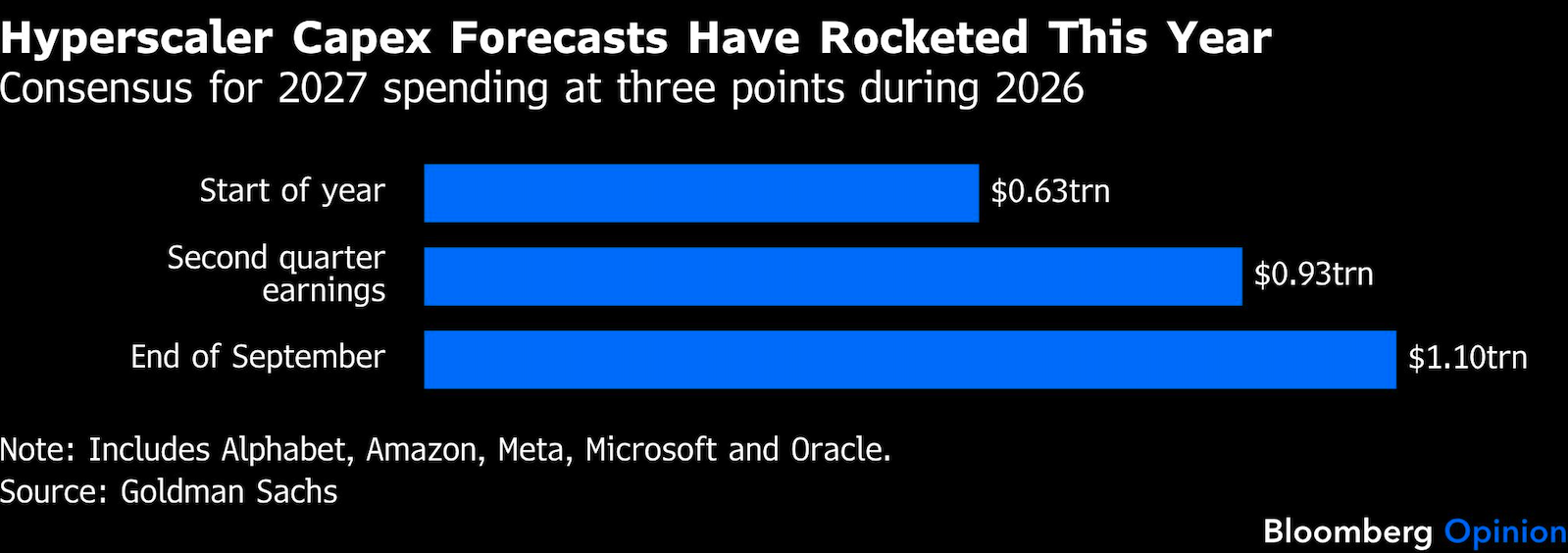
This mindset has driven the dizzying escalation of capital spending plans. At the start of this year, analysts estimated that the five hyperscalers alone — Alphabet, Amazon Inc., Meta Platforms Inc., Microsoft and Oracle Corp. — would spend $630 billion on new data centers in 2027. That forecast has now almost doubled to $1.1 trillion.

See more: Midterms, AI & Fed Hikes: What Financial Advisors Need to Know
That’s why people have started to look more closely at the income all this outlay could generate. Consultants at Bain & Co. predicted in late September that the likely revenue available from AI spending by consumers and companies by 2031 would be less than $2 trillion, which is far below the $6 trillion needed to justify planned investments.
Last week, Gartner Inc. upped the ante when the tech research firm estimated that data center owners would face a revenue shortfall of $6 trillion by 2032 compared with infrastructure spending — and that nearly $4 trillion risks getting written off as excess to the world’s AI needs. “At forecast trends, massive AI capital asset write-downs are more likely than not,” Gartner analyst Will Sommer wrote.
Wall Street banking executives were still bullish on the financing to be done — and fees to be made — from the AI boom on their recent third-quarter earnings calls, in spite of the uncertainty about the sector’s ability to generate revenue. “No one knows how the demands for capital and compute will evolve as the broader AI ecosystem matures,” as Goldman Sachs Group Inc. Chief Executive Officer David Solomon put it.
But even Goldman’s own US equity analysts have doubts. The five hyperscalers plus Space X Inc. need to generate an extra $300 billion annually in AI services revenue in 2026 and 2027 just to break even on their capital spending, stock analyst Ryan Hammond wrote recently. They need to deliver more than $400 billion to make a 10% return. As of the second quarter of this year, the extra cloud-services income they’re getting above pre-AI trends was just $70 billion annualized — and predicted near-term growth doesn’t close the gap.
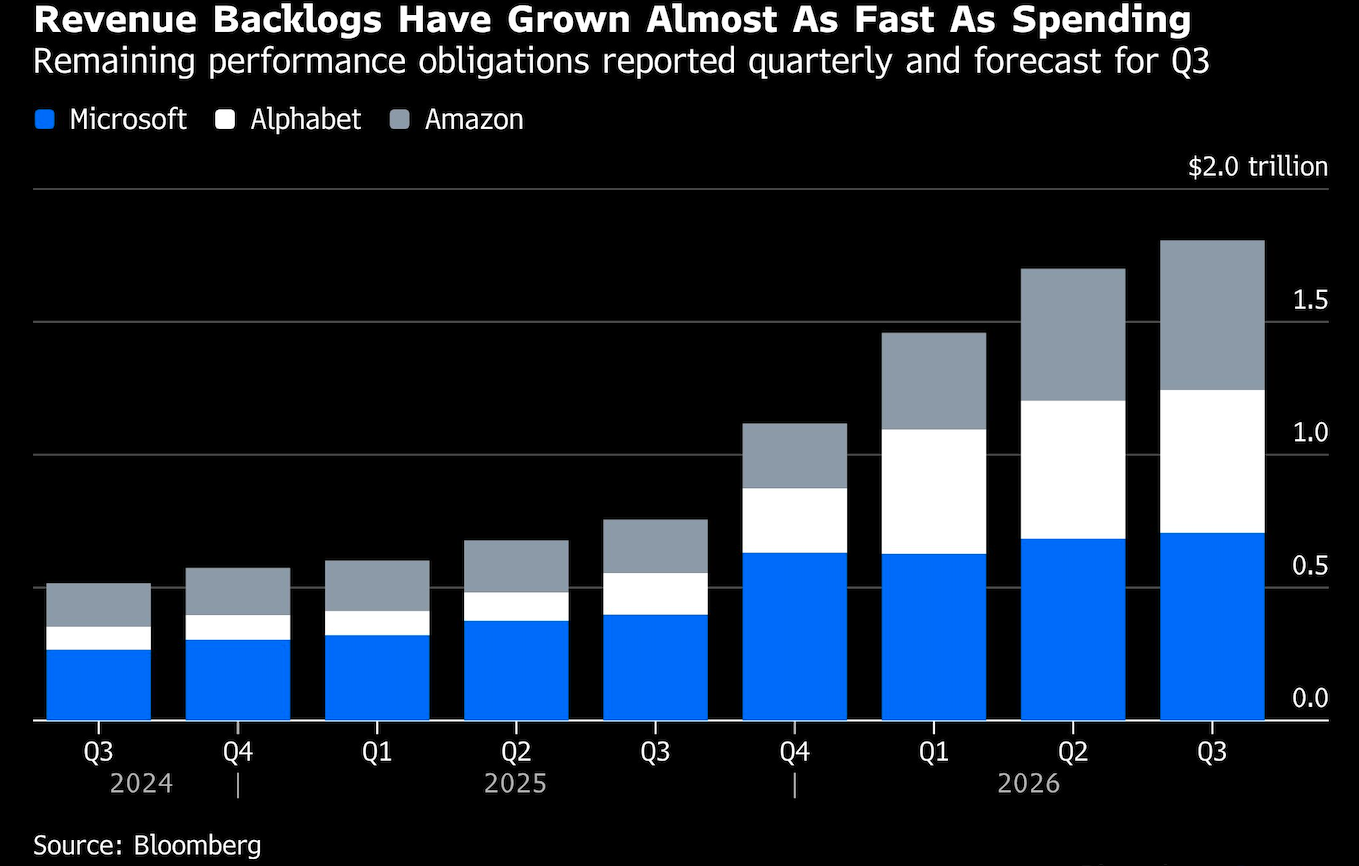
There is a potential silver lining for the cloud providers: the backlog of revenue they should get from contracts due to start once new data centers come online. The so-called Remaining Performance Obligations reported by Alphabet, Amazon and Microsoft alone totaled $1.7 trillion at the end of June, according to Bloomberg Intelligence. They have grown almost as rapidly as spending plans, jumping from less than $700 billion a year before. When the hyperscalers report third-quarter results later this month, those numbers will likely have grown again.
There are several reasons to be cautious about RPOs. They aren’t guaranteed, and some can be renegotiated. Many aren’t due to start for several years and they can be highly dependent on a single client. For example, almost half of Microsoft’s $684 billion revenue backlog is contracted from OpenAI alone, according to Bloomberg Intelligence; one-fifth of Amazon’s $496 billion is due from Anthropic PBC.
The AI software firms themselves have also aroused skepticism over the outlook for industry income. Anthropic’s update to investors last week ahead of its planned November IPO showed a slowdown in quarterly sales growth to 50% from 140% earlier this year. OpenAI rocked markets this month by giving investors new revenue guidance that was far below earlier updates (albeit measured differently). To top it all, Meta and Microsoft have both told their own staff to cut back on use of Anthropic’s leading model, Claude, according to The Information. The whole AI project is rife with internecine risks.
The flood of capital into this boom has given birth to an existential competition for market share, as Gartner’s Sommer put it. It’s high time that investors and lenders recognize the possible consequences of ending up on the losing side.
A message from Advisor Perspectives and VettaFi: Discover something new! Click here to register for our upcoming webcasts.
Bloomberg News provided this article. For more articles like this please visit
bloomberg.com.
More Innovative ETFs Topics >