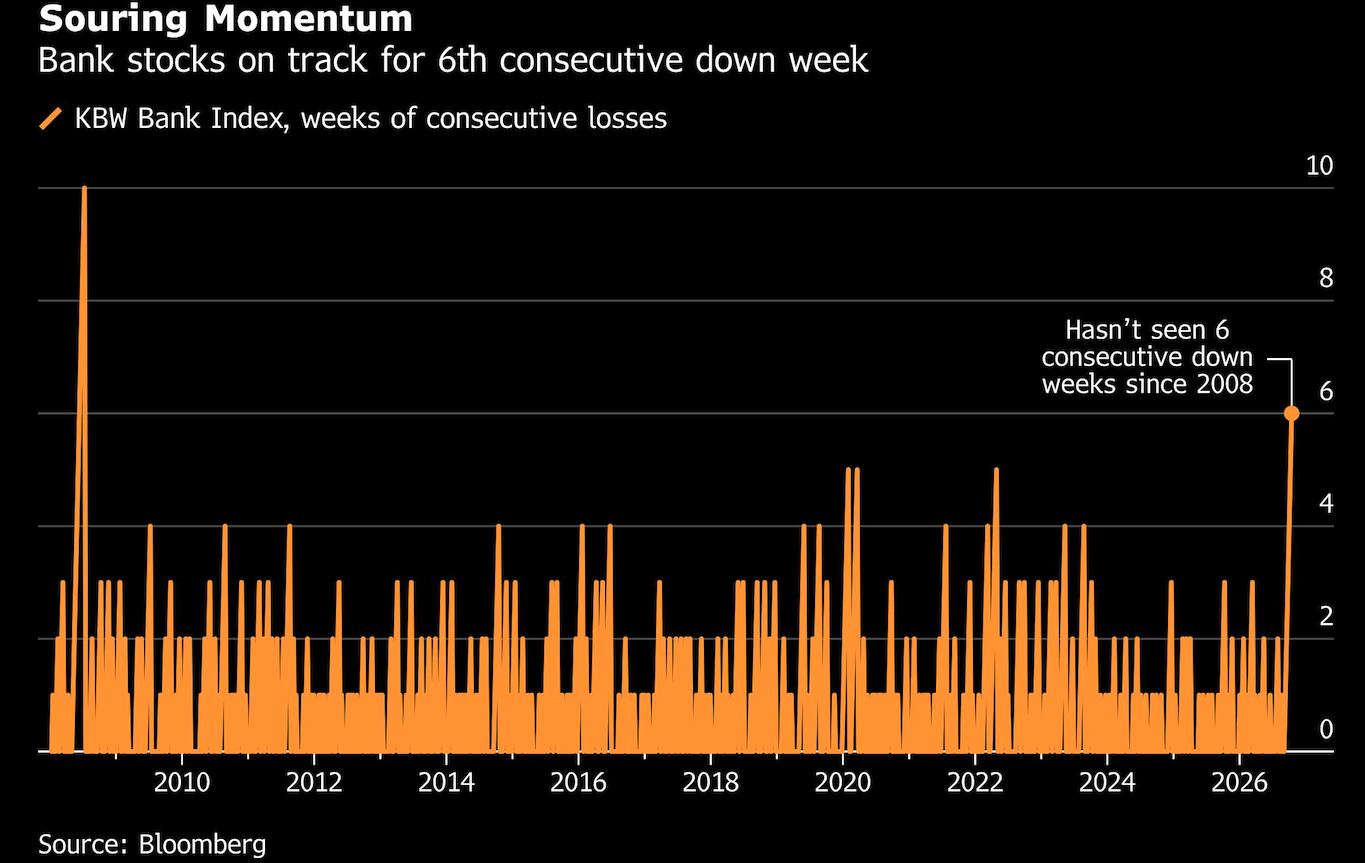
Big bank earnings offered little to alter the dimming views on the sector mired in the longest losing streak since the financial crisis. The bright spot: equities trading.
Stock desks at the largest US lenders generally thrived in the third quarter, helped by rising volatility in global markets and booming activity in prime-brokerage arms that serve hedge funds. Strong stock market activity and leveraged fund demand added to the momentum.
Goldman Sachs Group Inc., JPMorgan Chase & Co. and Morgan Stanley all posted beats in their stock trading businesses. Meanwhile, Citigroup Inc. and Bank of America Corp.’s figures fell short.
It was a silver lining for the group that delivered mixed third quarter results, and got a negative reaction on Wall Street. The broader KBW Bank Index has dropped 1.2% so far this week and is on track for a sixth consecutive week of declines, the longest losing streak since 2008.
The group has been battered by worries around how the artificial intelligence technology will disrupt the financial services space and how aggressive the Federal Reserve will be in its campaign to reign in persistent inflation.

Equities divisions at five of the largest lenders have raked in almost $67 billion in revenue in the first nine months of the year, roughly $5 billion more than from units handling bonds, currencies and commodities.
There’s a “multi-year divergence of equities versus fixed income,” Mike Mayo, Wells Fargo’s bank analyst, wrote in a note to clients. This year is likely to be the first since 2008 with equities trading exceeding fixed income trading, he said.
See more: Buy Small-Capitalization Stocks for Safety, Outperformance in the Coming Years
While benchmark equity volatility gauges are sitting at levels that suggest few signs of stress in stock market, a lingering conflict in the Middle East is keeping investors on edge, forcing them to reshuffle their portfolios, contributing to a pick-up in trading activity.
Average equity volumes across US exchanges are up 7.5% this year, data compiled by Bloomberg Intelligence show. On a dollar basis, trading is up 27% so far in 2026, after advancing 36% in 2025 and 18% in 2024.
“Volumes have been going through the roof,” said Larry Tabb, head of market structure research at BI.
The “gang-buster” volume in the first half of 2026 was driven by investors looking to position for events including the Iran war, the AI trade, the bearish software trade, SpaceX’s initial public offering and whenever President Trump “says this or that, that causes people to react,” he said.
Banks capture a significant portion of institutional trading, and they excel in services like research, conferences and providing access to senior corporate executives, he said.
Even so, there is a lot of uncertainty around whether the advance in equities trading is sustainable.
“The central risk in our view is that higher rates progress from a trading catalyst to a constraint on the super cycle’s share and duration,” Mayo said. “Volatility initially stimulates hedging and repositioning, but persistently higher yields raise financing costs, pressure valuations and delay M&A, IPOs and debt issuance.”
The big banks are also facing competition in securing retail stock trading. Charles Schwab Corp. saw one of the busiest trading days in its 55-year history when SpaceX made its June stock-market debut, an event that drew massive participation among retail traders.
The World Cup soccer tournament also propelled prediction markets Kalshi and Polymarket to record-high volume in July, while eyes are on the impact of upcoming US midterm elections.
The biggest banks are well positioned. “The ‘haves’ in global equities” - particularly the largest prime brokers, like Goldman, JPMorgan and Morgan Stanley — “continue to see strong outperformance versus the ‘have nots’,” Seaport analyst Jim Mitchell wrote in a note.
A message from Advisor Perspectives and VettaFi: Discover something new! Click here to register for our upcoming webcasts.
Bloomberg News provided this article. For more articles like this please visit
bloomberg.com.
More Innovative ETFs Topics >