Consumer confidence is collapsing, hiring is weak and the housing market is largely frozen. All of which serves to underscore that the US economy is only holding up because of the boom in artificial intelligence and an aging population spending ever more on healthcare. Although the former seems to garner all the attention these days, the latter is becoming a rising source of vulnerability. The risk is that unsustainable federal budget deficits will force a reckoning, with the government throttling Medicare funding and delivering a devastating blow to the economy in the process.
We got to this point, in part, due to demographics. Americans 65-and-over cohort have exploded to 18% of the population, or 63 million people and an increase of 17 million in the past decade. Seniors consume much more healthcare than the rest of the population, and pay for it through Medicare, the US health-insurance program created in 1965 to help older Americans afford their medical bills. This has all meant major profits for the medical community in all its forms, from physicians to drugmakers, as well as insurers that peddle Medicare plans.
Medicare outlays are up around 8% in the fiscal year to date, and they’re running at an annualized rate of some $1.1 trillion — an economic risk hiding in plain sight. One Medicare trust fund comes mainly from a designated payroll tax. Starting next year, current trends suggest Medicare will spend that money faster than it brings it in, with the fund depleted by 2033. That’s a deadline by which policymakers need to come up with a fix (raise the payroll tax, cut benefits or find resources elsewhere), or payments to hospitals could be cut to about 89 cents on the dollar. Another bucket of Medicare funding comes from general tax revenue and debt, and politicians will face increased pressure to rein in those costs as government interest expense, which has reached about $1 trillion annually, continues to climb.
This should all feel strangely familiar. Similar to healthcare, the AI story is riding on the back of a hyperscaler borrowing binge to help finance roughly $800 billion in capital expenditures from Amazon.com Inc., Microsoft Corp., Alphabet Inc., Meta Platforms Inc. and Oracle Corp.
A mountain of debt is behind each leg of the economy; it’s just that one stack is private and the other is issued by the Treasury Department.
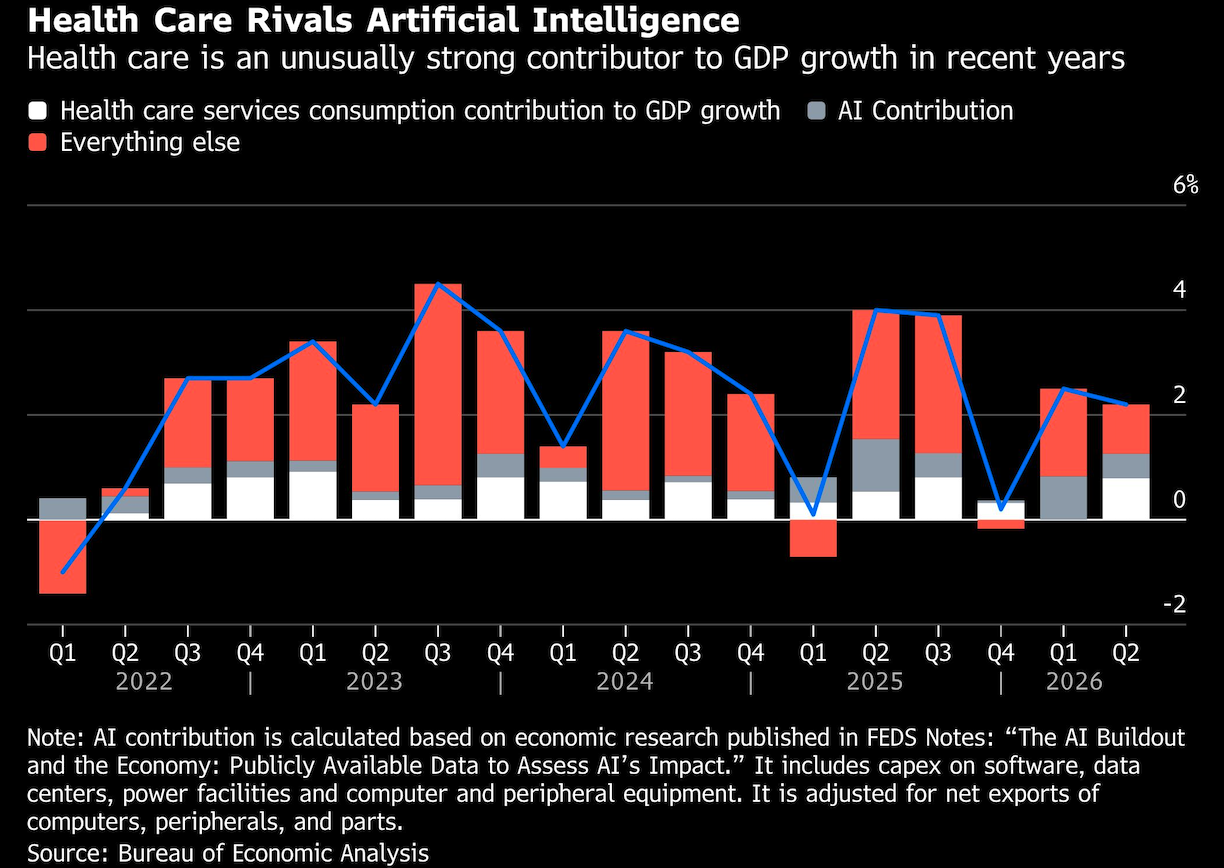
For now, healthcare is an economic tailwind. The health economy has created 372,000 positions in the past year, or about 75% of the 496,000 nonfarm payroll additions in the US overall. In the second-quarter gross domestic product report updated Wednesday, healthcare consumption accounted for well over a third of the 2.2% annualized expansion in the second quarter — more than AI investment.
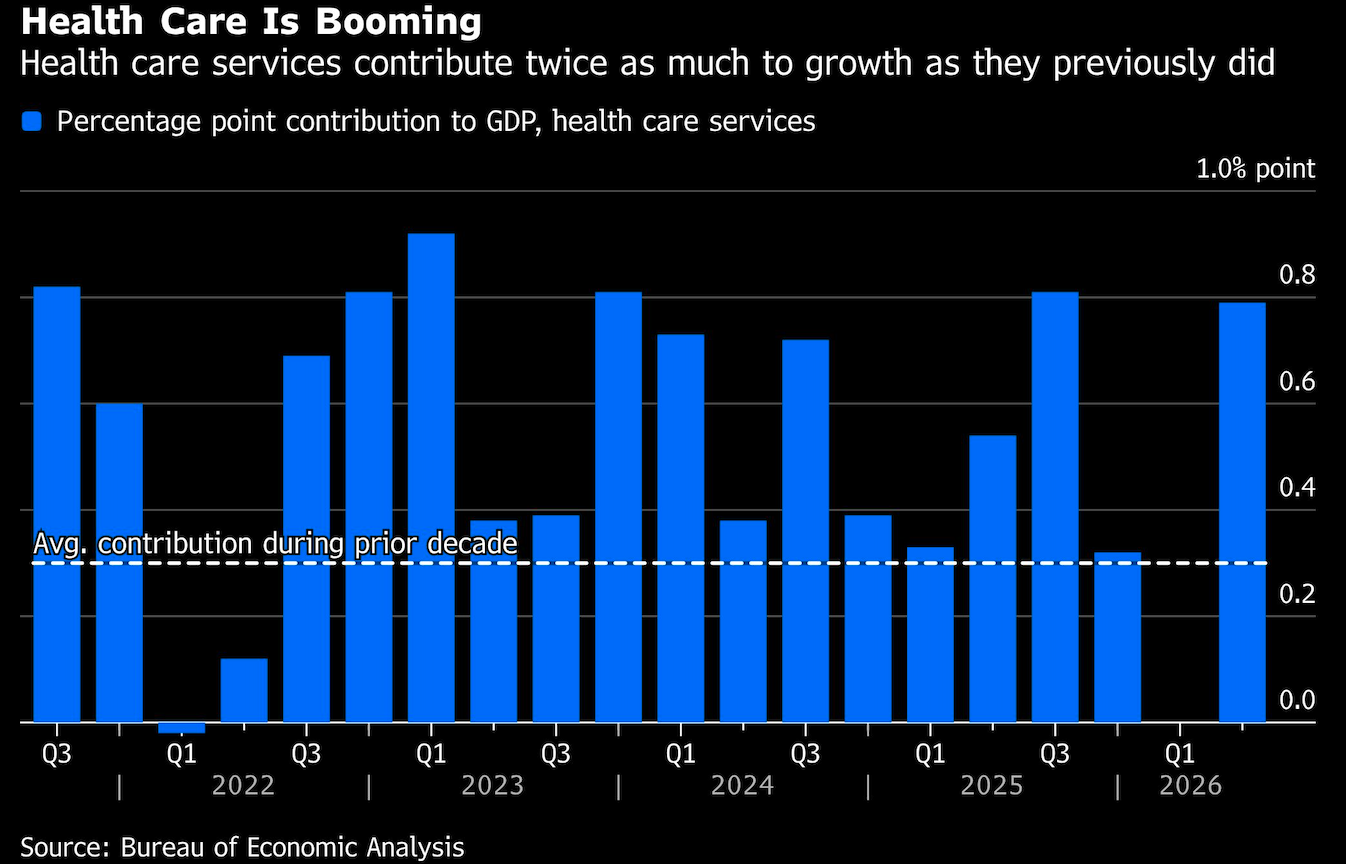
Healthcare has always been a big deal in the economy, but its contribution in recent years is roughly twice as large as it had been in the prior decade.
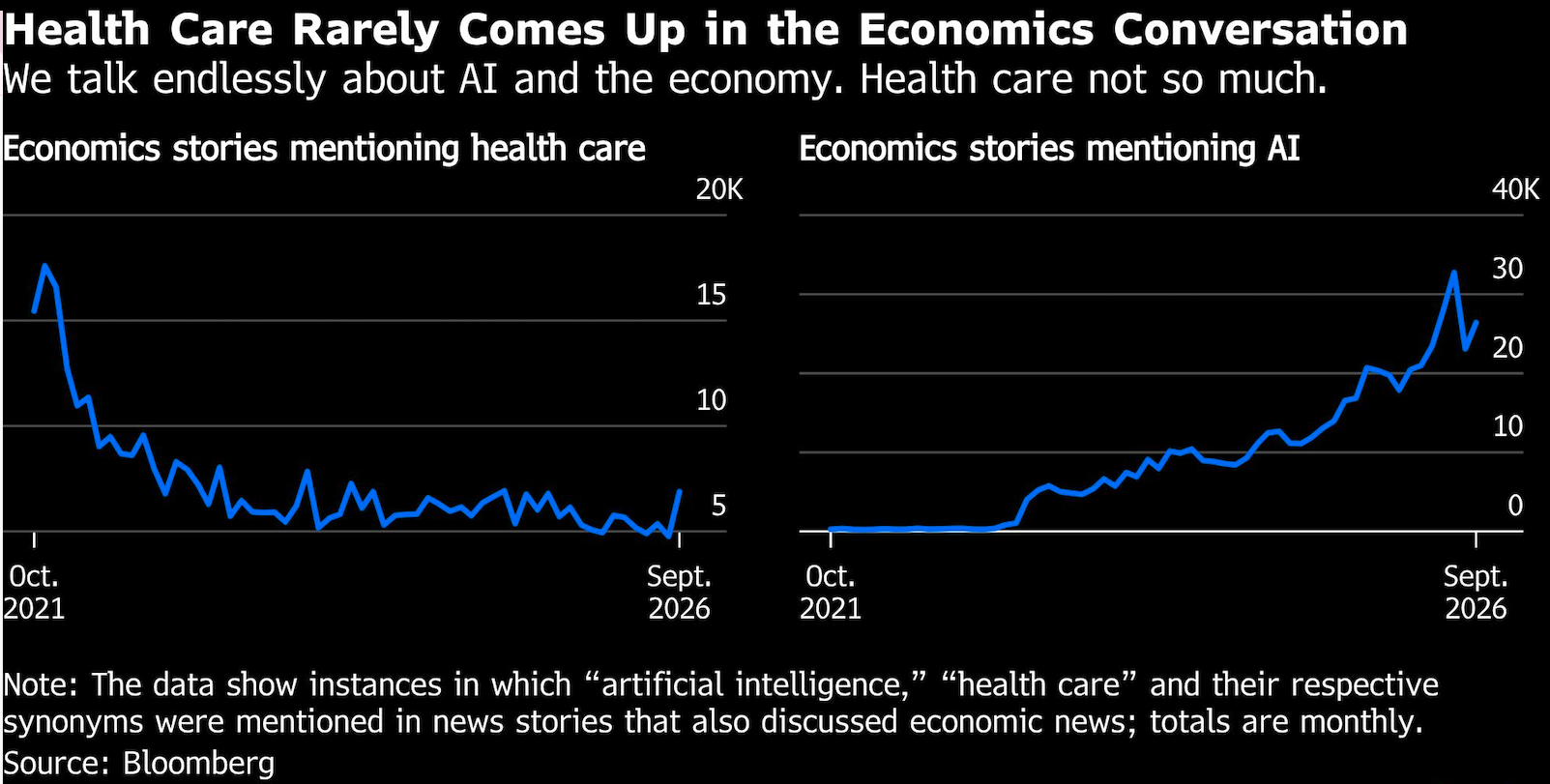
It’s no shock that we discuss AI much more than the healthcare economy. The former is a once-in-a-century economic surprise that’s catapulted the S&P 500 Index higher and helped add about $52 trillion to American households’ net worth since the release of ChatGPT in late 2022. The latter is an inertial feature of America’s demographic profile. The strength of the healthcare economy is a feature we take for granted, but one we’d miss terribly if government mismanagement transforms it into an unwelcome weakness.
America’s economic expansion depends on a resolution that addresses the hard budgetary math without forcing austerity on the most vulnerable Medicare users and crushing healthcare consumption. The means tackling loopholes and inefficiencies.
US lawmakers should consider a suite of reforms, including tweaks to Medicare Advantage, the version of Medicare that uses private company middlemen. Medicare pays Medicare Advantage plans 14% more per person — adjusting for demographics and health status — than what it spends under traditional Medicare, according to the independent Medicare Payment Advisory Commission, or MedPAC. That’s in part due to a perverse incentive to inflate diagnoses, and it demands fixing.
Another issue is that individuals that earn income through passthrough businesses can avoid the Medicare payroll tax on much of their income, a loophole that mostly benefits the top 1% of earners. And a third addressable concern is the inconsistency in what Medicare pays in different settings. One example from MedPAC: Medicare pays a hospital outpatient department $741 for the same exact epidural steroid injection (for back pain) that it pays $256 for in a physician’s office. As a result, hospitals systems are buying up physicians’ offices and reclassifying them as outpatient departments. Medicare should adopt so-called site-neutral payments. Medicare will probably require even bolder — and politically trickier — solutions to get through the next few decades as the population ages. But those ideas are a start.
In a twin-engine economy, we can’t take either one for granted. Healthcare will be the only bulwark protecting the expansion if the hyperscalers pull back on AI investment. And our leaders put it at risk by failing to act to ensure its viability.