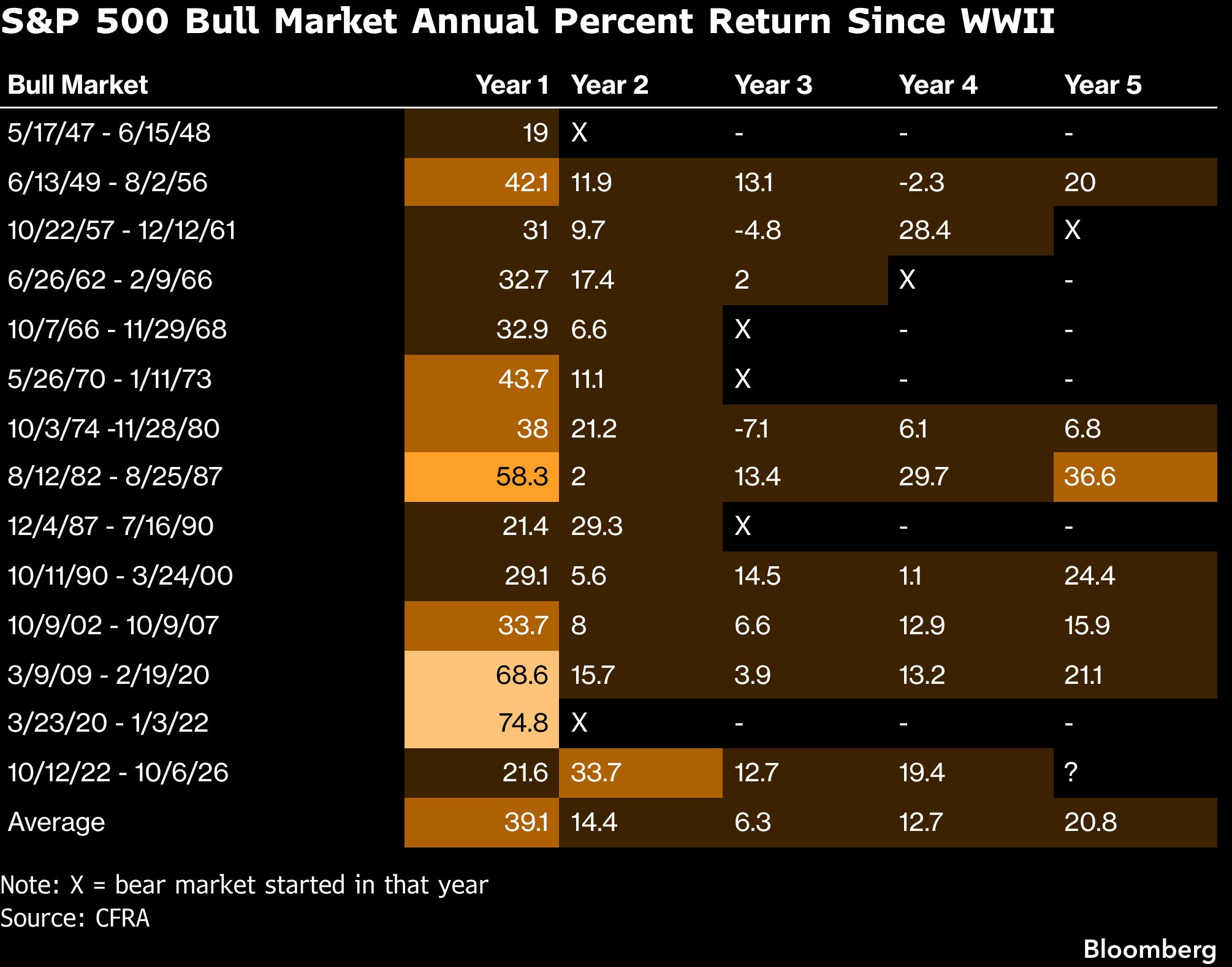
he bull market in US stocks is showing few signs of stress as it approaches its fourth anniversary: Corporate profits are rock-solid, the S&P 500 Index is near a record and volatility appears subdued.
But deep down, questions are swirling around what could derail the gauge’s 117% advance since Oct. 12, 2022, when this bull market began. While there’s no single answer, a massive divergence between stock indexes trading at records amid the lackluster performance of many individual shares is emerging as a major point of contention.
A version of the S&P 500 stripped of market-cap bias has trailed the benchmark equities gauge by 52 percentage points since October 2022. That’s the widest underperformance this far into a bull market since at least the 1990s, data compiled by Bloomberg show.
See more: The Message From Market Breadth
“This bull market will continue — but my worry is how narrow the rally is compared with history,” CFRA chief investment strategist Sam Stovall said by phone. “There will be a time when this ends, but everything will hinge on Corporate America’s profit growth and outlooks.”

At 117%, the advance in the S&P 500 since 2022 is the third-largest for bull markets at their fourth anniversary, according to CFRA data going back 1947. And when the rally extended to a fifth year, the average gain was 21%, the data show. Theoretically, that leaves plenty of room for the rally to broaden out beyond technology megacaps that have driven the lion’s share of gains since October 2022.
The artificial intelligence boom has been at the center of the bull market that’s added almost $40 trillion to the S&P 500’s market value. Chipmaker Nvidia Corp., the AI rally’s poster child, has soared more than 1900% since US stocks troughed in late 2022 and is on the verge of becoming the first company with a $6 trillion market capitalization.
But with so much in the stock market riding on AI-related optimism, the setup is vulnerable to massive swings if the tide turns downward. There are questions about when and if Wall Street will see returns from the billions of dollars spent on the AI infrastructure.
Bull markets typically start with broader stock-market participation in the first few years as the Federal Reserve cuts interest cuts rates to support the economy, said Jurrien Timmer, director of global macro at Fidelity Investments. The opposite happened this time: the central bank raised rates in 2022 to tame inflation, which pressured equities and forced companies to slash profit forecasts following the most aggressive monetary tightening in decades.
Corporate America is now navigating one of the strongest profit cycles in recent history, with the S&P 500 posting seven consecutive quarters of double-digit earnings growth. And investors want to see the momentum continuing.
“As long as companies keep delivering, investors will continue to look past most of these risks,” Timmer said. “But if there are any hints of weakness, the market will scrutinize valuations.”
The third-quarter earnings season, which begins Tuesday with big banks like JPMorgan Chase & Co. reporting results, will present a major test for the stock market. Then, the US midterm elections in November may stir up volatility in the near term. And the Fed’s interest-rate path remains one of the wild cards on the horizon.
Despite all the risks, the S&P 500 trades within striking distance of 8,000. Perma bull Ed Yardeni — president of Yardeni Research — projects the S&P 500 to hit 10,000 by the end of the decade, supported by robust corporate profits and a strong economy. Still, he cut his year-end forecast for the S&P 500 last month, to 7,900 from 8,400, saying the risks of a downturn over the next three to six months have increased.
So what gives? Rising yields are a major headwind. The 10-year Treasury yield rose as high as 5.34% last week for the first time since 2002, wreaking havoc on everything from rate sensitive small caps to banks and more speculative corners of the market, like unprofitable technology companies and those with the weakest balance sheets.
Another factor why bulls are optimistic is the resilience of the economy, with investors shaking off worries about a recession that helped valuations recover after 2022. The Atlanta Fed’s GDPNow model sees real gross domestic product climbing at a 3.7% annual rate in the third quarter, up from 2.2% in the second quarter.
That’s why Seth Merrill, managing director and chief investment officer at Melody Global, is hopeful the Fed’s move to gradually raise rates will pave the way for broader stock market leadership.
“My portfolio outside of megacap tech returns are moderate or even poor,” Merrill said. “You can’t see it at an index level.”
A message from Advisor Perspectives and VettaFi: Discover something new! Click here to register for our upcoming webcasts.
Bloomberg News provided this article. For more articles like this please visit
bloomberg.com.
More Wealth Management Topics >