The economist Robert Solow’s famous 1987 adage about the computer age — it can be seen everywhere except the productivity statistics — also applies to generative artificial intelligence.
The IT revolution did make workers more efficient globally, especially after the internet spawned entirely new business models. The changes, however, arrived in waves, long after the initial investments. They were hard to measure in real time.
Something similar is going on now. In less than four years since the first large language model was released, annual AI investment is approaching $1 trillion. Yet where is the evidence that firms using the technology are getting more juice out of their human resources, leading to economywide gains?
See more: AI Can Help You Build Faster. It Won't Make Billing Low-Risk.
A recent paper by Alex Blumenfeld at the University of California, Berkeley, with Jonathon Hazell at the London School of Economics and two other economists, has tried to fill the gap by putting a number on one crucial area where AI is having the most impact: software engineering.
Suppose there are two e-commerce platforms, but only one is redesigning its app so that Claude or ChatGPT agents can shop as effortlessly as humans. Before long, its careers page (and its LinkedIn listings) will be seeking more software developers skilled at using AI to complete projects faster than was previously possible.
Stock markets already have a decent sense of which companies are making the best use of AI. As the technology advances, investors will increasingly price the expected gains into the shares of those best placed to profit from it.
The researchers compare firms’ stock returns with an AI Index, holding other factors constant, and then examine how those excess (or deficient) returns vary with spending on programmers’ pay. Their conclusion was remarkable: Between November 2022 and December 2025, AI raised the market’s estimate of the present value of software-engineering productivity by the equivalent of a permanent 32.6% increase.
To arrive at their findings, Blumenfeld and his colleagues studied companies ranging from online marketplaces such as eBay Inc. to electronics makers including Sonos Inc. and travel platforms like Expedia Group Inc. and Airbnb Inc. What they have in common is that software engineering is key to their businesses rather than being the product itself. To differentiate AI’s effect on productivity, the researchers excluded software companies and firms in the semiconductor supply chain.
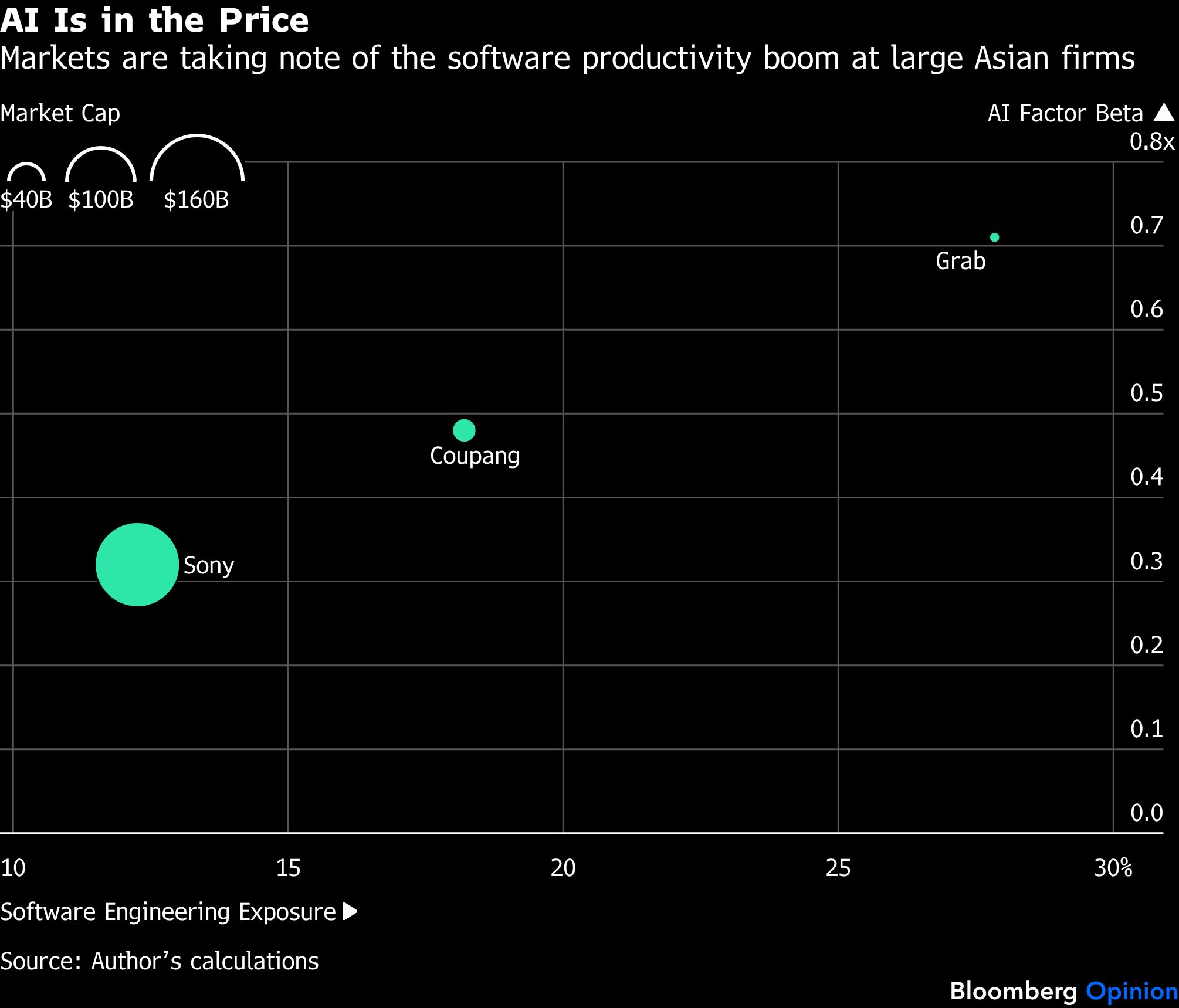
The same pattern appears to hold true for some of Asia’s biggest consumer companies. I ran a back-of-the-envelope test, measuring the sensitivity of the US-listed shares of Sony Group Corp., Coupang Inc. and Grab Holdings Ltd. to the ROBO Global Artificial Intelligence Index, and then comparing the result against their software engineering exposure. Without access to payroll data, I used the share of software-related vacancies on company careers pages as a proxy.

Think of it as a peek under the hood. A statistical investigation into AI’s productivity gains across Asian companies will require a much broader sample than three handpicked firms. Still, the trio offers a suggestive glimpse. Coupang is South Korea’s answer to Amazon.com Inc.; Grab is a Southeast Asian super-app. Sony — a global powerhouse spanning hardware, gaming and Hollywood entertainment — defies easy analysis.
For instance, my model excluded a senior technical program manager for PlayStation from the ranks of coders. Yet the job description says the role touches every phase of the software-development life cycle. Such cases suggest Sony’s actual exposure to software engineering may be considerably higher than my 12% estimate.
Glitches like this may help explain why we keep underestimating AI’s productivity gains. Improvements will emerge in roles and corners of companies that nobody is watching closely. By the time they become obvious, businesses may already be operating very differently. Even my crude exercise points in the same direction as the more rigorous Blumenfeld study: Software development is where the efficiency story is unfolding first.
The same effect should, in theory, be visible at Chinese tech giants. Alibaba Group Holding Ltd. illustrates why it can be hard to spot. The company’s shares move sharply to everything from US semiconductor export restrictions to competition in cloud computing from rivals such as ByteDance’s Douyin Co., distorting the stock’s relationship with the AI index. However, failure to isolate productivity gains doesn’t mean that they don’t exist.
“Software is eating the world,” Marc Andreessen, cofounder of venture-capital firm Andreessen Horowitz, wrote in 2011. He was right. Technology and technology-adjacent companies now account for roughly 95% of the market capitalization of the world’s 10 largest businesses. But software itself is undergoing another revolution. Until now, every line of code had to be written by a human. No longer. “When agents write 90% of the code, engineers can literally do 10 times as much,” Andreessen noted recently.
A message from Advisor Perspectives and VettaFi: Discover something new! Click here to register for our upcoming webcasts.
Bloomberg News provided this article. For more articles like this please visit
bloomberg.com.
Read more articles by Andy Mukherjee