How’s the US economy doing in President Donald Trump’s second term? Going by the topline economic statistics, not too bad. Second-quarter gross domestic product was revised higher last week, to a 2.2% annualized rate from a previously reported 1.5%. At 4.2%, the jobless rate is consistent with an economy considered to be at full employment.
Why then does almost every opinion survey find massive dissatisfaction with the president’s economic performance and the state of the economy in general? It could be a rational judgment that Trump’s policies have made certain matters somewhat worse, inflation and interest rates especially. With federal debt topping $40 trillion, the world’s climate going increasingly haywire and the prospectus for the year’s most-anticipated initial public offering warning of “catastrophic or existential risks to humanity,” it’s not hard to find something to worry about. It could also just be that, closing in on a decade after he was first elected president, most Americans have tired of Donald Trump and his schtick and are feeling grumpy about everything associated with him.
But there has been a disconnect between economic statistics and economic sentiment since the late 2010s, and especially since 2021, with the historic relationship between the two breaking down and sentiment consistently more negative than the data would suggest. Of the many possible explanations, one of the most convincing — and the only one that I personally can do anything about — is that media coverage of the economy has become consistently more negative relative to the statistics, which in turn has happened mostly because consumers of digital media reward negativity with easily measured clicks and engagement.
See more: Will the Real Yield Please Stand Up?!
Regardless of what one thinks of Trump, persistent negativity about the economy isn’t healthy, and can make it harder for politicians of all stripes to get useful things done. So at the risk of discouraging clicks and engagement, I’d like to emphasize one very important set of statistics that since the mid-2010s have conveyed spectacularly good news. Even after adjusting for inflation, US incomes and wages have grown at a pace not seen in many decades.

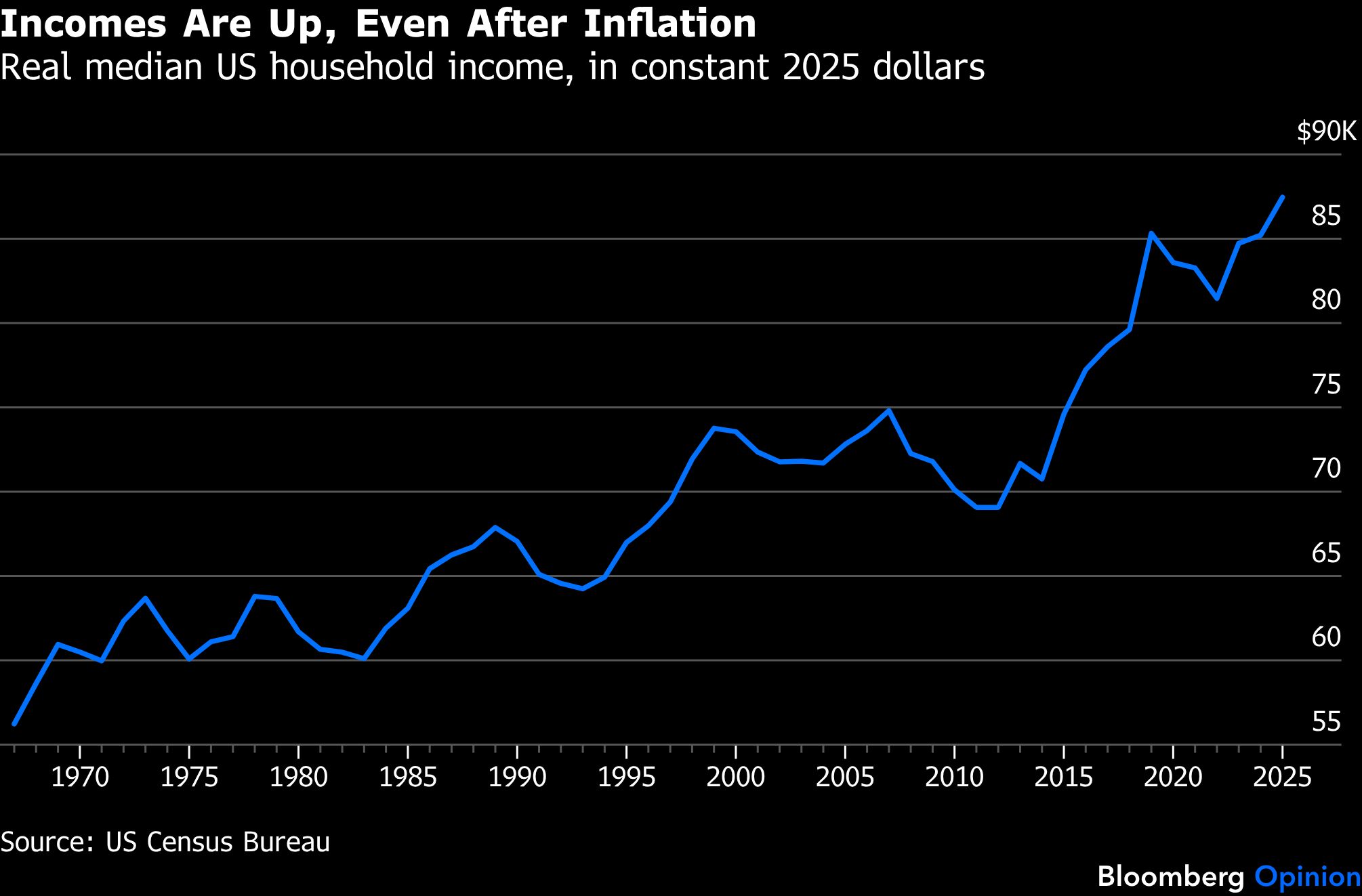
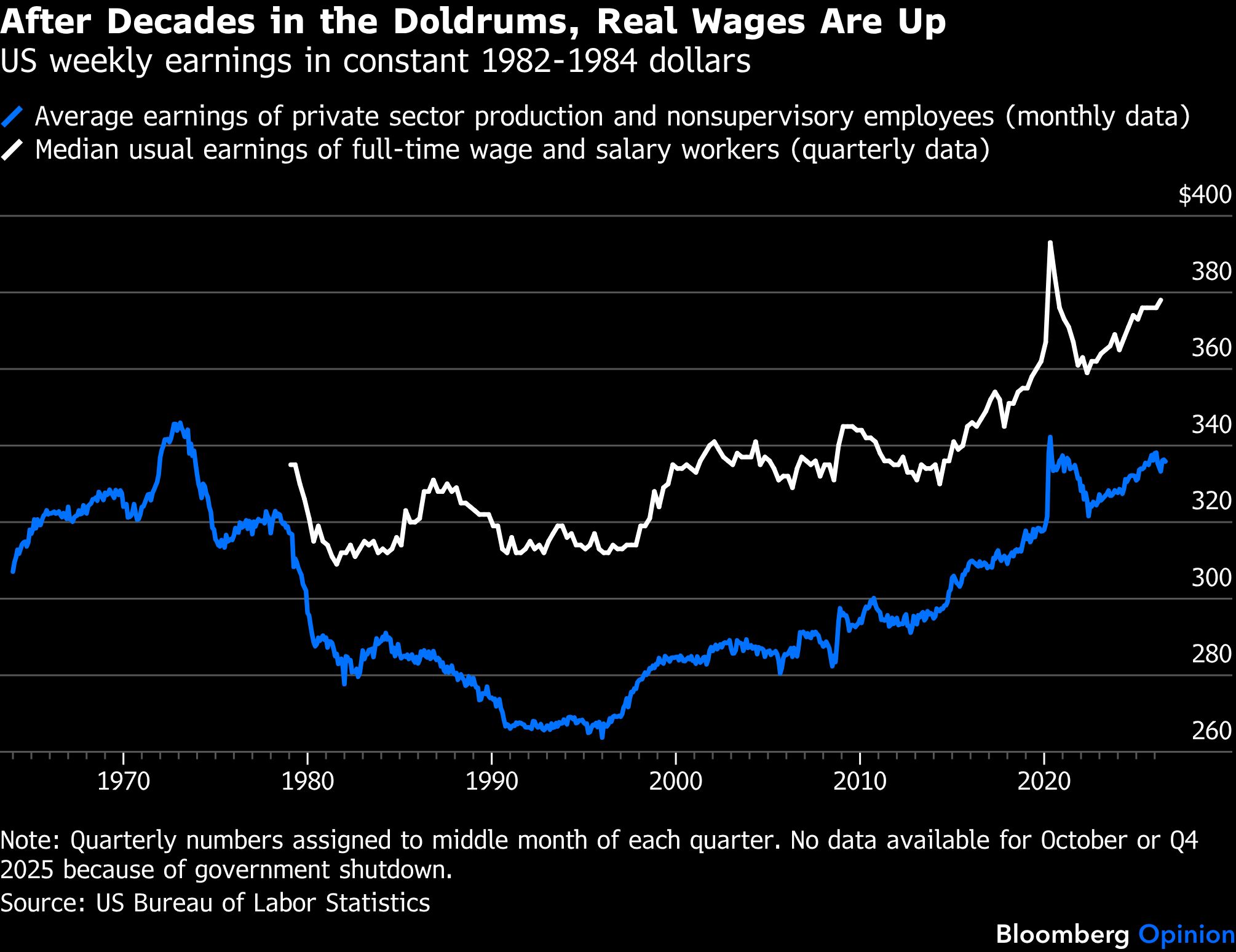
Just to be clear, this is the median income, not the average, meaning that in 2025 the same number of households made more than $87,460 as made less. When the median rises as it has since 2015 it signals that the income gains are broad-based, not concentrated at the top. The measure here is household income, and thus skewed upward somewhat by the fact that young adults — who tend to have lower incomes than their elders — have increasingly been staying at home with their parents rather than forming their own households. But real wages, which are not affected by this, have been on a similar if somewhat less steep trajectory over the past decade.
Some of the increase in both household incomes and wages can be chalked up to steady economic growth. Per-capita gross domestic product has risen at a 1.9% annual, inflation-adjusted pace over the past 10 years, which doesn’t sound like much but is better than in the 2010s (1.7%) and 2000s (0.8%) and only slightly below the 2.1% growth rate of the 1980s and 1990s and 2.2% of the 1970s.Avoiding recessions — and ensuring that the unusual pandemic-caused downturn in 2020 was short-lived — has done a lot for Americans’ incomes.
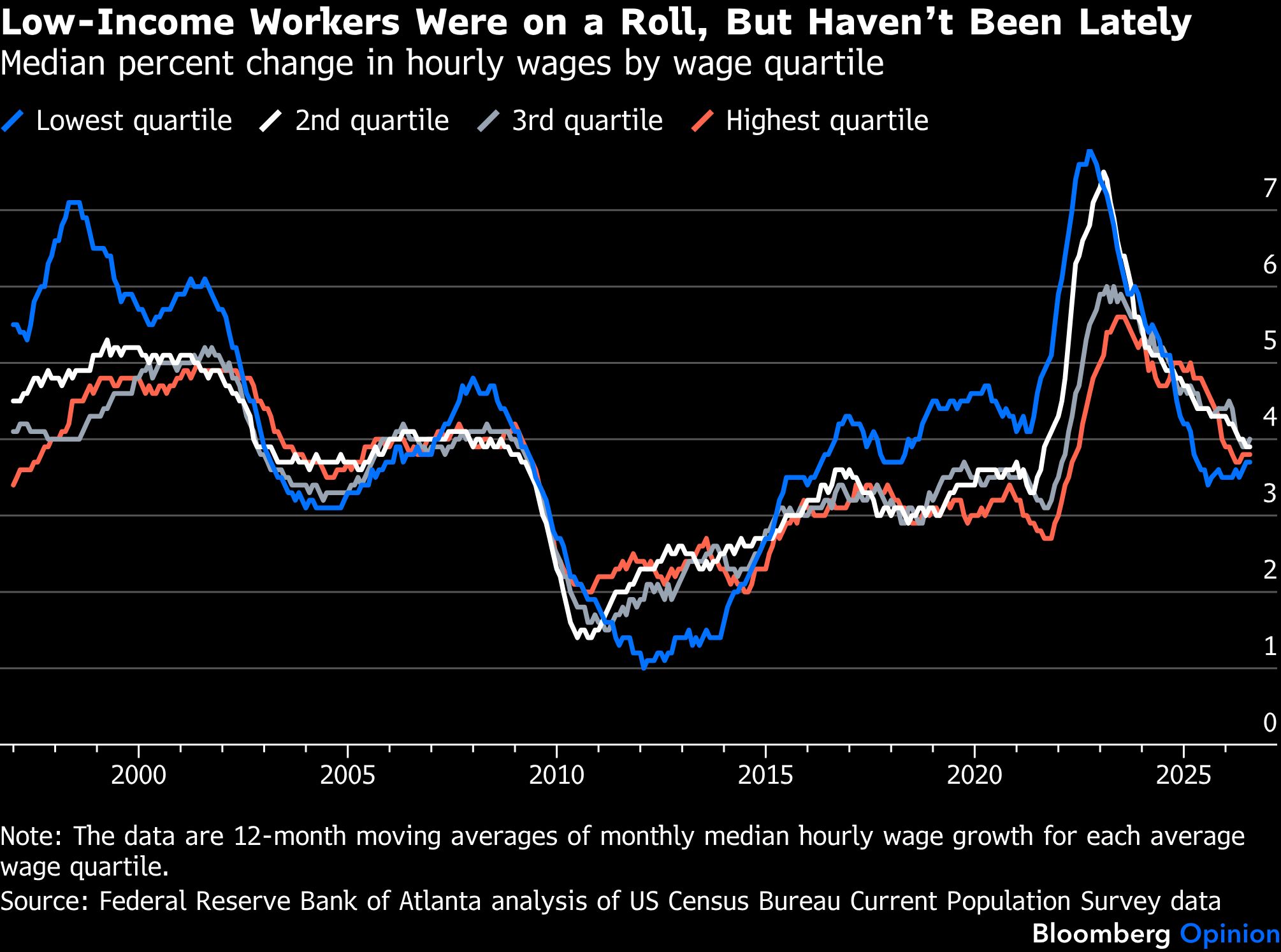
There have been some important labor-market-specific developments as well. The sharp increase in earnings in early 2020 was a byproduct of millions of low-paid service workers losing their jobs because of pandemic-related shutdowns — not a good thing. (Pre-tax median household income fell in 2020, although after-tax estimates that included federal stimulus payments showed an increase.) But the scramble to rehire these workers as the economy quickly recovered set off a positive chain of events that economists David Autor, Arindrajit Dube and Annie McGrew dubbed “the unexpected compression,” with wages growing much faster at the bottom of the income distribution than at the top.
Wage compression helped drive the rise in median earnings and incomes, and was also happening on a more modest scale in the years before the pandemic, which the economists attribute to the proliferation of state and local minimum wage increases in the 2010s. More recently this compression has stalled, with hourly wages for workers in the bottom quartile of the wage distribution rising more slowly than those of higher-wage workers since late 2024, although the gap has narrowed recently.
Since the beginning of Iran war in February, pay increases have also trailed inflation, meaning real earnings have fallen slightly. Yes, the earnings numbers have been weakening, and it’s reasonable for Americans to be cranky about this.
Harder to square with the income and earnings data is that in every month since March 2022 more respondents to the University of Michigan Surveys of Consumers have said their financial situation situation is worse than a year earlier than that it’s better, with the current ratio of negatives to positives almost as bad as during the Great Recession in 2008 and worse than at any time before then (the data go back to 1960). I suspect many respondents have gotten caught up in all the negative vibes.
The median income and wage numbers are also derived from household surveys, which could also be flawed. But the monthly Current Population Survey that’s the source of the wage data and its Annual Social and Economic Supplement from which the income numbers are derived are far bigger than any consumer confidence survey or opinion poll, and I suspect that asking for numbers delivers more reliable answers than asking if things are better or worse. Also, the average wage data comes from an entirely separate survey of employers, and has followed a recent trajectory very similar to the household-survey median wage data. Real incomes and wages really have grown.
This doesn’t mean every person is better off in every way. Even if your real income is up you may still not be able to afford a house or a car. But it’s a lot better than having incomes and wages fall.
What is to be done other than proclaiming this good news about incomes and wages? Building momentum behind a policy likely to bring more such good news seems like a promising first step. While many economists long assumed that minimum wage increases destroyed jobs, empirical research enabled by the wave of state and local experiments since 2013 has established that the job losses have been minimal. This indicates that the federal minimum which has been stuck at an increasingly meaningless $7.25 per hour since 2009, could be increased and boost incomes with little collateral damage. Such an increase would also be popular, with Democrats, independents and even, as long as it’s on the small side, Republicans. Politicians sincerely interested in combating economic negativity ought to embrace it.
A message from Advisor Perspectives and VettaFi: Discover something new! Click here to register for our upcoming webcasts.
Bloomberg News provided this article. For more articles like this please visit
bloomberg.com.
Read more articles by Justin Fox