Larger asset managers including Goldman Sachs Group Inc. have been looking to snap up CLO management businesses as they hunt for lucrative fee streams in the $1 trillion US market.
The once-torrid growth in collateralized loan obligations has been slowing and profit margins have thinned, turning the existing stable of CLO firms into juicy takeover targets for larger rivals. A subset of smaller managers has particular appeal: While those small firms aren’t churning out a lot of new CLOs anymore, they’re still collecting fees on the ones they’ve already created.
“If you’re a small- to mid-sized CLO manager and don’t have a parent or key equity investor, and haven’t raised a captive equity fund, it has been difficult to issue CLOs,” said Ian Gilbertson, co-head of US CLOs at Invesco. But “the management fee stream is real,” he said, and “CLO businesses are very scalable.”
See more: Why Active CLO ETFs Can Shine as PCE Data Cools
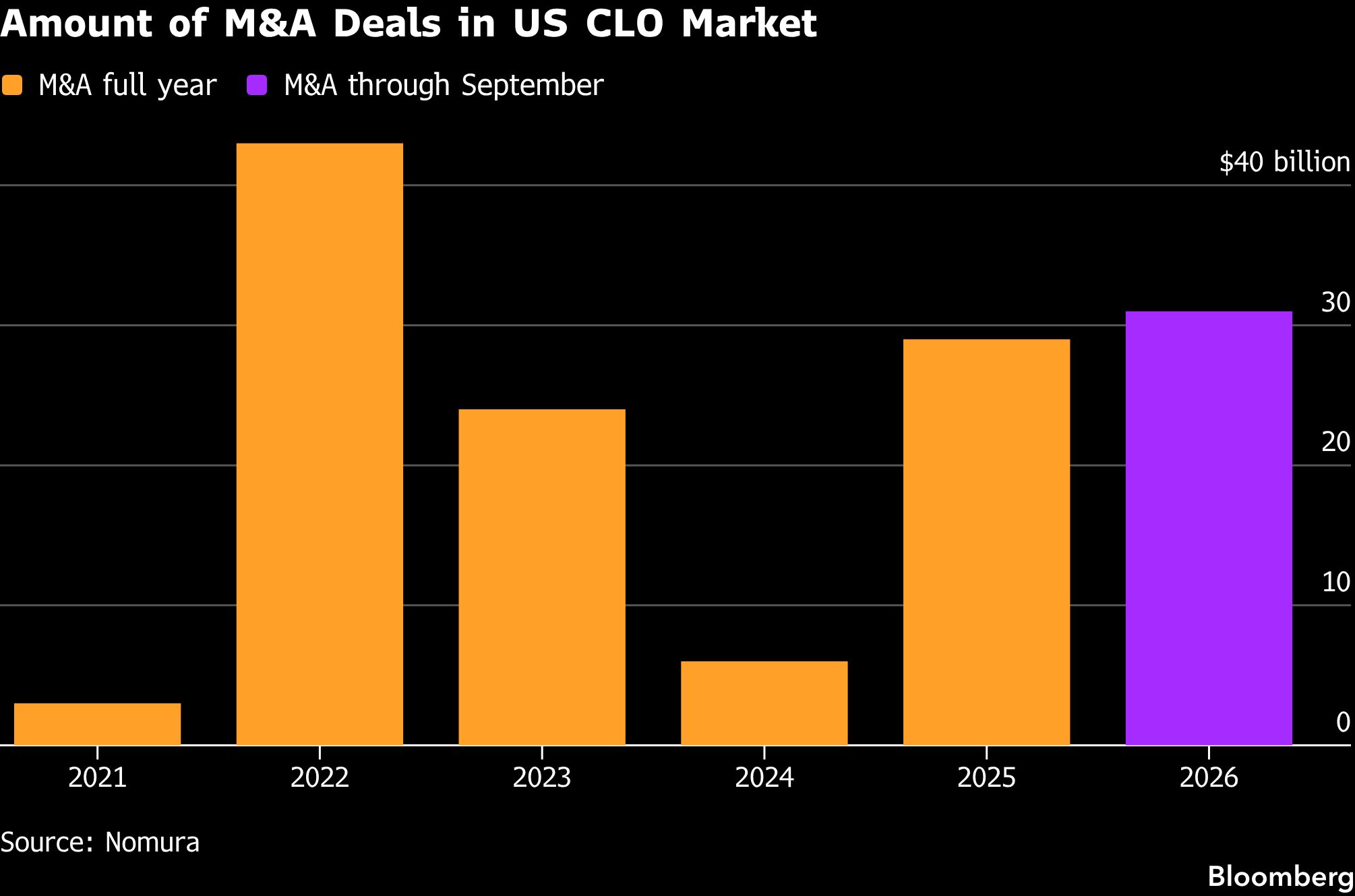
Some $30 billion of corporate M&A activity involving CLOs has taken place so far this year, already the highest since 2022, according to Nomura. The tally could leap higher if $37 billion credit manager Palmer Square is sold to Goldman Sachs or other bidders. Bloomberg reported previously that the firm is up for sale.
Palmer would be an outlier in the M&A trend because it’s among the bigger CLO managers and the firm is more self-sufficient when it comes to lining up fresh cash.

CLOs are bonds backed by pools of hundreds of small portions of corporate loans. Unlike most securities, the vehicles are actively “managed” by a designated company — typically, the same firm that issued it — after being created. In exchange, managers are compensated with fees based on the amount of the underlying assets as well as their performance.
But profit margins on the riskiest portions of CLOs, known as equity, have been driven down to vanishingly small levels. As a result, larger firms now have an advantage. Big CLO firms nowadays frequently raise their own in-house “captive equity” funds, bypassing the onerous step of persuading outside investors to back each new deal. That makes it easier to keep lots of CLOs in the market — and harvest the fees they throw off.
Recent Deals
Recent deals include Clearlake Capital Group’s assumption of management for more than $5 billion of CLOs overseen by LCM Asset Management, and asset manager Anchorage Capital Advisors’ purchase of $4.7 billion worth of CLOs from Signal Peak Capital Management, a platform owned by Japanese investment firm Orix.
Clearlake, Anchorage and Orix declined to comment. Orix looked to sell in part because Signal Peak’s focus on liquid markets was no longer aligned with the asset manager’s focus on private markets, according to a person familiar with the matter who asked for anonymity to discuss the private transaction.
But the hunt for fees isn’t limited to smaller managers. In August, for example, Victory Capital struck a deal to acquire First Eagle Investments, which runs a $41 billion CLO and alternative credit platform.
Goldman Sachs declined to comment. Palmer Square and Victory Capital didn’t immediately respond to messages.
Palmer Square’s sale would rank as one of the largest CLO corporate deals in years. For Goldman, which was reported to be among the most interested bidders, there’s obvious appeal. The bank has been looking to bolster its asset management business, according to a recent note by Morningstar.
A message from Advisor Perspectives and VettaFi: Discover something new! Click here to register for our upcoming webcasts.
Bloomberg News provided this article. For more articles like this please visit
bloomberg.com.
Read more articles by Scott Carpenter