Higher-for-longer interest rates are forcing buyout firms to face facts. Struggling since 2023 to sell companies purchased in the long decade of ultra-cheap debt before the Covid pandemic, they’ve tried to placate investors with clever financial engineering to help keep some money turning over. But after several false dawns for a return to low rates, the classic private-equity leveraged deals industry is moving into the final stage of grief over its prospects: acceptance.
Executives in the sector are beginning to admit openly that returns will fall short of what was promised for a lot of existing funds, and especially those that did most of their deals between 2017 and 2021. Investment lifespans are extending well beyond the three-to-five years that used to be the norm. In the US alone, $860 billion, or more than 40% of total buyout assets, is tied up in companies that have been owned for more than seven years, according to Pitchbook, a data company.
Industry leaders need to do something. With leveraged deals gummed up, new fundraising has been hurt for the past couple of years. It’s a pain for the industry’s rainmakers, too. Poor capital returns mean they’re not getting paid the fat bonuses they expected, driving some managers to quit the sector in search of more fulfilling and enriching work elsewhere.
Major buyout firms have already been expanding into new business areas, and I expect more to start playing down the importance of the funds that made their names. Apollo Global Management Inc. was one of the first to make a big breakaway from its private-equity roots, focusing instead on less risky private loans created for its life insurance business. Chief Executive Officer Marc Rowan now revels in the fact that buyout funds make up just 8% of the group’s total assets. Longtime rivals such as KKR & Co Inc. and Blackstone Inc. also have been buying or working with big life and annuity businesses to follow the same path.
See more: The Private-Market Liquidity Gap Advisors Can Close
The unusually favorable conditions before Covid allowed a lot of firms to grow dramatically and many new ones to emerge. Plenty turned out to be more dependent on 0% rates than on anything else. In the view of Scott Kleinman, Apollo’s co-head of asset management, many firms will fall away, and what’s left of private equity could evolve into an industry of long-term manager-owners of companies that are more stable, produce good cash flows and are much less burdened by debt. Investments could be held this way for decades, Kleinman said this month at a conference run by Barclays Plc.
But in a sense, this is just recognizing how the world already is. Many investments have been in buyout funds more than 10 years. The human resources company UKG (formerly Kronos Inc.) has been owned by Hellman & Friedman for nearly two decades, and there are no plans to sell it soon, according to Bloomberg News.
Another view is that many former startups in technology and other sectors will just stay private indefinitely rather than pursuing a place in stock markets through an initial public offering, which used to be almost every entrepreneur’s aim. SpaceX Inc. completed a record-breaking listing this year, but companies like Stripe Inc., an online payments outfit worth $159 billion, show no signs of interest in going public. (Stripe co-founder John Collison, in a CNBC interview, called an IPO “a solution in search of a problem.”)
This feeds into an idea being peddled in financial circles that private equity isn’t just about buyouts, but also about equity that simply happens to be private. It’s a neat little turn of phrase that may help alter perceptions. However, managers extracting their usual high fees will still need to convince investors that there is something in this for them.
Blackstone had an unsuccessful run at this argument recently with an attempt to repackage the awkward remnants of geriatric buyout funds held by one of its older secondaries funds into a shiny new box known as a collateralized fund obligation. The aim was to buy stakes in the funds from existing investors using money mainly from issuing bonds that would pay a steady income to the holders. It’s similar to how mortgages are turned into supposedly safe debt through securitization. Unfortunately for Blackstone, despite months of work it couldn’t drum up enough interest and abandoned the deal last week.
Even where managers have been selling companies, in recent years they’ve often been selling them to each other, which is another way businesses stay private. Almost one-third of exits are so-called sponsor-to-sponsor deals, according to data from Bain & Co, a consultancy.
Without solutions, the buyout business is going to see ever growing numbers of zombie funds, where a manager can’t sell the last of the assets or return investors’ cash but continues collecting management fees that help keep the fund’s lights on. More than half of private-equity investors in a survey this summer expected a proliferation of the walking financial dead over the next two years.
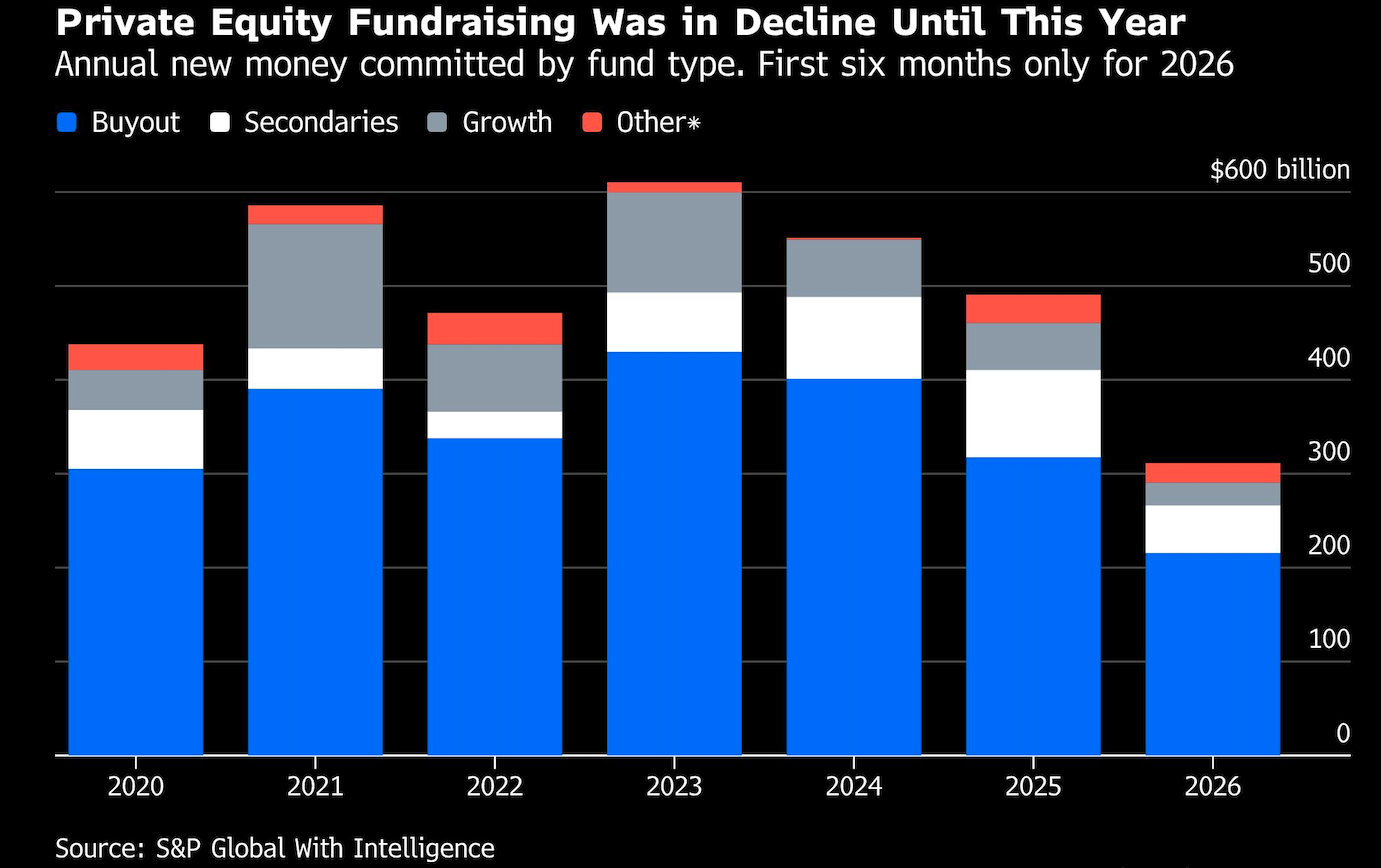
It is tempting to say here that the whole buyout industry faces a long, slow death. The counter argument is that fundraising has picked up this year and is looking stronger than the past two. The $216 billion committed to buyout funds in the first six months of 2026 is more than half the full-year totals in each of 2025 and 2024, according to S&P Global’s With Intelligence.

However, there are changes behind these numbers, too. The 20 biggest funds captured more than half the money raised this year, and much more cash is going to funds that are allowed to hunt for deals in several regions rather than sticking to just North America, say. And as in other recent years, a good share of new capital is going to firms that specialize in buying old private-equity stakes through secondaries funds.
The buyout business bloomed in the decades when interest rates were on a long and steady decline to the rock-bottom levels where they stayed for years. In today’s world of trade shocks, excessive government debt and persistent inflation, borrowing costs are rising and likely to stay elevated. Private equity won’t die completely, but the firms that survive will look very different.
A message from Advisor Perspectives and VettaFi: Discover something new! Click here to register for our upcoming webcasts.
Bloomberg News provided this article. For more articles like this please visit
bloomberg.com.
More Alternative Investments Topics >