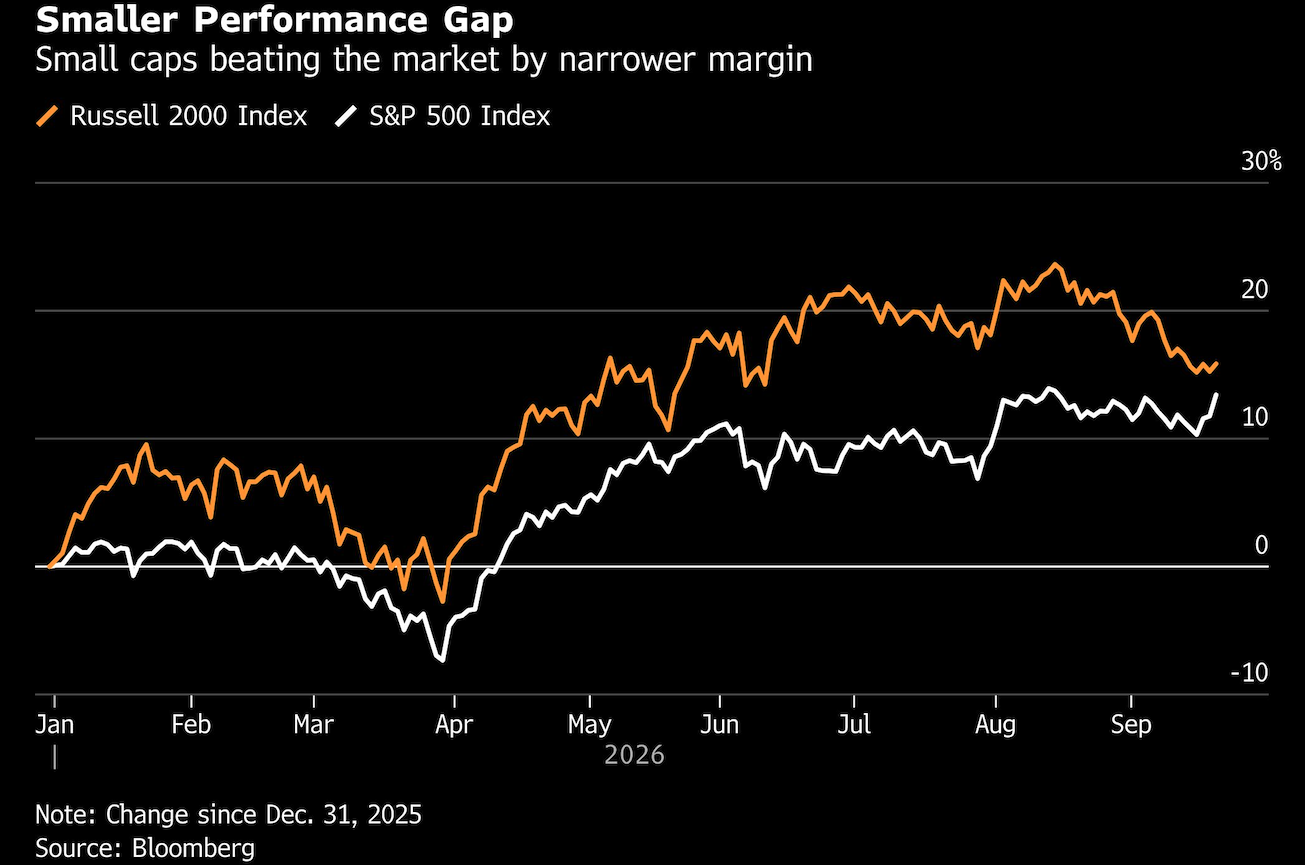
For most of this year, investors have flocked into small caps to diversify away from the concentrated AI trade. Rising interest rates are threatening to put a damper on that.
The Russell 2000 Index has already narrowed its lead over the S&P 500 this year from 11 percentage points in June to just 2 percentage points this week. Now, with the market pricing in more hikes and worries growing that the process of taming inflation will be painful, the path forward is looking fragile for small-cap companies already saddled with the reputation of being among the riskiest groups of stocks.
“The largely performative hikes are neither apt to impede earnings as the driver of S&P 500 gains nor to significantly deter inflation,” Lisa Shalett, CIO at Morgan Stanley Wealth Management, said in a note to clients. At the same time, she sees “marginally cooler growth in already-weak areas, such as housing, regional bank lending and small caps.”
“The implication is that some equity market broadening is apt to fade, again giving way to a concentrated, AI/Magnificent Seven-oriented tape and a renewed sense of economic imbalance,” she added.

See more: The Case for Small-Cap Investing: A Cyclical Story, Not a Broken One
Already, the Russell 2000 has breached its 50- and 100-day moving averages, while larger equity benchmarks continue to trade above their support levels. Despite Monday’s rally, the small-cap index remains 2% below its 100-day average. Yet even after the recent weakness, the Russell 2000 is on track for its best year in a decade relative to the S&P 500.
“We’ve been in a period where low-quality small-caps were what was working for about a year and a half, and that performance got very extended,” said Jill Carey Hall, Bank of America Corp.’s equity and quant strategist. She urged investors to “avoid more levered and rate-sensitive small caps given the Fed is hiking.”
That won’t be easy. Some of the most successful, highest-quality names have been rebalanced out of the index, leaving the average stock in the group smaller and more sensitive to a rate-hiking cycle.
Bloom Energy Corp., Credo Technology Group Holding, Sterling Infrastructure Inc. and TTM Technologies Inc. collectively accounted for two-thirds of the Russell 2000’s advance through June 29, when they were all moved to the Russell 1000 Index.
“It was a bit more concentrated than usual,” Carey Hall said of the first-half, small-cap performance. From here, she expects mid caps to outperform small caps given the recent index rebalance and rising interest rates.
Moreover, multiple stocks that had been beneficiaries of the AI trade were also among those moved out of the Russell 2000, including Credo Technology Group Holding Ltd. and Fabrinet.
“With both the rates backdrop and AI composition effects becoming less supportive, we continue to see downside risks for small caps,” said Barclays Plc strategist Stefano Pascale. He recommended investors hedge against the “big rate bites” for small caps with bearish Russell 2000 put spreads.
Stefano traced the narrowing performance gap between large- and small-cap stocks to the release of the FOMC meeting minutes in July, which pushed traders to re-price their interest rate expectations.
To be sure, optimism over a strong pace of earnings growth in the Russell 2000 Index has overshadowed concern about rising rates for most of the year. Small cap stocks just posted their fastest quarter of earnings growth since 2022, data compiled by Jefferies show.
JPMorgan Chase & Co.’s Andrew Tyler is among those preferring to stay away from small caps, at least for now. The bank’s head of global market intelligence maintains a preference for larger stocks with “small caps still pressured,” he said in a note to clients on Monday. Tyler noted that fund flows from professional money managers show more risks to the Russell 2000 than to the S&P 500 and Nasdaq 100.
The Russell 2000 gained 0.5% on Monday, trailing the gains in the S&P 500 and further shrinking the performance gap between small and large stocks this year.
“Small caps have clearly lost their leadership position in the market,” said Jeff Jacobson, head of derivative strategy at 22V Research.
A message from Advisor Perspectives and VettaFi: Discover something new! Click here to register for our upcoming webcasts.
Bloomberg News provided this article. For more articles like this please visit
bloomberg.com.
Read more articles by Geoffrey Morgan