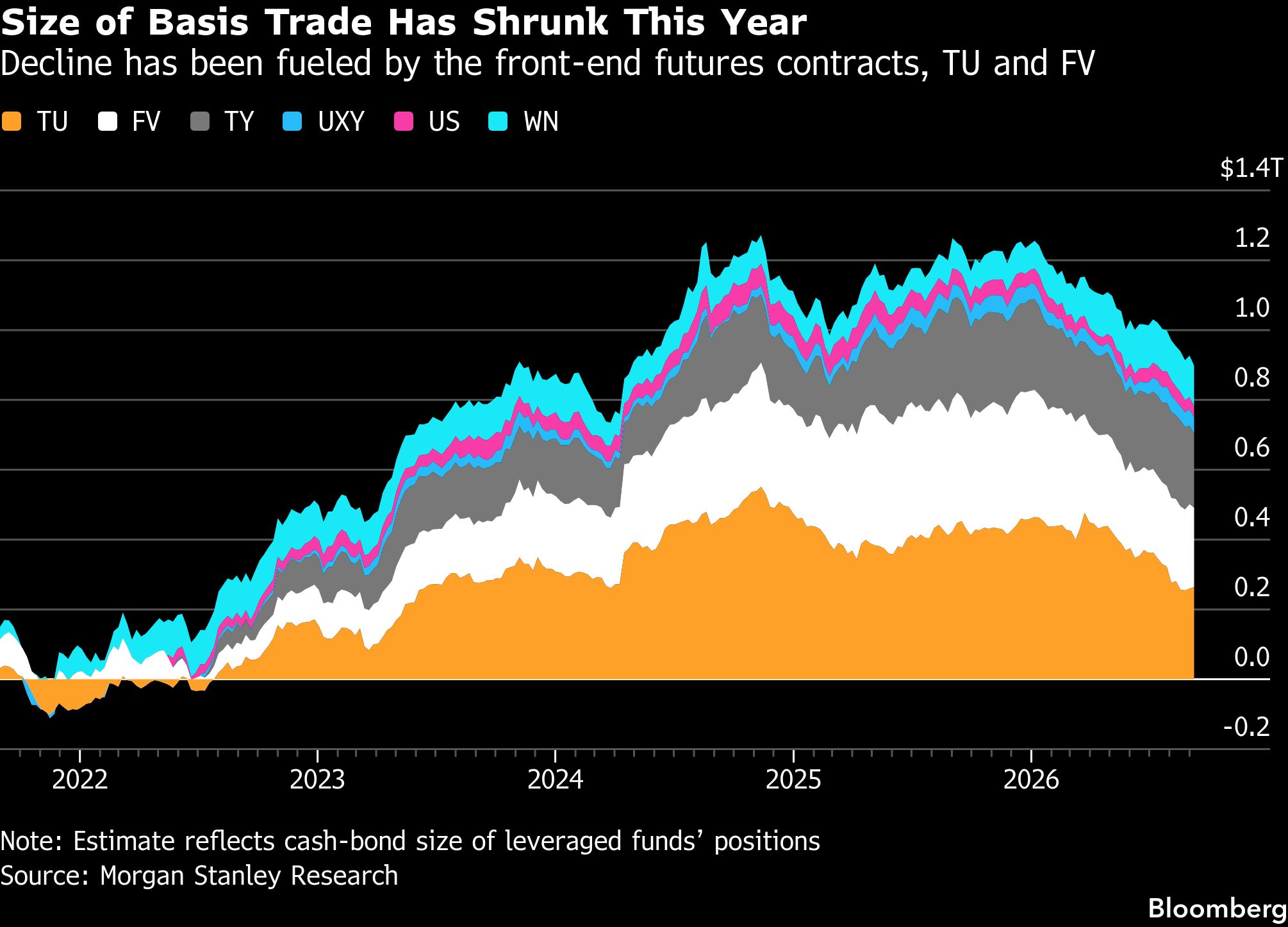
A popular trade in US Treasuries has shrunk to its smallest size in over two years, in what Wall Street strategists say reflects fewer dislocations in the bond market for hedge funds to exploit.
The strategy, known as the basis trade, helps generate demand for Treasuries and provide liquidity in the $32 trillion market. It involves wagering on the small price difference between Treasury bond futures and the underlying securities, using heaps of borrowed cash to scale up the bet.
As these gaps are narrowing, the trade has been losing steam, potentially depriving the market from a key source of funds. While sudden pullbacks in liquidity have sparked disruptions in financial markets in the past, strategists from banks including Morgan Stanley and Citigroup Inc. said the trade is far from disappearing and the change in momentum merely reflects reduced relative-value opportunities.
See more: Has the Bond Market Already Done the Fed's Job?
“Basis books are declining as dislocations and volatility have fallen materially over the past few years,” Jason Williams, Citi’s head of US rates strategy, said. “Rather than signaling risk, the shrinking opportunity set suggests that underlying Treasury demand may be stronger than we think.”
By Morgan Stanley’s count, the total notional size of leveraged investors’ Treasuries basis trades has fallen to around $900 billion from $1.26 trillion at the start of the year.

The drop reflects less-attractive returns in contracts linked to short-dated Treasuries due to a smaller arbitrage opportunity, a Morgan Stanley team led by Eli P. Carter wrote, noting that basis trades between longer-duration bonds and futures remain popular. The strategists see no evidence of market stress as a result of the reduced activity.
As it has grown in size, the Treasuries market has increasingly relied on hedge funds to provide the liquidity to keep markets operating smoothly. Their favorite strategy in recent years has been the basis trade, where such funds typically buy cash bonds and sell corresponding futures contracts.
The strategy’s popularity has sparked warnings from regulators over the years about the risks of abrupt shifts in demand. This was evident in March 2020 when hedge funds furiously unwound basis trades in the face of market turmoil. Markets were only stabilized after bond-buying and repo interventions from the Federal Reserve.
Read more: Death of the Basis Trade Is Treasury’s P(Doom): MacroScope
A period of extreme Treasury market volatility or stress in short-term markets could cause a potential unwind of hedge funds’ basis trade positions, the Morgan Stanley strategists wrote. However, they said they are “comfortable with the trade’s current resilience,” citing its stability during recent periods of turbulence while the repo market is currently flush with cash.
Rather than a market shock, more benign factors are at play. The trade is predicated on a tendency for Treasury futures to trade at a premium to the cash market, a byproduct of asset managers’ preference to take on interest-rate risk using derivatives instead of the underlying bonds. Uncertainty over which bond will be the cheapest to deliver — the Treasuries that are the least costly to settle expiring futures contracts — can also create opportunities.
This year, asset managers decreased their net long positions in shorter-maturity Treasury futures contracts, according to Commodity Futures Trading Commission data, as the outlook for the Federal Reserve’s monetary policy flipped from expectations for interest rate cuts before the war on Iran to hikes after oil prices surged. With less demand for Treasury futures, their gap to the underlying bonds narrowed.
“Weaker asset-manager futures demand has reduced the underlying arbitrage opportunity,” the Morgan Stanley team said.
Carter said the decline in basis-trade positions has been largely contained to the two- and five-year areas of the Treasury curve. For the futures contract tied to Treasuries maturing in 25 to 30 years from now, basis positions have increased, signaling no “evidence of impaired hedge-fund Treasury demand or broader stress in the basis trade.”
Citi’s Williams said changes in the net supply of Treasuries, with the Treasury Department buying back off-the-run bonds and the Fed stopping its quantitative tightening program, also curbed arbitrage opportunities.
That’s on top of a growing willingness by banks to hold bonds. Increased demand for Treasuries helps keep any dislocation between Treasury futures and the underlying securities in check, reducing the appeal of the basis trade.
“The trade has done its job superbly and is naturally self-correcting,” said Agha Mirza, global head of rates and OTC products at CME Group Inc. “The reduction in trade size due to relative-value economic reasons does not impact the broader level of yields.”
A message from Advisor Perspectives and VettaFi: Discover something new! Click here to register for our upcoming webcasts.
Bloomberg News provided this article. For more articles like this please visit
bloomberg.com.
Read more articles by Greg Ritchie