The midterm election season has entered its final stretch, and Wall Street is busy drawing up game plans for a range of scenarios. Yet, in a fortuitous turn of events, the best outcome for markets is also looking like the likeliest one.
Investors have become increasingly confident that Democrats will take the House of Representatives in November, while assigning a slight edge to Republicans in the Senate. To many market watchers, this is the ideal setup with least risk of disruptive policies.
While confidence in that outcome is not unfounded, it’s far from guaranteed. Democrats are by far the predictions markets’ favorites to take control of the House. The Senate race, however, has grown tighter, with Republicans currently narrowly ahead on Kalshi and Polymarket.
See more: What the 2026 Midterms Could Mean for the Markets
“Investors are expecting a split Congress,” said Brian Gardner, chief Washington policy strategist at Stifel. “If that is the outcome and Democrats kind of do what they have to do to win the House but don’t have a wave election, I could see a bit of a relief rally after that.”

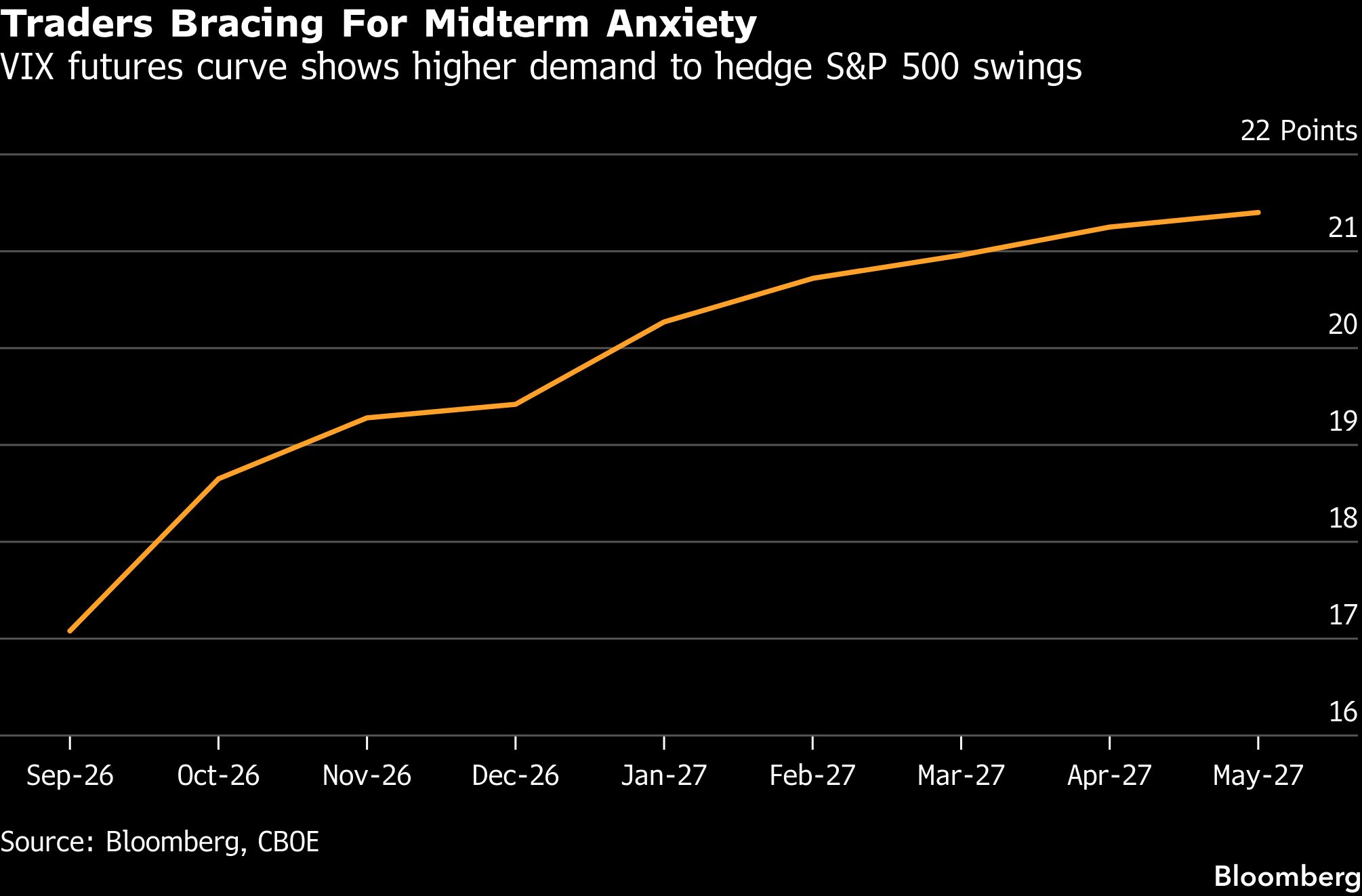
In the meantime, Wall Street is bracing for some jitters around the midterm elections. The futures market tied to the Cboe Volatility Index, or VIX, is showing signs of higher demand to protect against volatility in the S&P 500 Index in early November.
Evercore ISI recommends traders to position for potential swings in the market through a so-called straddle on the State Street SPDR S&P 500 ETF Trust. The options strategy that allows traders to benefit from big moves — both up and down — without making a directional bet would involve buying both bullish and bearish options expiring in November with a strike price of $770.
That position is attractively priced because the VIX is sitting well below its long-term average, despite the potential for big-picture forces to push stocks higher or lower, said Julian Emanuel, a strategist at the firm. “Surprise is drastically underpriced.”
When it comes to election results, Wall Street’s thinking is that with different parties at the helm in the two chambers, the likelihood of drastic policy changes — be it in artificial intelligence, defense or healthcare — will be lower. That would mean less uncertainty for the markets.
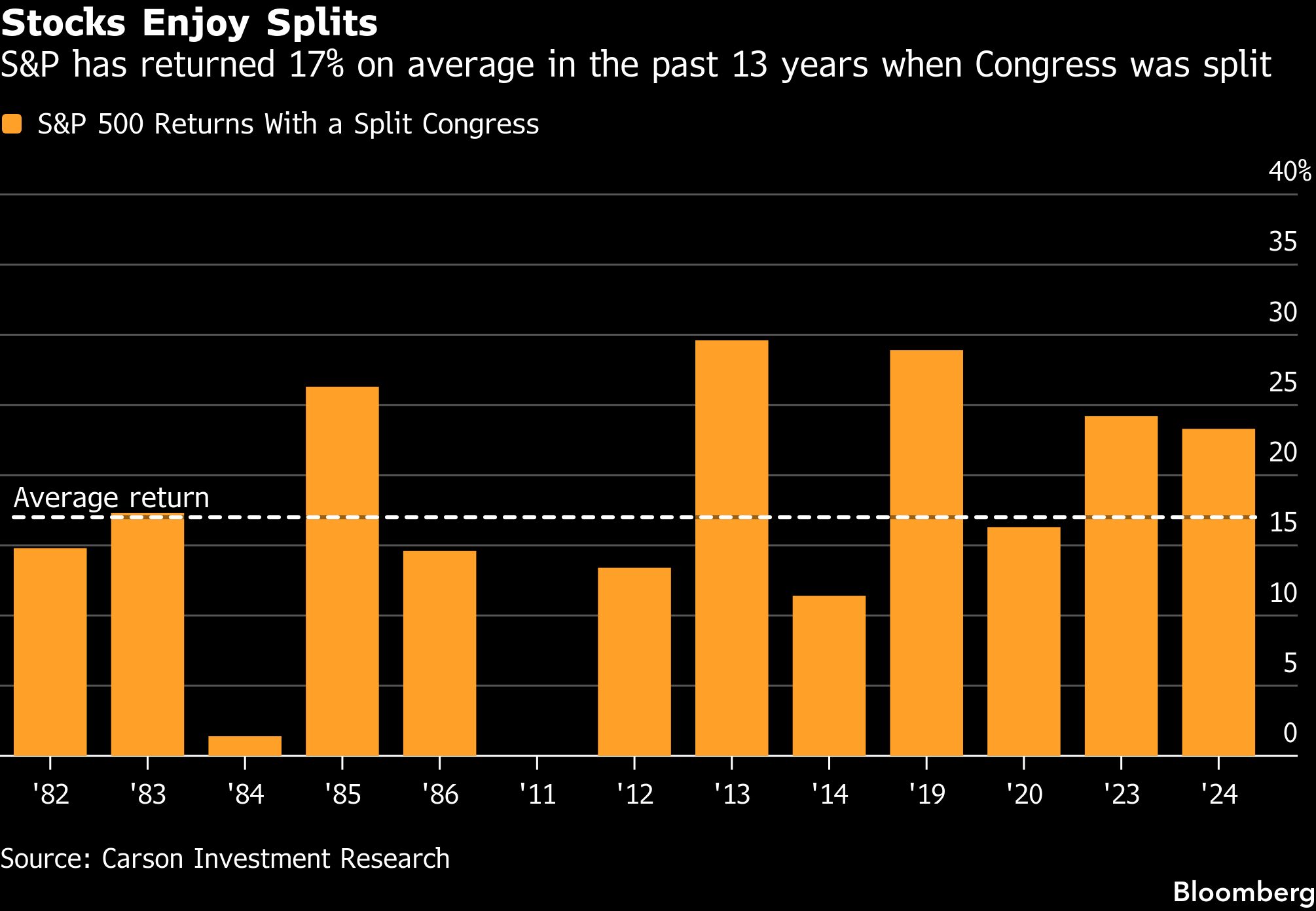
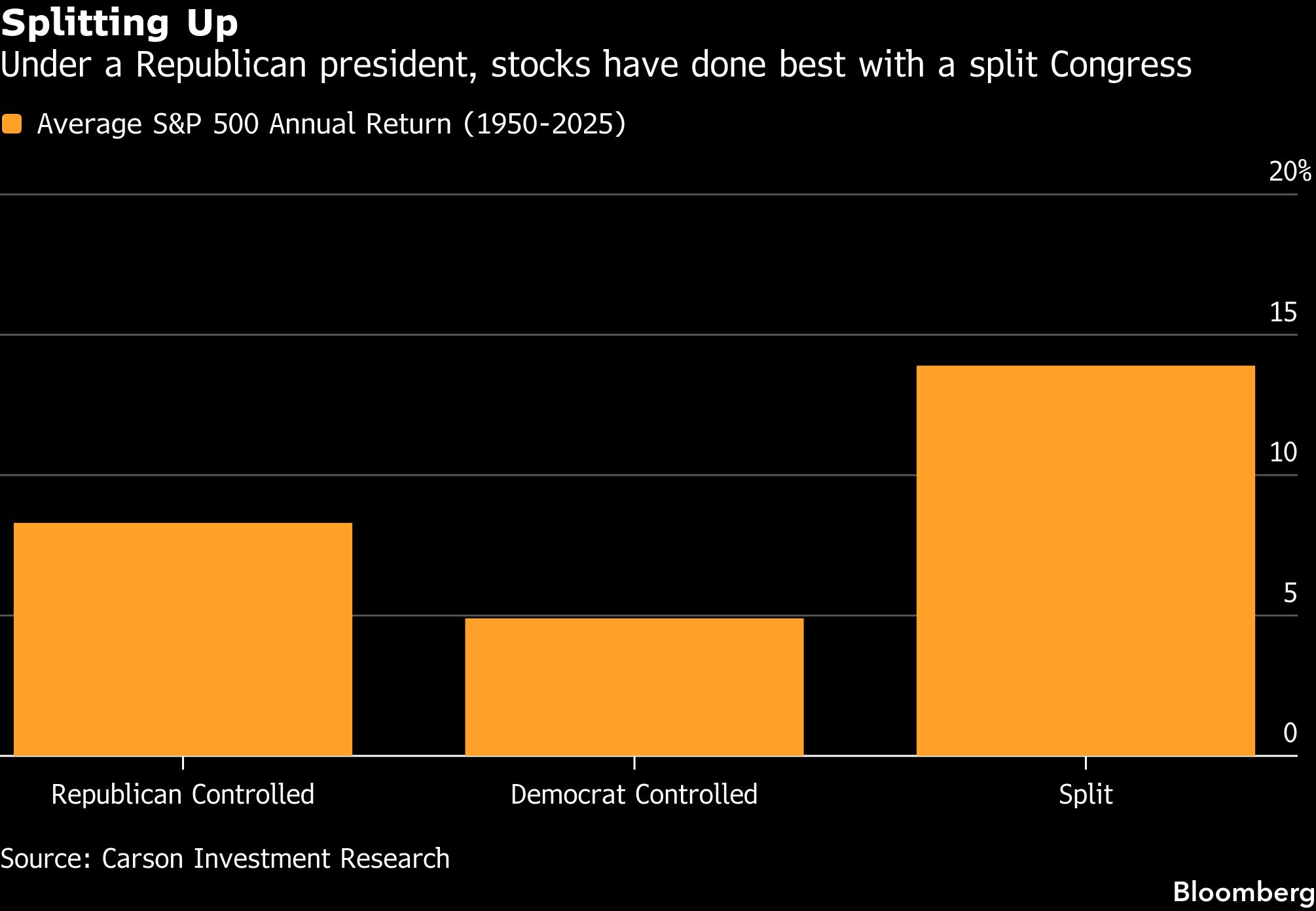
A divided Congress has been a welcome development for US stocks in the past. Under a Republican president and a split Congress, US stocks have advanced 13.7% per year since 1950, data compiled by Carson Investment Research show. That compares with a gain of 8.3% and 4.9% when the Congress was controlled by Republicans and Democrats, respectively.
AI has steadily risen to prominence as one of the standout issues of this election season, amid growing backlash against datacenter buildouts. That’s forced investors to reckon with rising regulatory risks around the technology at the epicenter of a four-year bull run in US stocks.
A split government would “force either gridlock or compromise,” said Stuart Kaiser, head of US equity trading strategy at Citigroup Inc., noting that it would be both the most likely and most positive outcome. “In that case, policy choices would be moderated, allowing equity markets to focus on corporate and economic fundamentals,” Kaiser wrote in a note to clients earlier this week.
Kaiser recommends taking bullish positions in the S&P 500 Index or the Invesco QQQ Trust for exposure to technology companies’ surging earnings and the easing of election-related risk premium.
JPMorgan Chase & Co.’s Delta One trading desk points to stocks that are levered to the Affordable Care Act as an opportunity in the event of a split Congress. The desk also sees traditional defense companies benefiting, as it is currently a bipartisan priority.
What If
The building consensus for a split Congress creates a risk of a major swing in the stock market if expectations suddenly swerve toward a sweep by either party.
There is at least some possibility of Democrats winning both chambers. While President Donald Trump remains the biggest draw for Republicans, his record-low approval ratings are a big liability for the party heading into November. Republicans are hoping a midterm convention — informally dubbed “Trumpapalooza” — can stave off the kind of losses that defined Trump’s first term.
Last month, Bank of America Corp. strategists led by Michael Hartnett said a strong showing from Trump’s party and re-election of Greg Abbott in Texas would be particularly positive for the AI trade. On the other hand, Hartnett sees a “big slump” facing stocks should Democrats take the Senate and unseat Abbott.
To that end, a Republican sweep would likely help sectors that would thrive from further deregulation, according to Rayliant’s Phil Wool, who outlined energy and financials as potential beneficiaries. A blue wave, meanwhile, could boost renewables and healthcare providers.
Then there are some who are treating the midterms as only a blip.
While political outcomes may always create uncertainty to the dismay of clients, most of the results tend to have little impact on long-term outcomes for the market, said Omar Aguilar, chief executive officer at Schwab Asset Management. Certain sectors will be more volatile than others, but that is an opportunity for repositioning portfolios in the longer term.
“Clients are paying attention, the same way they’re paying attention to $100 oil,” said Aguilar. “Does that mean that they had to change their strategy? Our advice is always no, just continue to weather.”
A message from Advisor Perspectives and VettaFi: Discover something new! Click here to register for our upcoming webcasts.
Bloomberg News provided this article. For more articles like this please visit
bloomberg.com.
Read more articles by Joel Leon, Matthew Griffin