A chorus of investors is urging Federal Reserve Chairman Kevin Warsh to express a strong determination to deal with high inflation to boost the long end of the Treasury market.
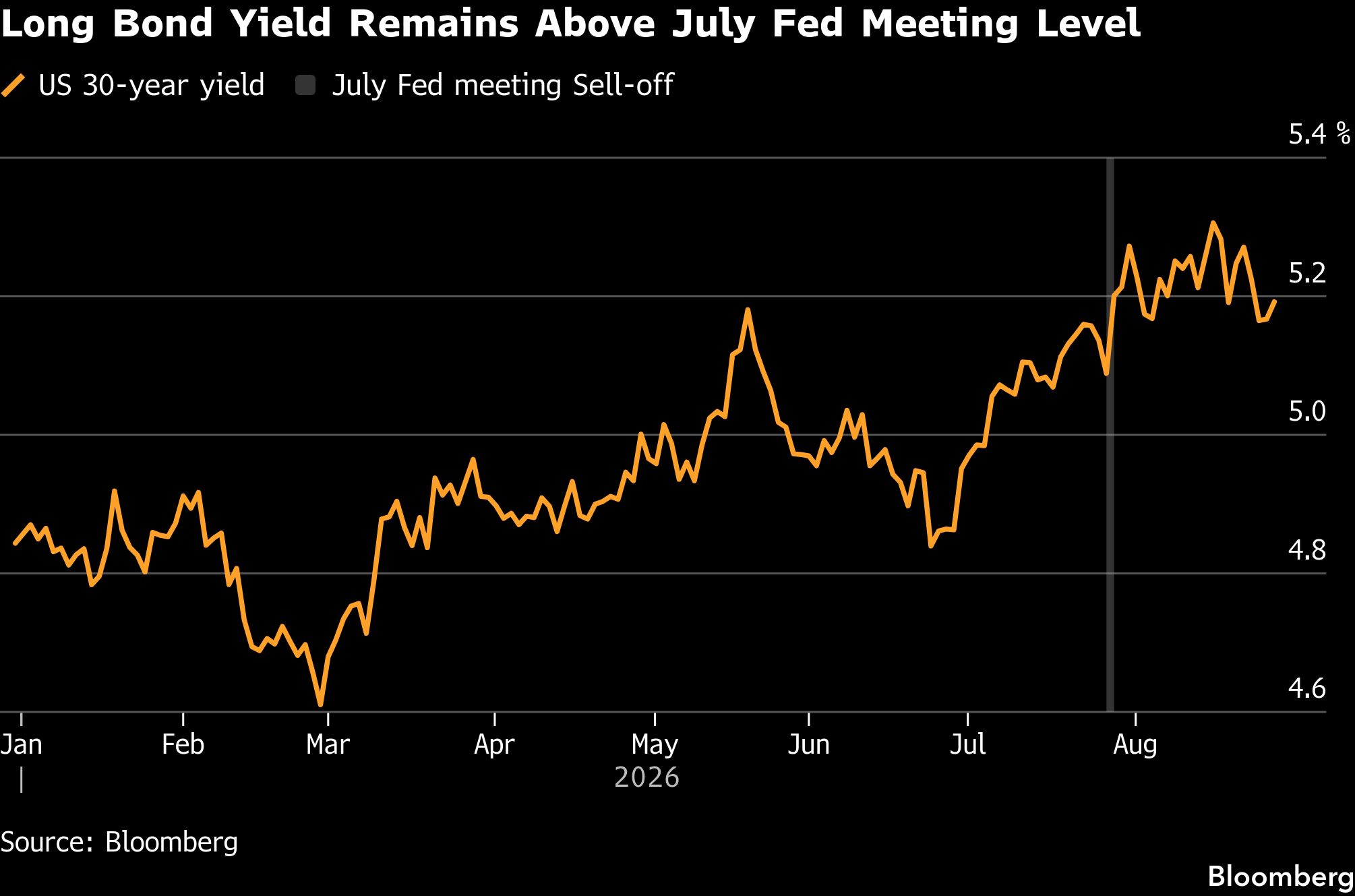
Showing a clear commitment to price stability in his Jackson Hole speech on Friday may trigger buying of US 30-year bonds, whose yields hit the highest since 2007 last week. Such a move would also aid Treasury Secretary Scott Bessent’s mission to stop a selloff in longer debt and manage the country’s ballooning interest burden.
Fed watchers at JPMorgan Chase & Co., Apollo Global Management Inc. and Morgan Stanley say Warsh has a chance to convince the market that managing inflation is his priority.
If he can, then “some of the angst on Fed credibility will reduce,” said Priya Misra, a portfolio manager at JPMorgan Investment Management.
See more: Two Measures of Inflation: July 2026
That makes his Jackson Hole speech a pivotal early test for the chairman, whose evasive communication style has baffled investors and raised doubts about how dedicated his central bank is to controlling price growth.
Treasuries were steady early on Friday, with policy-sensitive two-year yields up about one basis point.
US inflation has floated above the Fed’s 2% target for the past five years and 30-year Treasury yields have sat above the key 5% level for the last two months despite Bessent’s interventions, which include a plan to buy back long bonds. Persistently high borrowing costs have weighed on the US housing market, private equity firms and small businesses alike.

Warsh’s speech comes as views diverge among Fed officials on the need for higher rates. Boston Fed President Susan Collins said on Thursday that there’s still evidence the central bank’s current policy setting is mildly restraining the economy and helping to slow inflation.
Cleveland Fed President Beth Hammack, one of the officials who dissented against last month’s rate decision, reiterated Thursday that policymakers should act now to contain inflation because rates are not slowing the economy enough for price pressures to cool on their own.
Preferred Measure
US personal consumption expenditures, the Fed’s preferred measure of inflation, rose 3.7% from a year earlier in July. Inflation, which erodes the purchasing power of the fixed payments from bonds, remains well above the central bank’s 2% goal.
At the same time, the closely followed New York Fed gauge of term premium, a measure of how much extra compensation investors demand to shoulder the risk of owning longer-term US debt, is trading near levels last seen in 2014.
“If the Fed is focused on inflation, term premium should get crushed because now the Fed is a lot more credible,” said Vishal Khanduja, head of broad markets fixed income at Morgan Stanley Investment Management.
Market participants will scrutinize every word from Warsh at the Fed’s annual gathering in Wyoming. In his press conference following the central bank’s July meeting, he refused to explain how policymakers might react to different economic outcomes. One remark led some to think that the Fed’s inflation target could be altered in January, creating more uncertainty and sparking a selloff in long-end Treasuries.
“He will have to deliver something that is clearer than the July press conference,” Torsten Slok, chief economist at Apollo Global Management, said in a Bloomberg Television interview.
While Warsh doesn’t need to telegraph the Fed’s next move on interest rates, Slok said the chairman should offer his view on the state of inflation and the job market to make his priorities clear.
Warsh’s speech is also an opportunity to share a macroeconomic outlook ahead of the August jobs report next week and consumer price index data that will land just days before the Fed’s next policy decision on Sept. 16. The market is currently pricing a roughly one-in-three chance of a quarter-point rate increase next month.
“The final arbiter is still the data and that’s what the market will look for once Warsh speaks,” said Kevin Flanagan, head of investment strategy at WisdomTree.
“The two-year still trades above fed funds and that reflects some uncertainty premium around Warsh, and a market that has not eliminated the possibility of a rate hike even after the softening in the July data for jobs and inflation,” he said.
Treasury options suggest traders see Jackson Hole sparking only limited market moves, rather than a major inflection point. Options based on 10-year note futures are pricing in a move of roughly 13 basis points, below the average 30-day change in yields around Jackson Hole over the past decade.
The cost of hedging the euro-dollar currency pair over the next week also remains relatively low. At 4.69%, volatility is well below the year-to-date average, and at the second-lowest level relative to its prevailing annual norm going into Jackson Hole since 2010.
“The markets have got used to being spoon-fed information — and lots of it — by the Fed,” said Paul Jackson, global market strategist for EMEA at Invesco, on BTV. Warsh may prove less accommodating, he said, posing plenty of questions without necessarily providing the answers. “The markets probably will be frustrated.”
A message from Advisor Perspectives and VettaFi: Discover something new! Click here to register for our upcoming webcasts.
Bloomberg News provided this article. For more articles like this please visit
bloomberg.com.
Read more articles by Michael MacKenzie, Ye Xie