The artificial intelligence trade is booming, and so is the hunt for new ways to diversify AI exposure. Traders can buy power futures, track the technology’s beneficiaries and back data-center real estate projects, alongside buying the usual haul of chipmaker shares. Prediction markets are beginning to offer an alternative — and could eventually provide something other trades can’t: a highly tailored hedge against the rising cost of AI.
The launch of new futures products on exchanges such as CME Group Inc. later this year (pending regulatory approval) will give speculators the ability to bet on the price of so-called compute, a term that encompasses power, memory, storage and the other resources necessary for AI. Platforms such as Kalshi Inc. and Polymarket already started providing event contracts on computing power this summer, tracking questions like whether Nvidia Corp.’s H200 chip — a popular graphics processing unit used to run AI models — will cost more than $5 an hour to rent this month, or what its average price might be by the end of the year.
Compute shortages are widespread right now, making derivatives an appealing way for investors to speculate on the growing AI infrastructure asset class. Prediction markets, much like futures, are often pitched as a handy tool for businesses and consumers to hedge against volatile costs — something AI adopters desperately need as expenses balloon with each new technological breakthrough.
The problem? Barely anyone’s trading them. Kalshi’s most popular compute market this month has recorded slight more that $100,000 in notional volume, while Polymarket’s has about half that. That lack of liquidity is impacting how accurate they can be, with Kalshi’s estimate for the value of a benchmark Nvidia chip typically off by a median 10% two days before the contract closes, according to research by blockchain analytics firm Allium.
Part of the gap in demand may come down to timing: We’re just too early in the cycle. These compute markets are nascent instruments, and prediction markets themselves remain new enough that Wall Street isn’t yet willing to regularly stake millions of dollars on them. Most businesses are still in the early stages of exploring the power of AI, while monthly usage is so unpredictable that even large-scale adopters are struggling to budget for it appropriately.
See more: AI In Your Backyard: The Water and the Wires
But my hunch is that it’s also a matter of product-market fit. Retail traders — the bulk of today’s prediction market customers — aren’t as interested in wagering on GPUs as they are on crypto prices, elections or sports. And if they were, they might want something more readily understandable than the average hourly price of computing power.
Most users aren’t building their own AI models from scratch, so the cost of a subscription to Anthropic PBC’s Claude Pro is far more relevant than the price of GPU rentals. Tokens are the fundamental units of data used by AI customers and are the pricing mechanism that AI operators like Microsoft Corp., OpenAI and Anthropic use to measure and charge for the use of their models.
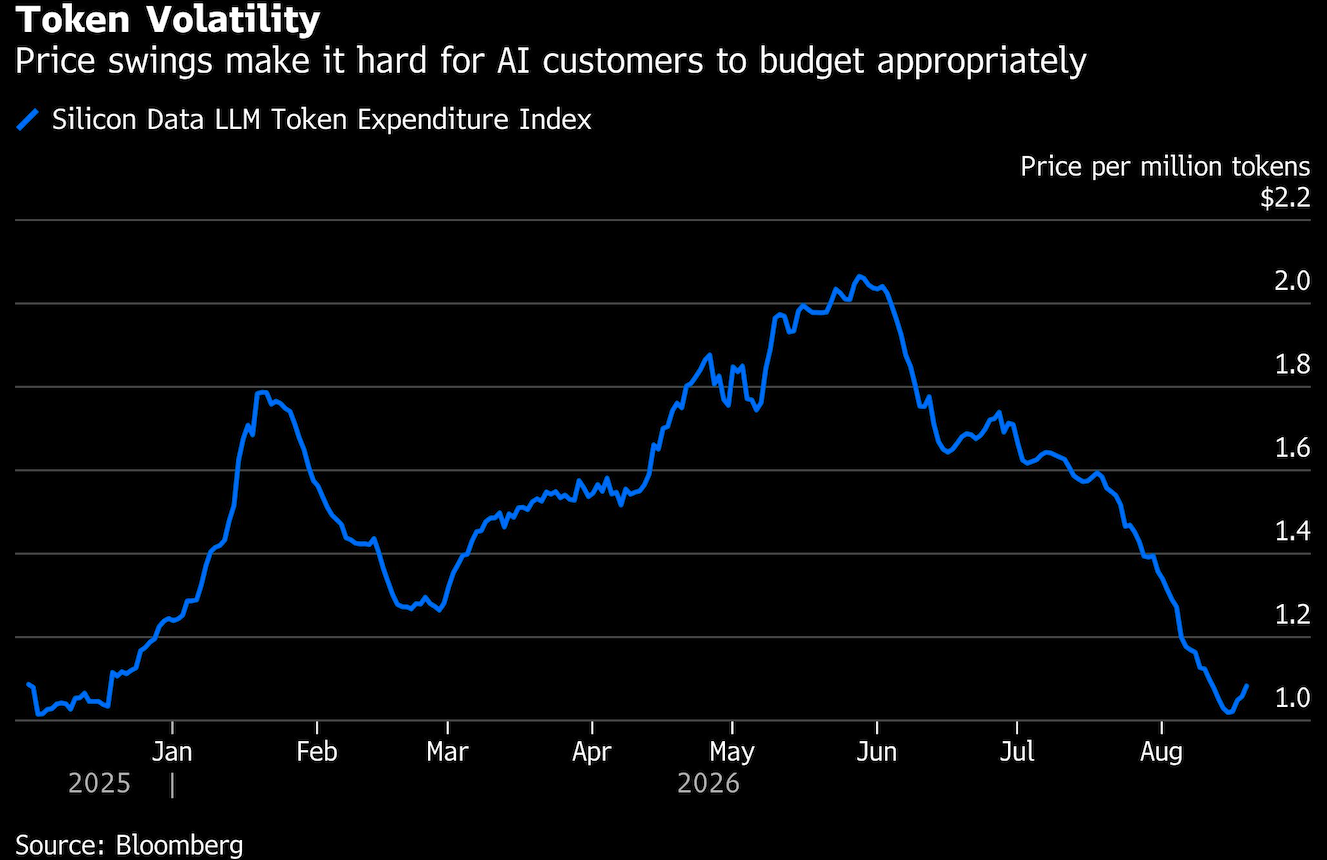
In time, markets dedicated to token prices could become the preferred vehicle for hedging those costs. Traditional exchanges currently have the edge in this space — the Silicon Data LLM Token Expenditure Index, which tracks what users pay for AI tokens across a range of models, provides a much clearer view today than prediction markets. A Kalshi contract on what the average price of an OpenAI token will be at the end of this month has almost no trading volume, while Polymarket doesn't even offer token-pricing markets. For everyday investors and businesses attempting to visualize their monthly AI usage against price increases, an index is the obvious choice.

That could change as AI development progresses. While prediction markets are still dominated by sports betting, there have been a number of instances of businesses using event contracts for real-life hedging — from an ice cream vendor protecting against cold weather, to a goat herder facing higher wage costs. These markets’ ability to cater to specific outcomes, alongside a faster turnaround time for bespoke contracts, could help them take the lead in the future.
The Silicon Data index represents a combined view across a number of AI models, making it harder to tell exactly what might be causing day-to-day changes. Is it one provider’s price increase, overall demand shifting to other models or something else? Event contracts, on the other hand, can tackle the minutiae: Say, how low will input token prices get this year for Claude Opus 4.8? Or how about OpenAI’s GPT 5.5?
Contracts attached to specific tokens and models are an important level of distinction when power varies greatly between cheap and frontier versions. A business that uses Google’s Gemini for customer service tools and Anthropic’s Fable for research and development would find the granularity offered by prediction markets useful in allowing it to hedge its exposure to price changes by its favored AI operators. What’s more, as providers begin to consolidate and advances slow, token markets can become a new vehicle for tracking a model’s overall popularity and staying power.
The Commodity Futures Trading Commission is now seeking feedback from the public on the launch of futures contracts for computing power, generating rules that could also impact prediction markets down the line. Futures could also start tracking token prices one day, though they might find it difficult to compete with the speed of a Kalshi or a Polymarket in releasing new contracts to match demand, given how frequently AI models change.
For now, the growth prospects of prediction markets as an AI hedge are a bit of a coin-flip. The arrival of compute futures could raise interest in the trade and help more people discover event contracts, acting as a tide that lifts all boats. Or, the option to buy a familiar derivative on a traditional exchange could sap interest in gambling on prediction markets. Either way, now’s the time for Polymarket and Kalshi to stake their claim to the asset class or risk missing out.
A message from Advisor Perspectives and VettaFi: Discover something new! Click here to register for our upcoming webcasts.
Bloomberg News provided this article. For more articles like this please visit
bloomberg.com.
Read more articles by Emily Nicolle