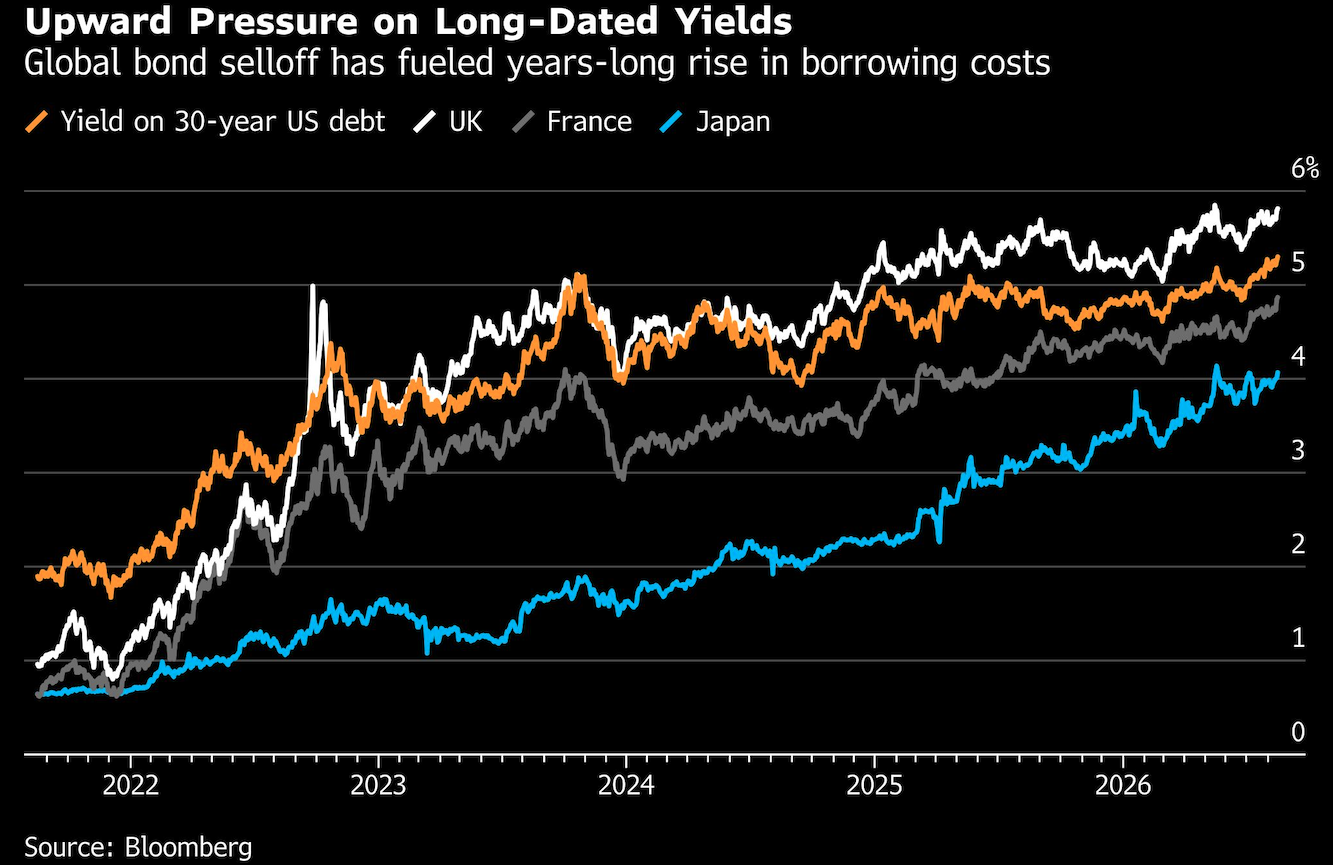
The yield on 30-year US Treasuries hit the highest in almost two decades, reflecting investor angst over surging government spending, a flood of long-dated bond sales and inflation that’s been stuck over the Federal Reserve’s target for the past five years.
The interest rate on the so-called long bond rose nearly six basis points to 5.31% on Monday, surpassing a high from last month to reach the loftiest since 2007. The move was echoed in the Canadian bond market, where the yield on 30-year securities rose to the highest since 2010, as well as in Europe, where German rates were at 2011 levels.

The rise in the US, which is driving up the federal government’s borrowing costs, is part of a broader global shift as investors demand more compensation to protect against the risk of persistently high inflation that’s likely to keep short-term interest rates elevated.
The movement is also being fueled by a ramp-up of corporate borrowing to fund the artificial-intelligence investment boom and waning demand from traditional buyers of long-dated bonds, just as the federal government’s nearly $2 trillion annual deficits keep pushing up the national debt.
“We have been arguing against fading the long end sell-off, and we continue to do so,” said Anshul Pradhan, head of US rates strategy at Barclays Plc. “A constructive view would require some combination of a downside fiscal surprise, slower AI-related issuance, a shift in Treasury’s issuance strategy, and a sustained run of soft activity data.”
See more: Lacy Hunt Turns Bearish: Studying His Reversal
The trading Monday extends the selloff from last week, which forced the US Treasury to sell $25 billion of new 30-year bonds at a yield of 5.216% — the highest level for such an auction since 2001. A day earlier, the Treasury Department’s 10-year auction drew the highest financing cost since 2007. That yield edged up 3 basis points to about 4.72% Monday.
Nohshad Shah, Citadel Securities’ head of EMEA fixed-income sales, said long-term bond yields also reflect the Fed’s reluctance to tighten monetary policy despite the prolonged period of above-target inflation.
The move is likely vexing to Trump administration officials, who early last year said the president’s fiscal policies would pull down long-term interest rates by taming government spending and inflation. Instead, Treasury rates have marched higher this year, rippling through to the cost of mortgages and other loans, as the US war on Iran hits the economy with an oil-price shock and the government continued to spend far more than it brings in.
The rise in yields comes even after recent economic data appeared to take some of the pressure off Fed officials to raise short-term interest rates in coming months. A gauge of underlying inflation released last week showed it was more subdued, the latest employment report revealed that US employers unexpectedly cut jobs in July, and US retail sales fell by the most in more than a year.
Still, inflation remains well above the Fed’s 2% annual target, with the consumer price index last month rising 3.4% from a year earlier. The July reading of the price index for personal consumption expenditures, the Fed’s stated inflation metric, will be released on Aug. 26.
That softening of US economic data has fueled a divergence between different maturities of Treasuries, steepening the yield curve. The gap between 2- and 30-year yields has risen to 113 basis points, the most since April.
A message from Advisor Perspectives and VettaFi: Discover something new! Click here to register for our upcoming webcasts.
Bloomberg News provided this article. For more articles like this please visit
bloomberg.com.
Read more articles by Greg Ritchie