Power utilities across the US are already strained from AI data centers. But they’re increasingly facing an even bigger threat: that developers will be forced to walk away from projects, leaving households on the hook for massive infrastructure bills.
To minimize that risk and get utilities on board with projects, data center operators are tapping banks to guarantee the full costs of the AI buildout will be paid for.
They’re doing this through letter-of-credit facilities — a classic industrial backstop long used by oil and gas companies that’s surging in prominence across the data center industry. These ensure that if a developer can’t complete a site and doesn’t pay for upgrades that were needed to plug it into the grid, utilities can draw on the credit lines so that regular households are spared the costs.
TeraWulf Inc., a bitcoin miner-turned-data center developer, is in talks with bankers for such a facility, according to a person familiar with the matter. Blackstone Inc.-owned QTS is in discussions about expanding a potential $2 billion deal the operator was already negotiating with lenders, another person said. Switch Inc. recently got a host of banks to commit $3.5 billion to fulfill its grid obligations.
With the letters of credit in hand, developers can avoid tying up vital cash upfront when utilities demand billions of dollars for grid upgrades to keep them in the queue for power. And Wall Street is now syndicating these guarantees at an unprecedented scale to meet AI’s enormous spending needs.
“Securing abundant, reliable electrons now matters more than chips or capital,” said Arnaud Stevens, head of global trade for the Americas at Natixis SA, which co-led the Switch deal. “Raising large, syndicated letter-of-credit facilities is increasingly a key priority of large developers.”
The size of the commitments underscores the costs of fueling the AI revolution, which have propelled Wall Street firms to devise billions in novel debt deals.
See more: Beyond Moore’s Law: The Full Stack Driving AI in 2026
But these letters of credit are putting Wall Street on the hook as big AI players face a reckoning over their lavish — yet unmonetized — AI spending, a friction that’s already cooled demand from bond investors. Meanwhile, the warehouse-scale computing facilities powering AI models are igniting fierce local backlash.
Industry executives say the letter-of-credit facilities are necessary for developers to ensure reliable power connections. Overall, there are some $10 billion of the arrangements currently under discussion, according to one of the people familiar, who asked not to be identified discussing private information.
Giving fresh impetus to the instruments, President Donald Trump’s administration is pressuring data center operators to fund the power generation and infrastructure such projects need. On Monday, Texas governor Greg Abbott ordered audits of data centers seeking connections to the state’s grid, effectively freezing all projects until the reviews are complete. Across the country, regulators are directing regional grid operators to swiftly create processes to protect consumers from higher energy bills to cover the costs.
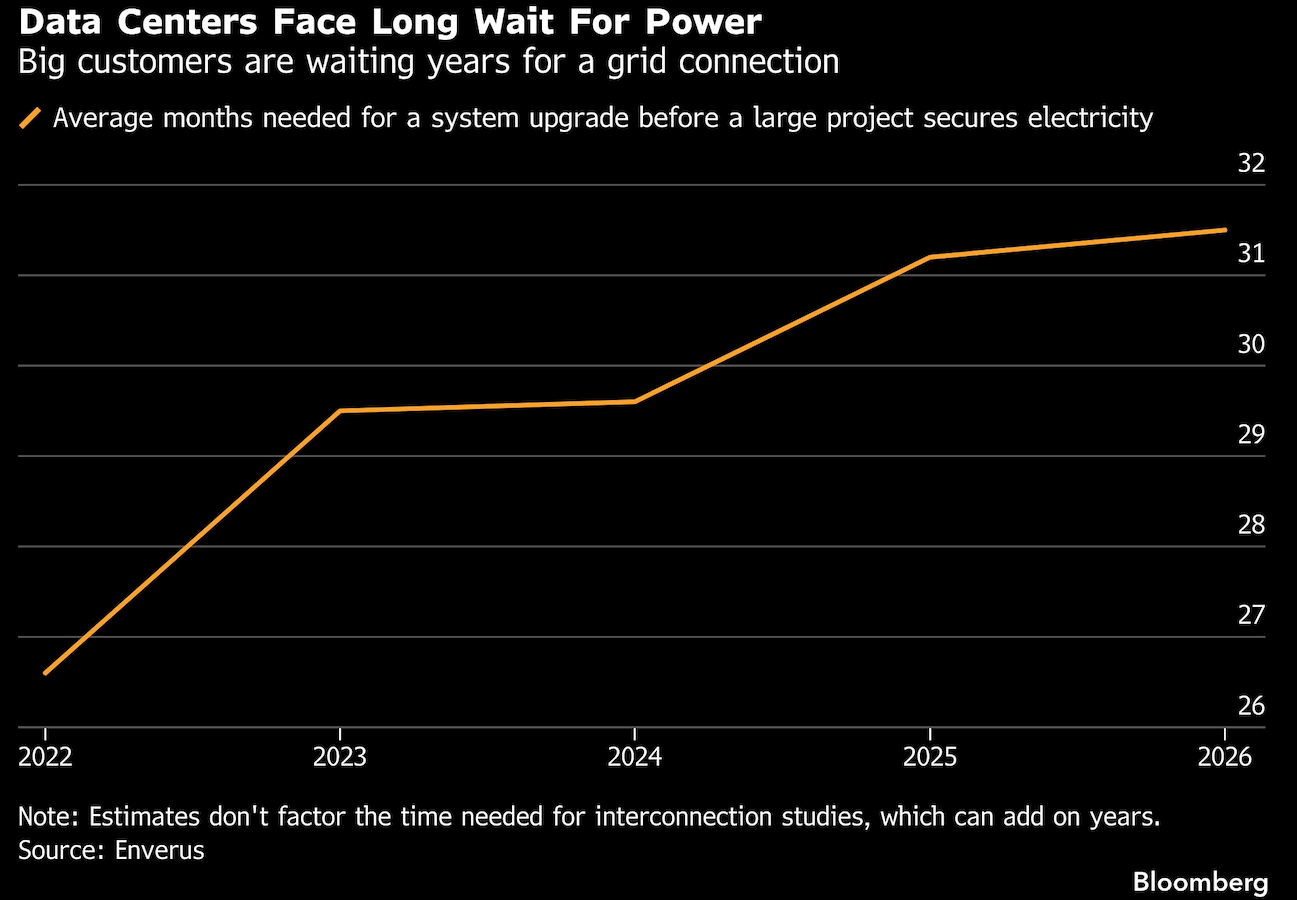
“Without a letter of credit, most utilities won’t even study your project,” said Carson Kearl, a senior analyst at energy research firm Enverus. “Vast amounts of capital are required upfront to participate in this market.”

Letters of credit have long underpinned much international trade, with commodities giants and oil frackers relying on them to guarantee cargo shipments and equipment costs.
While data centers have also tapped the arrangements as power needs soared, the scale of the bank syndication is new: Switch, for example, ultimately gathered 15 lenders to back its letter-of-credit facility after increasing the deal in a matter of weeks, according to one of the people.
Instead of posting cash to utilities, Switch provides the letter of credit as security. This arrangement — which it said was the first of its kind — costs the company a roughly 2% rate. Switch, which is majority-owned by DigitalBridge Group Inc., is weighing plans for a public listing.
Representatives for TeraWulf, Blackstone and Switch declined to comment. Representatives for QTS didn’t respond to a request for comment.
Speculative Plans
As data center grid connection applications overwhelm local power networks, utilities like Virginia’s Dominion Energy Inc. are working to purge speculative proposals. According to Enverus, data centers and other large industrial facilities are waiting in line for more than 800 gigawatts of power, comfortably surpassing the entire nation’s average electricity demand. Many of the projects are speculative and unlikely to materialize.
Developers with Wall Street guarantees stand out from speculative builders, helping utilities identify serious players just as public anger over soaring utility bills, proliferating transmission lines, and rolling blackouts have made data centers a flashpoint.
“Utilities are getting smarter,” said Michael Lardieri, a managing director at BBVA, which co-led the Switch deal with Natixis. “They’re realizing not every person who asks for power is going to be able to take it because they may not be around.”
For private equity backed developers, whose closely-held financials make it difficult for utilities to assess their creditworthiness, letters of credit are crucial. For them, the guarantees function like an alternative credit rating, where banks effectively substitute their creditworthiness for that of the developer.
Bankers say that because letter-of-credit facilities are typically tied to several properties and utilities, the prospects of power providers drawing the entire multibillion-dollar amount — or of many projects failing at once — are unlikely. Still, banks at times agree to letters of credit before the developer has signed a lease with a tenant or even before the project financing is put in place, raising potential risks.
That’s prompting caution on Wall Street, too: Morgan Stanley, for one, has signaled to developers that it holds a high bar for leading any letter-of-credit deals, according to another person.
A representative for Morgan Stanley declined to comment.
Either way, the deals could become lucrative. The strategy positions banks to win ancillary business from developers down the road, such as mergers and acquisition advice or other services to fuel more AI spending.
Smaller players are also turning to the arrangements: Yondr Group, backed by DigitalBridge and La Caisse, recently secured such a facility. Some developers, unable to get bank support, are even sounding out private credit lenders to guarantee payments, according to another person familiar with the matter.
“Power availability is the single biggest limiting factor on the pace of the data center buildout,” said Mario Iacobacci, head of construction and infrastructure advisory for North America at Oxford Economics.
A message from Advisor Perspectives and VettaFi: Discover something new! Click here to register for our upcoming webcasts.
Bloomberg News provided this article. For more articles like this please visit
bloomberg.com.
Read more articles by Dawn Lim, Michelle Cheng