BlackRock Sets Out for Private Credit Glory After Year of Upheaval
Membership required
Membership is now required to use this feature. To learn more:
View Membership BenefitsIt was “Christmas in July,” and, for the recently united employees of BlackRock Inc. and HPS Investment Partners, the mood was buoyant.
At the party, hosted on a hot day last July at HPS business development head John Christmas’ New Jersey beach house, bandana-clad colleagues across his teams mingled poolside with the wind at their backs. With the addition of HPS, one of the biggest names in private credit, it seemed BlackRock was set to break through in the market in a way that had eluded the asset manager for years. The combined business, referred to as Private Financing Solutions, could invest across capital structures large and small.
Then came a period of upheaval unlike any the $1.8 trillion direct lending market had ever seen.
BlackRock’s prior private credit unit, which was rooted in direct loans to small- and medium-size companies, was hit especially hard, with Justice Department prosecutors probing its practices. As retail investors sought to pull cash from the market at a record pace, the flagship HPS Corporate Lending Fund in March enforced a 5% limit on withdrawals, a path many of its rivals later followed.
At the time, skeptics whispered that it seemed BlackRock’s splashy $12 billion HPS acquisition had effectively signaled a high point for the market.
Now a year into the merger, executives across units acknowledge this much: it hasn’t been an easy ride. HPS senior staffers have spent considerable effort on what they view as a cleanup job for loans made years in the past by BlackRock, while also looking to quell redemption pressure from retail investors that has put the entire market on its back foot.
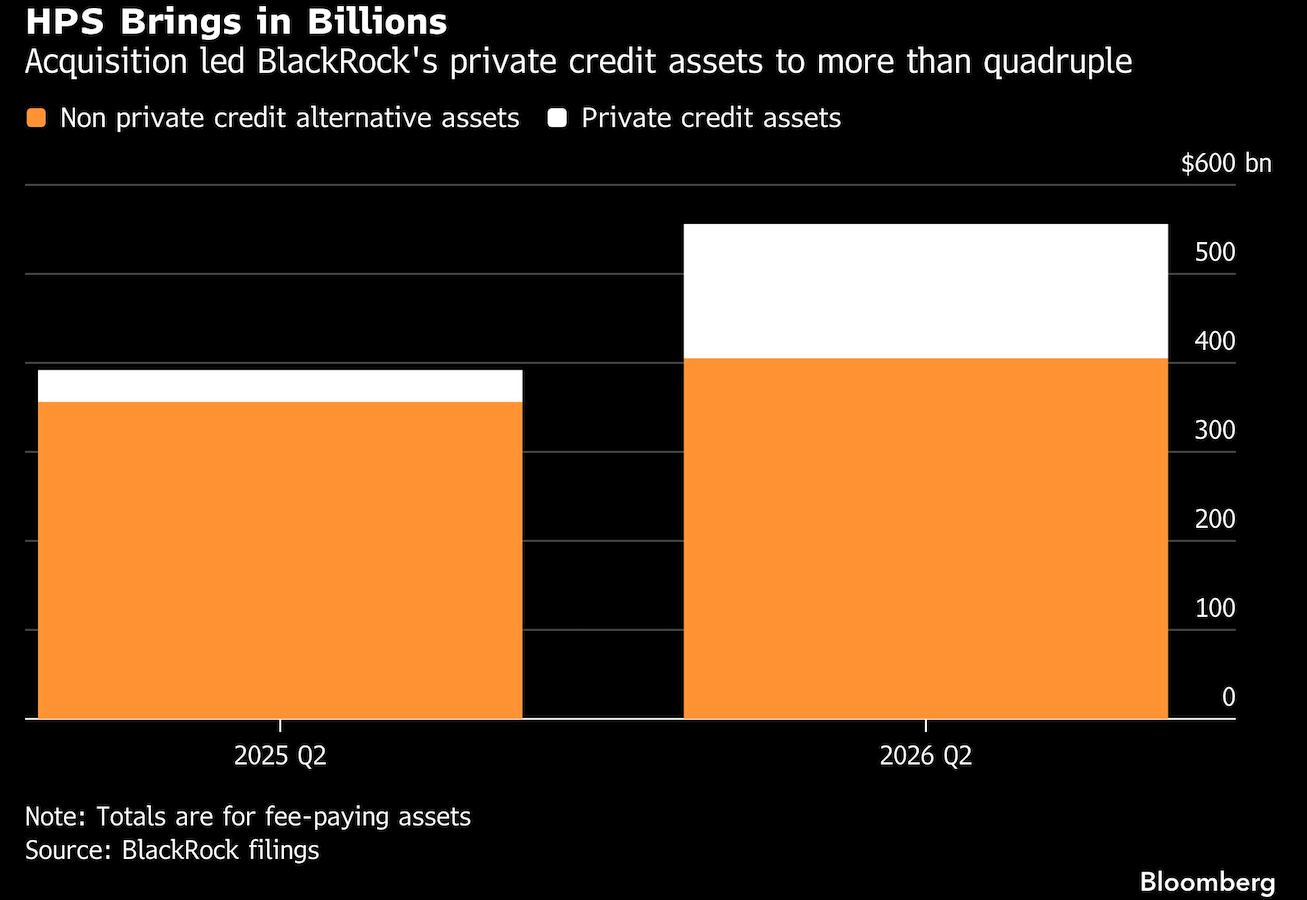
Still, the attitude among leaders at the combined company is optimistic, according to interviews with nearly a dozen current and former employees, as well as others close to it, all of whom requested anonymity to speak freely about private conversations. Absorbing HPS into the sprawling apparatus of Chief Executive Officer Larry Fink’s BlackRock, the thinking goes, has dramatically enlarged its footprint in private credit to around $151 billion. It has also allowed HPS to leverage BlackRock’s clout across the corporate world to generate new business and better compete for the biggest deals in the market.
Whether BlackRock emerges as “the world’s leading provider of private financing solutions,” as it said when announcing the HPS purchase in December 2024, remains to be seen. But the reveal this month that HPS and Global Infrastructure Partners — which BlackRock also bought — were together chosen by Meta Platforms Inc. as partners on a data center project, shows the firm is now competing on the same playing field as longtime private markets stalwarts like Apollo Global Management Inc., Blackstone Inc. and Blue Owl Capital Inc.
“You need to have a very large investor base to be relevant, and you need a large-scale infrastructure equity player and a credit underwriter,” said Alex Blostein, a senior analyst at Goldman Sachs Group Inc.
BlackRock paid a steep multiple to get HPS, which has likely weighed on its shares over the past year, he said. But now it’s capable “of what only a handful of firms in the world can do — and they wouldn’t have been able to be there before.”
A BlackRock spokesperson declined to comment for this story. Chief Financial Officer Martin Small has told analysts the firm sees “incredible opportunities” in private credit.
Price Tag
The past year at BlackRock and HPS — and the path forward for the combined firm — is in many ways emblematic of a shift in how industry titans are seeking to broaden the meaning of “private credit.” Long used as a way to describe direct lending to riskier borrowers, Apollo’s Marc Rowan and others have argued that the term encompasses any non-bank or asset-backed financing — a potential $40 trillion market that is largely investment grade.
At BlackRock, the price tag for HPS — roughly 30 times earnings — was viewed as worth it to secure a large, blue-chip business and bring aboard founders Scott Kapnick, Scot French and Michael Patterson, who have already established significant clout internally. The sense of urgency intensified as the investment industry pushed to make higher-fee private assets an option for the almost $14 trillion Americans have in their 401(k) plans and similar retirement accounts.
“If they hadn’t been willing to pay that price, they might not have gotten” HPS, said Brennan Hawken, head of diversified financials research at BMO Capital Markets. “Being able to provide private assets, it was a missing piece for BlackRock.”
That’s not to say private credit was entirely absent from BlackRock’s dizzying array of offerings. In fact, it had one thing that HPS itself lacked: a publicly traded investment vehicle that bundles direct loans.
In the early days of the merger, Phil Tseng, head of BlackRock TCP Capital Corp., said the fund, known as TCPC, would remain a strategic priority for the combined business. A product of the 2018 acquisition of Tennenbaum Capital Partners, it was seen as a complement to HPS’ private credit suite, even though the firm had historically shunned that structure.
But like at other firms, it is retail-oriented products that have experienced the most volatility.
Slashed Valuation
TCPC, while tiny in the scheme of BlackRock’s $15.3 trillion empire with about $1.5 billion of assets, cast a pall on the firm in January when it filed an off-cycle disclosure announcing it would slash its asset values by 19%. That news followed some drastic moves in how it marked assets, including taking the value of its investment in home improvement business Renovo from 100 to zero in weeks.
BlackRock’s legacy business also faces losses of more than $500 million stemming from an over $1 billion exposure to e-commerce aggregators — companies that buy and manage Amazon.com Inc. sellers — according to people familiar with the matter.
TCPC executives have been questioned on valuation practices as part of a probe by the Manhattan US Attorney’s office. The SEC has also been looking into the fund’s write-downs, which spurred a flurry of lawsuits, the people said. A representative for the SEC declined to comment.
Those at HPS, along with the remaining TCPC team, which includes Co-Chief Investment Officer Dan Worrell and President Jason Mehring, have made few new middle-market investments. Instead, they’ve largely been looking to sell or manage struggling loans still on their books.
All told, the merger has culled BlackRock’s former US private debt investing team, with only about a dozen people remaining after two rounds of job cuts overseen by HPS executives, according to people familiar with the matter. Carolyn Glick, who had run origination across BlackRock’s direct lending platform, and Keon Reed, a managing director, are among those to be impacted, they said. Neither Glick nor Reed responded to attempts to reach them for comment.
Inside BlackRock’s offices, Vikas Keswani, HPS’ head of direct lending, has emerged as a main player on investment committees at the company’s private debt funds. Tseng is now in the process of leaving the firm.
Redemptions Surge
To be sure, HPS’ funds haven’t come out of the private credit storm unscathed, including some instances of investments going bust.
The firm in June limited withdrawals from its $25 billion flagship fund for a second straight quarter, after investors ramped up redemption requests to about 13% of shares. HLEND’s performance has sagged of late like other major funds, returning 7.5% over the past year, compared with 10% annualized since inception.
“Historically, periods of uncertainty and volatility have created some of the most compelling investment opportunities within private credit markets,” HPS told investors in a March letter. It reiterated to HLEND shareholders in June that “the opportunity set is becoming increasingly attractive.”
BlackRock’s purchase price for HPS was driven by a need for big-ticket deals, with HPS executives having a history of working directly with borrowers in the market. The focus now is to keep the money spigot flowing to win major financings like the Meta data center in Texas — the kind of higher quality partnership that Apollo, Blackstone and KKR & Co. are all vying to do more.
As the retail market wobbles, BlackRock has emphasized the potential for more of its existing insurance clients, overseeing roughly $700 billion, to rotate into private investments. Even a 10% shift, which executives have suggested is possible, would considerably expand BlackRock’s footprint (it has indicated it’s about $20 billion of the way there so far). As it stands, about 85% of BlackRock’s private financing business is for institutional investors.
The push industry-wide to offer more private credit funds for individual investors, meanwhile, ran almost immediately into the anxiety sweeping the market, which has created an unprecedented $14.5 billion redemption backlog. Still, BlackRock’s senior executives have talked about rolling out an H-series of funds for individuals this year and putting private credit into 401(k) investments, which could take years to ramp up.
In the meantime, the combined firm has brought in roughly $27 billion in what it calls net new money in private credit over the past year — approaching the size of BlackRock’s entire division before the merger.
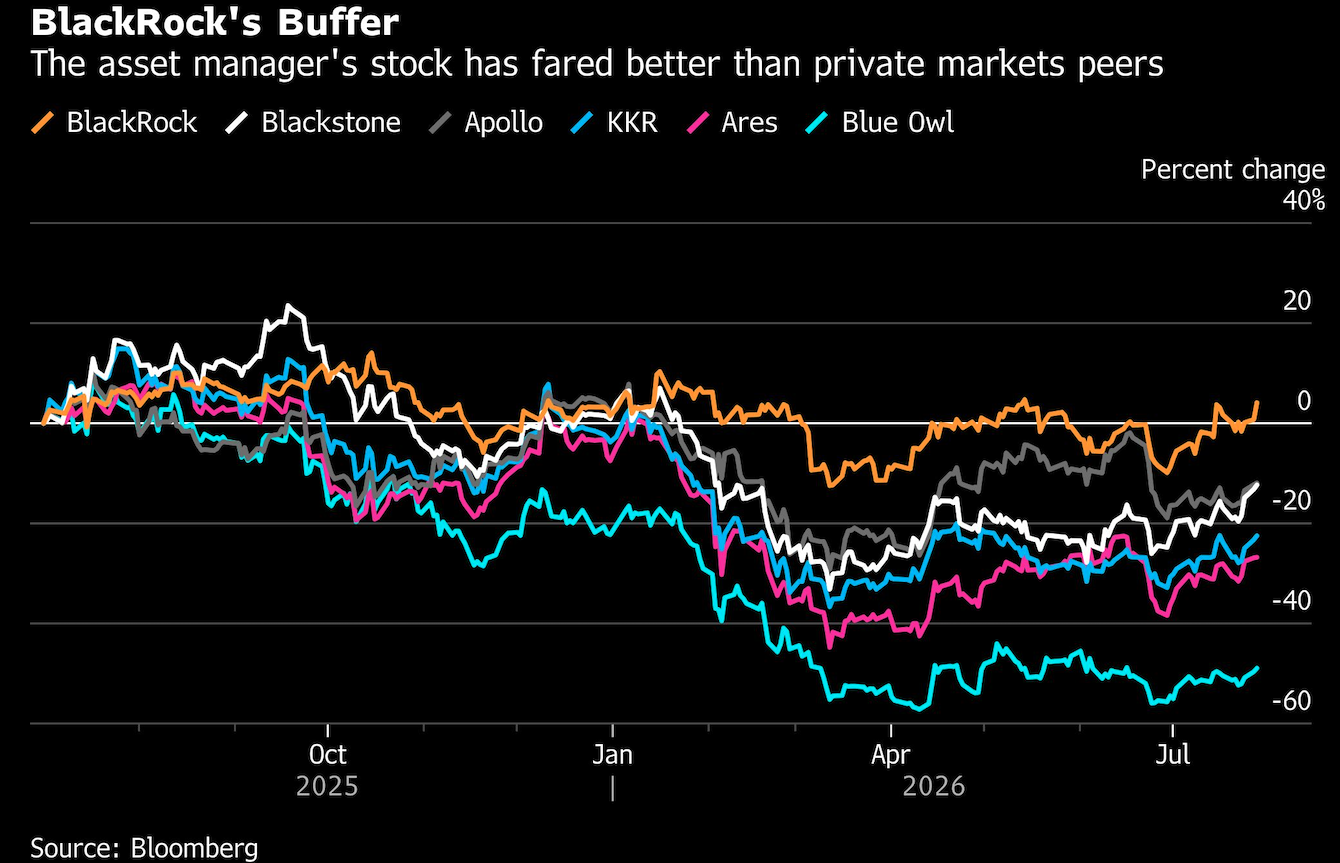
As year two of BlackRock-HPS kicks off, one thing for which HPS employees are grateful: that its founders didn’t go public.
Two close peers, Blue Owl and Ares Management Corp., have seen shares plunge 49% and 27% since July 1, 2025, respectively. BlackRock, which set aside as much as $675 million worth of restricted stock units as an equity retention pool for HPS staff, is up about 4%.
And through private credit’s cooldown, Christmas’ party is still on.
Last week, more than 100 people descended upon his coastal property, arriving via buses arranged for the event. The affair was bigger this time, as additional BlackRock teams now fall under Christmas’ purview.
At 79 degrees and sunny, it was more temperate than last year, too.
A message from Advisor Perspectives and VettaFi: Discover something new! Click here to register for our upcoming webcasts.
Bloomberg News provided this article. For more articles like this please visit bloomberg.com.
Read more articles by Olivia Fishlow, Davide Scigliuzzo, Silla Brush
Membership required
Membership is now required to use this feature. To learn more:
View Membership BenefitsSponsored Content
Live Virtual Event: Join Now

Upcoming Virtual Events View All









