Let’s get this out of the way right away: It’s highly unlikely the Federal Reserve will raise interest rates when policymakers meet this week after the latest data showed inflation has slowed. Plus, the five task forces that new Fed Chair Kevin Warsh announced, to much fanfare, to review the central bank’s methods and operations are just getting going. Would Warsh really tighten monetary policy before getting the results, which are due by year-end?
And yet, raising rates might accomplish several goals at once for Warsh, including winning the approval of President Donald Trump, who tried firing Warsh’s predecessor, Jerome Powell, because he wouldn’t lower rates. Hear me out.
It’s true that the White House gave Warsh an unofficial mandate when he was put in charge of the central bank: Find any excuse to cut rates so that borrowing costs throughout the economy follow. But that’s not how it works. In reality, the Fed’s control only extends to very short-term borrowing costs, from overnight out to about two years or so. Bond traders are the real drivers of longer-term borrowing costs, including those that determine things the president cares about — mortgage rates, auto loan rates, credit card rates and corporate bond rates among them.
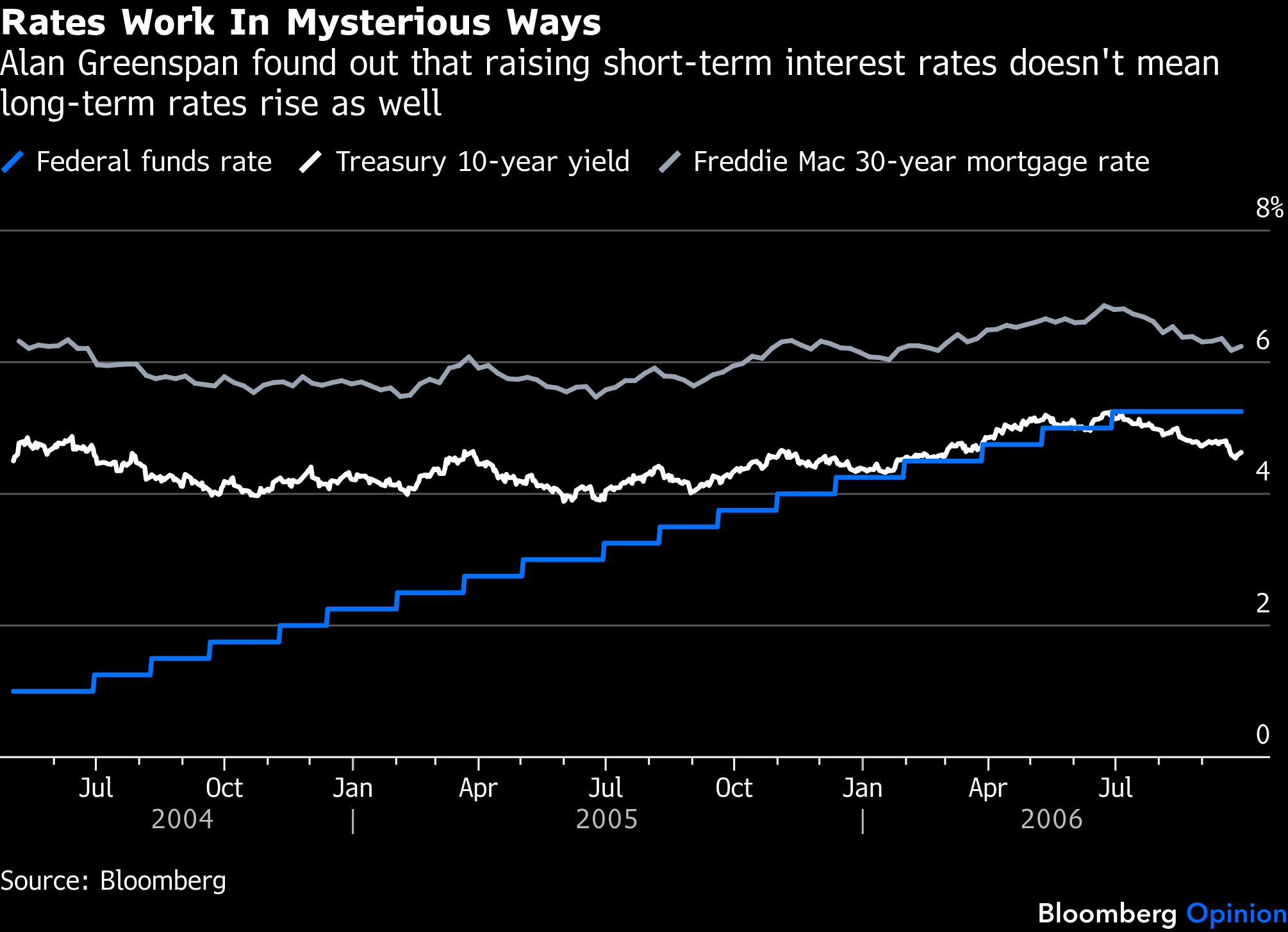
The recently deceased Fed Chairman Alan Greenspan found that out back in 2004, when the central bank started raising its target for the federal funds rate from 1% to 4.75% by early 2006 only to see longer-term bond yields fall. This became known as Greenspan’s “conundrum.” But it really wasn’t a conundrum in the sense that the market’s reaction to rising benchmark rates was puzzling. Rather, the market is forward-looking, and every rate increase by the Fed only reinforced the notion among investors that policymakers’ promises to keep inflation under control were credible. Rates on 30-year mortgages went from as high as 6.34% in mid-2004 to as low as 5.47% a year later.

I bet that’s a trade former hedge fund manager and current Treasury Secretary Scott Bessent would make in a heartbeat. He said early last year that he and Trump were more focused on bringing down long-term rates than influencing the Fed to lower its target rate. There’s some speculation in the market that this could well happen. Here’s what Wells Fargo Securities LLC Chief Economist Tom Porcelli wrote in a research note to clients last week:
So, one thing we have heard with great regularity from those who think the Fed will hike rates as soon as next week is that, by raising rates, Warsh (and by extension Bessent) will get what they ultimately really want: back-end rates to move lower. The thinking goes that by hiking, Warsh will firm up his inflation fighting cred and squeeze out the inflation premium built into the back end of the rates market.
Warsh, who took over from Powell in May, has sought to portray himself as being independent from the White House despite the president’s stated desire to see the US have “the lowest interest rates in the world.”
“I will tell you what I’ve said to the president repeatedly and said to the Treasury secretary: They chose an independent guy to do an independent job, and that’s exactly what I plan on doing,” Warsh said in answering a question at a Senate Banking Committee hearing July 15 on whether he’s had communication with Trump since taking the helm of the Fed. His comments led to a mini “conundrum,” as Treasury 10-year yields fell the most in three weeks despite Warsh’s hawkish tone.
Warsh has indeed surprised with his determination to whip inflation. Of that same testimony, Bloomberg Economics noted how Warsh “was unapologetically hawkish. In his telling, after 63 months with inflation above the Fed’s 2% target, the price-stability side of the Fed’s mandate is in worse shape than the full-employment side. Moreover, the AI buildout is adding to inflation as the effect on demand is arriving faster than the supply response.”
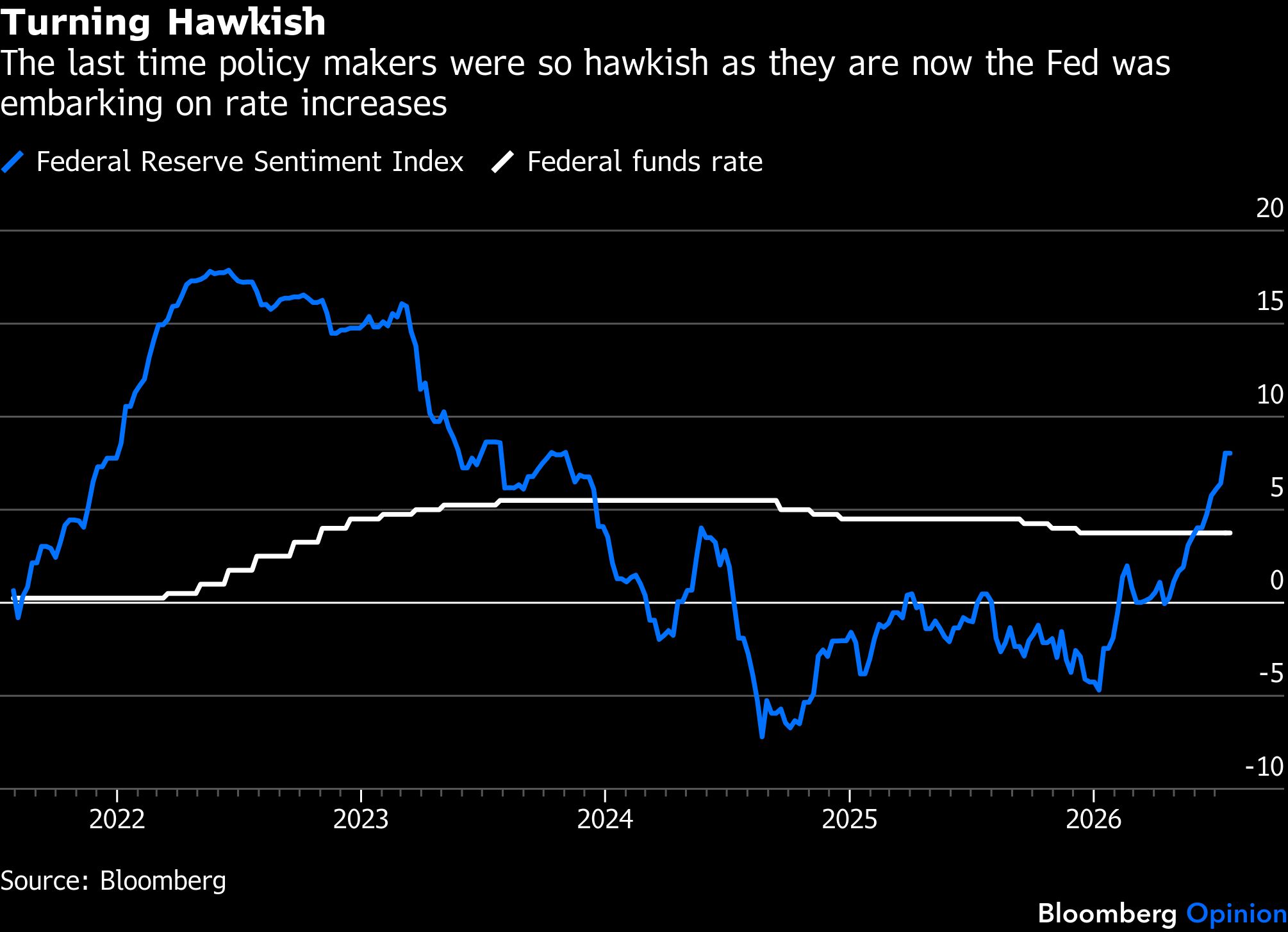
Although I said at the top that the odds of rates being raised this week are remote, they are not nil. The bond market is pricing in a not-inconsequential 38% chance of a boost in the target federal funds rate from the current 3.75%, rising from less than 10% before the Senate testimony. Warsh is just one vote on a Federal Open Market Committee that requires seven to change policy rates. But that might not be such a high hurdle, given a number of policymakers have suggested that tighter monetary policy may be needed. Bloomberg Economics’ Fedspeak Sentiment Index shows that, collectively, policymakers are more hawkish than at anytime since 2023, a period when they were raising rates, with seven voting members solidly hawkish.
Don’t discount the tradition of new Fed chairs quickly raising interest rates, either. Paul Volcker did so within two months of taking the job, while it took Greenspan, Ben Bernanke and Powell just one month, according to TS Lombard strategist Dario Perkins. Janet Yellen bucked the trend, not lifting rates until 22 months into her term. “Rookies always start out hawkish,” Perkins wrote in a research note to clients. “It helps establish their inflation-fighting credentials. Paul Volcker summed up the vibe, when he welcomed Greenspan’s first hike with the words ‘congratulations — you are a real central banker now.’”
It’s still early days in Warsh’s tenure, but so far, he has said and done all the right things to help ease concerns among his doubters that he was put in charge of the world’s most consequential financial institution solely to carry out the White House’s wishes. So although a rate increase this week is unlikely, Warsh surely knows that reinforcing a tough stance on monetary policy will further boost his credibility and reassure the bond market — the ultimate determinant of borrowing costs. Even Trump should be happy with that outcome.
A message from Advisor Perspectives and VettaFi: Discover something new! Click here to register for our upcoming webcasts
Bloomberg News provided this article. For more articles like this please visit
bloomberg.com.
More Fixed Income Topics >