The Mega-cap IPOs’ Impact on Index Funds
Membership required
Membership is now required to use this feature. To learn more:
View Membership Benefits Advisor Perspectives welcomes guest contributions. The views presented here do not necessarily represent those of Advisor Perspectives.
What stock fund could be safer than a total U.S. stock market index fund with thousands of securities? That was my thinking for the last three decades, but things are changing.
First, there is concentration risk, with nearly 35% of the total weight of the Vanguard Total Stock Market ETF (VTI) in its ten most valuable companies. Now, the mega-cap IPOs have started, with SpaceX (SPCX) rapidly reaching a $2 trillion market capitalization before declining slightly. More are coming, as shown below with estimates by Pitch.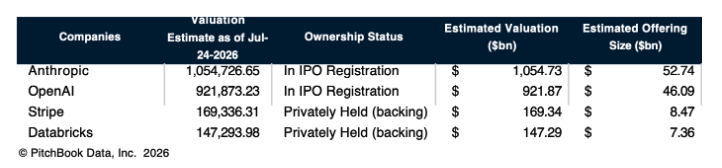
Although SpaceX was the first out of the gate and few expected it to jump to $2 trillion, it’s quite possible the other estimated valuations of upcoming IPOs are low as well. Thus, we could be looking at far more than $4 trillion coming to market.
Most of these companies are unprofitable, so it would be reasonable to expect these stocks to be quite volatile. After all, expectations for free cash flow are high. I would venture to guess people are now questioning how safe even broad U.S. index funds are due to concentration and the risk presented by these mega-cap IPOs.
The good news is that no broad index fund initially includes the full valuation in the index. Total index funds will use the float-adjusted valuations, and none is likely to be added to the S&P 500 right away. Inclusion in that index is a committee decision based on rules that include the requirement of positive earnings for at least four straight quarters, among other criteria. Below is a summary of the indexes the largest total U.S. stock index funds follow.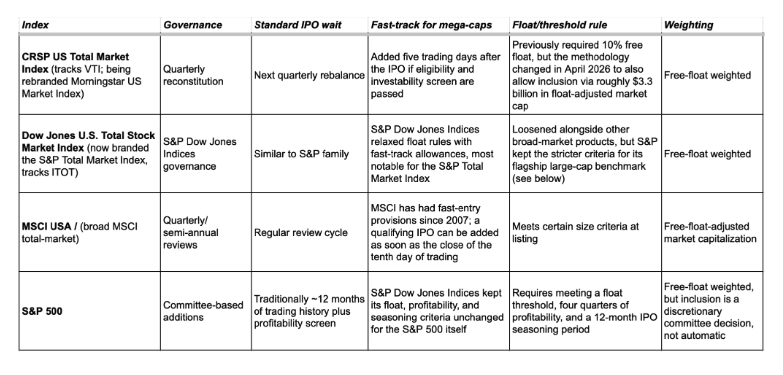
Risky Additions?
To better understand the risk, I looked at the Vanguard Total Stock Market Index Fund, which has $2.3 trillion in assets across all share classes, and the implications of SpaceX, since it’s the only new mega-cap that has had its IPO. The fund follows the CRSP U.S. Total Market Index, recently renamed the Morningstar US Total Market Index, after Morningstar purchased CRSP.
To see how these mega-cap IPOs are added to the index, I spoke with Alex Poukchanski, Morningstar director of index analytics. Like MSCI and Dow Jones did with their total stock indexes, Morningstar added a fast track for mega-cap IPOs. Although CRSP had a fast track prior to this year, the index’s new owner adapted the criteria so the mega-caps would be added if they have sufficient liquidity.
SpaceX completed its IPO on June 12 at $135 a share. It was added to the index at the market close on June 18 at $185 a share. Poukchanski told me the $85 billion raised accounted for 0.15% of the Morningstar US Total Market Index. That’s a pretty small number, but as of this writing, SpaceX was down 40% from the $185 price, so it would account for a not-so-insignificant estimated 0.06% decline in the index and the fund.
When did the Vanguard fund buy SpaceX? I asked, and a Vanguard spokesperson responded, “Our goal as an index fund manager is to track the index for each of our funds as closely as possible, leveraging our five decades of deep indexing expertise as a guide.” That would imply the fund did not participate in the IPO and purchased SpaceX either in after-hours trading on June 18 or early on June 22.
Lockups are Temporary
The real question is what will happen when the lockups keeping employees and other insiders from selling their shares expire. All other things being equal, if the current float increases from 5% of shares to 50%, then a 20% decline in the stock would lead to about a 0.30% decline in the total stock market. That’s still small compared to Nvidia, which would trigger a 1.34% decline in the index if it fell 20%, an impact more than four times the SpaceX example. However, Nvidia — like most of the ten most valuable companies based on free float — is profitable, which could translate into less volatility.
The good news is that the lockups don’t all expire immediately after 180 days; they are staggered, as shown below. Elon Musk owns about 48% of the shares, and the lockup doesn’t expire until mid-2027.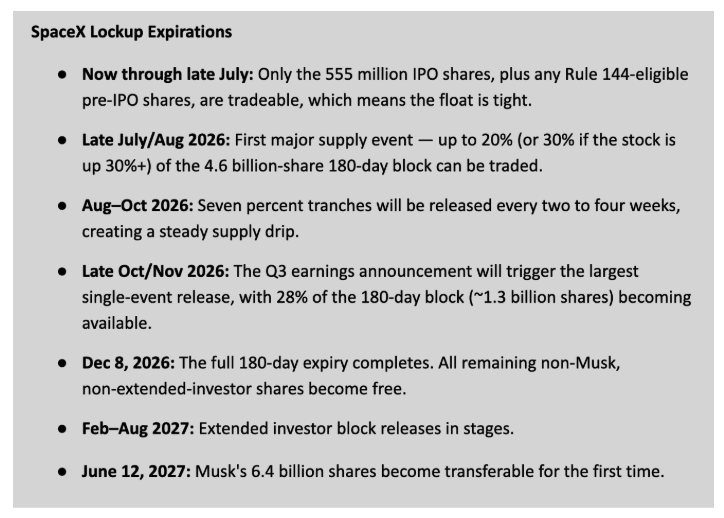
The total stock market index funds reconstitute periodically to match the float, relative to the total market. Morningstar does this quarterly, but waits an additional 180 days before adding new float for new fast-track IPOs. When the quarterly reconstitutions occur, it makes the changes over five trading days at 20% each day. The full methodology is described here using the Morningstar Market Indexes Transitional Reconstitution Calendar
Extrapolation to Other Mega-caps and Indexes
Will the other mega-caps also have rolling lockup expirations? I researched Anthropic and OpenAI, but little information is available. While OpenAI filed a confidential S-1, it’s not public.
My hypothesis is that those companies will also have rolling lockup expirations. That’s based on the fact that investment bankers involved in raising huge amounts of private funding had the IPO in mind for the exit strategy and therefore wanted a successful IPO process. If all the lockups expired on the same day, that would likely spook investors, who would avoid buying at the IPO because those shares being sold all at once could cause the price to plummet.
These mega-caps will have significant impacts on broad index funds but huge impacts on narrower index funds that include SpaceX and the rest of the upcoming mega-caps. A sector index fund that includes SpaceX, for example, will have a much heavier weighting than a broad total index fund.
Portfolio Considerations
The most obvious consideration is to decide whether you believe SpaceX and the upcoming mega-cap IPOs are under- or overvalued. A recent Morningstar piece made the case that SpaceX is way overvalued.
I’m not smarter than the market so I know that I don’t know. But if you believe in broad indexing and the mega-caps are hyped stocks that will plunge, then an S&P 500 index fund will exclude these mega-caps until they reach profitability and the committee votes for their inclusion.
A second consideration is to be careful in mixing brands of narrower index funds. For instance, Morningstar classifies SpaceX in the industrial sector while MSCI classifies it in Communication Services. Mixing brands is often dangerous because not all sector classification systems necessarily assign every company to the same sector. A discrepancy could result in either missing out or double-counting a mega-cap.
This isn’t a new issue as, for example, South Korea is considered an emerging market by MSCI while FTSE/Russell considers it a developed country. Thus, if you bought the Vanguard FTSE Developed Markets ETF (VEA) and the iShares Core MSCI Emerging Markets ETF (IEMG), you would be doubling up on South Korea.
Finally, and perhaps most importantly, understand that the best way to mitigate this new market risk is to invest in other asset classes. Most notably, international stocks and high-quality bonds.
Conclusion
There is no doubt that the old game of only small-market-cap companies going public is over. A new game calls for new rules, which is why the majority of index providers have added or changed fast-track rules. Brian Coco, Chief Product Officer at TMX VettaFi, discussed the logic his firm used, stating that these changes are a highly collaborative, deliberate process designed to ensure the benchmark continues to accurately represent the market. Ultimately, the fear of missing out on the next generational compounding asset significantly outweighs the fear of an overvaluation of pending mega-cap IPOs.
Coco’s conclusion, which I agree with, is that indexing must reflect where the market’s return drivers are shifting.
See more by Allan Roth:
- How the CFP Board Sold Out the Public & the Profession
- High Inflation May Continue: How It Could Affect Your Investing
- Ten Nasty Financial Tricks Predators Play on Our Clients
Allan Roth is the founder of Wealth Logic, LLC, a Colorado-based fee-only registered investment advisory firm. He has been working in the investment world of corporate finance for over 25 years. Allan has served as corporate finance officer of two multibillion-dollar companies and has consulted with many others while at McKinsey & Company.
A message from Advisor Perspectives and VettaFi: Discover something new! Click here to register for our upcoming webcasts.
Membership required
Membership is now required to use this feature. To learn more:
View Membership BenefitsSponsored Content
Upcoming Virtual Events View All