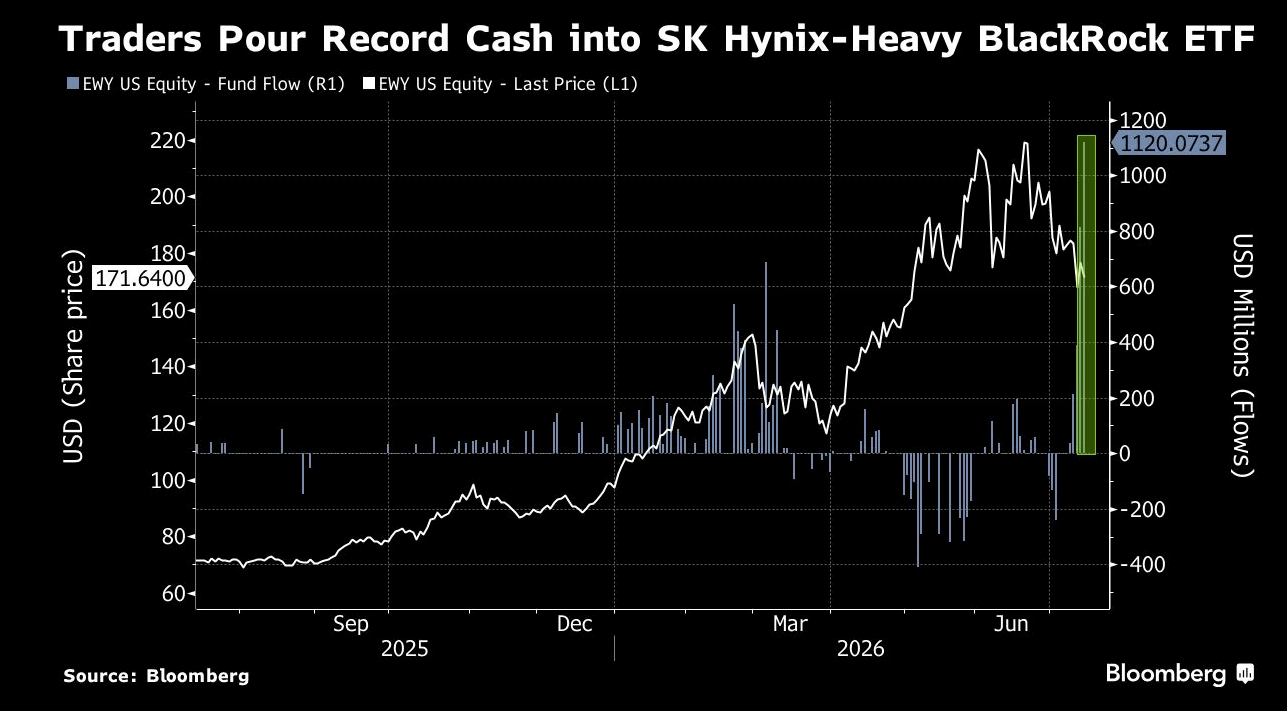
A record inflow hit the largest US-listed South Korea exchange-traded fund, as investors seeking exposure to SK Hynix Inc. piled into the ETF as a proxy at a time when the chipmaker’s new American depositary receipts trade at a substantial premium to its local shares.
BlackRock’s $23 billion iShares MSCI South Korea ETF, known by its ticker EWY, attracted more than $1.1 billion on Wednesday after taking in a record $814 million a day earlier, according to data compiled by Bloomberg. The fund allocates roughly a quarter of its portfolio to Korea-listed SK Hynix shares, giving investors one of the easiest ways to access the stock’s trading in Seoul.
“ETFs, in general, are proxy plays,” said Todd Sohn, chief ETF strategist at Strategas Securities. “They are extremely efficient for exposure to either emerging or well-developed market themes.”

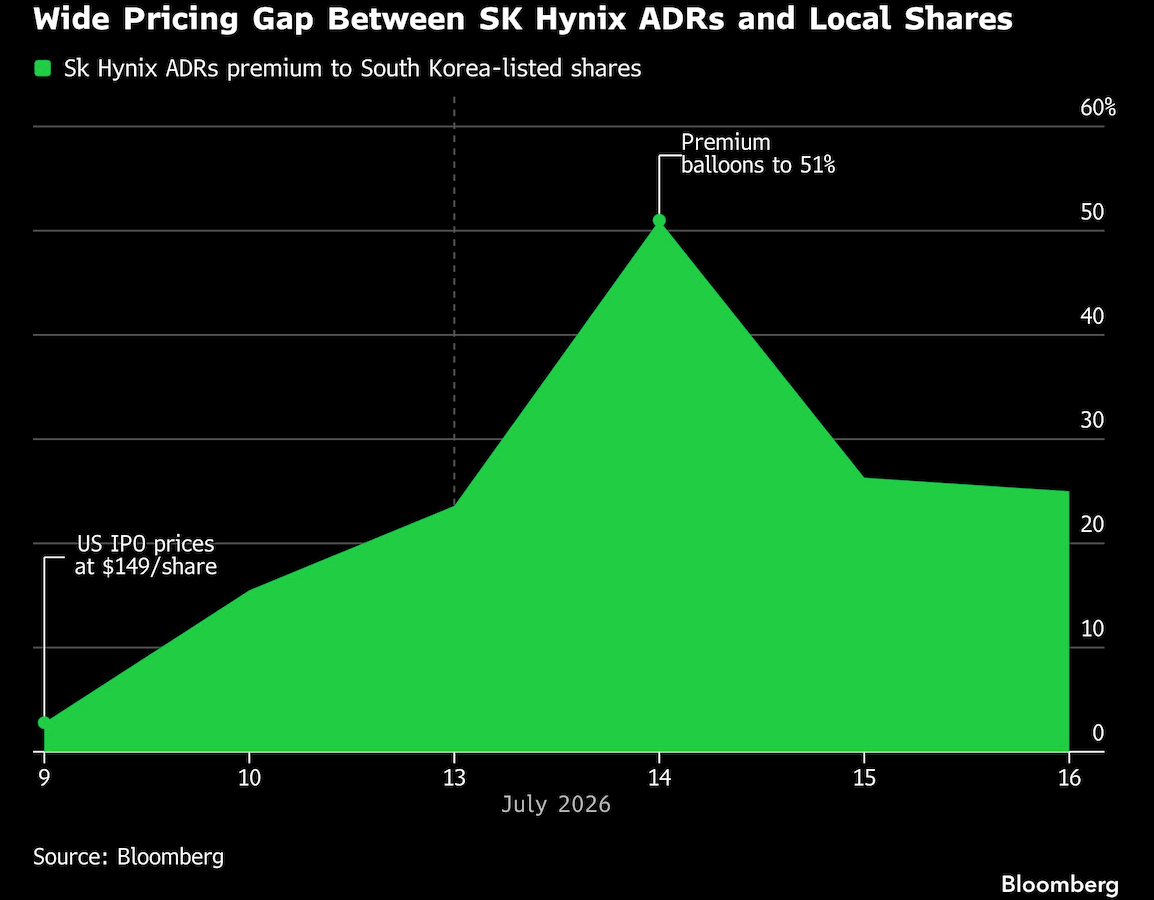
The surge of inflows comes just days after the memory-chip maker’s US debut ignited intense trading activity and sent its ADRs soaring far above the underlying shares in the Korean market. The premium for the ADRs over its South Korean shares was at around 27% as of Thursday afternoon in New York, after hitting a record 51% one day earlier.
Rather than paying up for the more expensive US-listed shares, some investors appear to be using EWY as a proxy for exposure to the Korean-listed stock. Unlike owning the Korean shares directly, the ETF eliminates the complications of off-hours trading and currency exchange.
“Investors are using EWY as a way to get exposure to the Korean-listed issuance,” said Dave Lutz, equity sales trader and macro strategist at Jonestrading Institutional Services LLC.
The pricing gap between the SK Hynix ADRs and local shares persists because the normal mechanism that typically keeps the two securities aligned remains constrained. The ADR books are closed for issuance and cancellation until later this month, limiting investors’ ability to convert between the US-listed and Korean-listed shares. Even after that, uncertainty remains over how much conversion capacity will ultimately be available and whether additional regulatory approvals will be required.
A similar ADR premium pattern has been seen in Taiwan Semiconductor Manufacturing Co. because its local shares are only partially fungible. TSMC’s ADRs traded at an average premium of roughly 20% during the past year, data compiled by Bloomberg show.
The burst of inflows comes as Korean memory-chip stocks have become one of this year’s hottest AI trades, with investors continuing to swarm into the sector despite bouts of volatility following SK Hynix’s US listing. In Korea, a retail trading frenzy around single-stock ETFs tied to the chipmaker and Samsung Electronics Co. led officials to temporarily halt new listings of single-stock ETFs.
“Some of that flow might have been short covering,” said Tom Graff, chief investment officer at Facet, a Baltimore-based money manager. “Demand remains extremely hot. How sustainable that is remains an open question, but it makes sense that most short bets would have a quick trigger.”
EWY has seen over $6.3 billion in inflows this year, with the fund’s assets ballooning over 180% to $23 billion in that period, data compiled by Bloomberg show.
A message from Advisor Perspectives and VettaFi: Discover something new! Click here to register for our upcoming webcasts.
Bloomberg News provided this article. For more articles like this please visit
bloomberg.com.
Read more articles by Carolina Wilson, Yiqin Shen