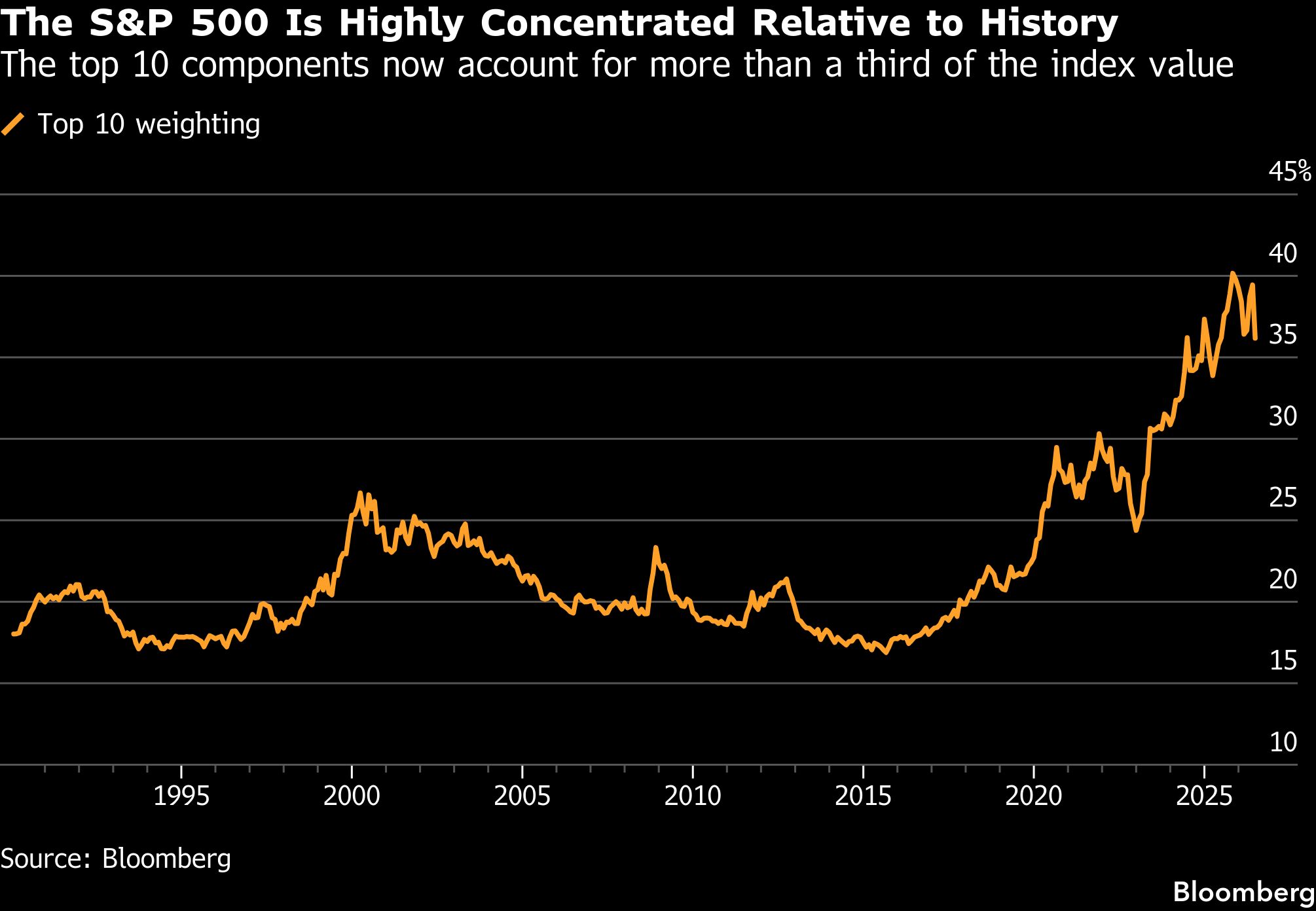
The US equity market, with the S&P 500 hovering near all-time highs, is expensive. This isn’t controversial. Depending on which measure you use, US stocks have arguably been overpriced for several years.
But now, the S&P 500 may be at never-before-seen levels of overvaluation, according to recent research from analyst Joachim Klement of Panmure Gordon.
The benchmark index is currently trading not far from the 44 level it reached during the dotcom bubble in 2000 based on a cyclically adjusted price-to-earnings (CAPE) ratio, which compares the index price to average earnings over 10 years rather than one.
Klement says the CAPE ratio is closer to 68, or higher than it has ever been, when adjusted for the fact that earnings are also well above their long-term trend. In short, the US is experiencing a price bubble on top of an earnings bubble.
The obvious culprit is artificial intelligence. A small group of technology-focused stocks dominate the investment indexes as companies compete to outspend each other on AI infrastructure. We’ve seen variations of this story before, from railroad booms to the aforementioned dotcom bubble, and we know how it typically ends.

However, the trouble with bubbles is that while they aren’t always hard to spot, it’s nigh on impossible to predict when they’ll pop (if it was easy, they wouldn’t form in the first place). Timing the market is a fool’s errand.
In the immortal words of John Maynard Keynes, markets can remain irrational for longer than you can remain solvent.
But there’s a difference between flipping to 100% cash and trying to guess when to get back in (a bad idea) and ensuring that you’re sufficiently diversified so that you don’t sacrifice too much on the way up and have a cushion on the way down. So how might you do that?
Invest in Tech – Just Not US Tech
“One of the advantages of all the market oxygen being drawn into a small number of AI-related hardware stocks is that it means the relative value in several other corners of the market looks pretty good,” says Alexander Chartres, fund manager at UK-based Ruffer LLP.
One such area of relative value is big Chinese tech stocks. Driven partly by political risk and partly by the country’s subdued economic backdrop, Chinese tech stocks trade at far lower valuations than their US counterparts.
“If you think about who provides cloud computing globally, it’s basically the US and China, with a handful of names in both countries,” Chartres says.
Chinese tech companies are fundamentally attractive businesses, with decent revenue growth and plenty of “optionality” in terms of exposure to AI, Chartres says. They’ve simply been beaten down by weak sentiment, in contrast to their US peers, he says.
While Ruffer owns individual tech stocks, investors looking for a straightforward way to get exposure to the broad theme may want to consider an exchange-traded fund such as the iShares MSCI China Tech ETF (CTCE LN) whose top 10 holdings include e-commerce and cloud-computing giant Alibaba Group; gaming, social media and cloud company Tencent Holdings; and search engine and cloud services giant Baidu. The ETF has an annual total expense ratio of 0.45%.
The Land That Tech Forgot
Another option is to avoid tech altogether and focus on markets and sectors that may have been neglected in the rush to invest in AI.
In a discussion with the Association of Investment Companies, Tomiko Evans, chief investment officer at Crossing Point Investment Management, sees the UK — and UK equity income in particular — as a good diversifier if your portfolio feels a little too tilted towards tech.
“The UK market has a very different sector composition from global equity indices, with greater exposure to financials, energy, healthcare, consumer staples and other cash-generative businesses,” she says.
Specifically, she highlights the Murray Income Trust (MUT LN). The closed-end fund, which focuses on finding companies that will enable it to sustain and grow dividends over time, has recently changed management, “bringing a more flexible and cash flow-focused approach to the portfolio.”
The fund’s 10 largest holdings at the end of May included UK high-street banks Lloyds Banking Group, Barclays and NatWest Group, insurer Aviva and pharmaceutical giant GSK. The trust trades at a discount to net asset value (the value of the underlying portfolio) of about 6% and offers a dividend yield of roughly 4%.
Energy as the New Diversification Play
In terms of crash risk, from a portfolio resilience point of view, Chartres notes that it can be tricky to find assets that offer genuine diversification in a world where inflation volatility means that “bonds are an unreliable hedge.”
One asset that fits the bill for this new world is energy, according to Chartres. While “the recent Gulf War reminds us of the potential for energy spikes to cause both equities and bonds to sell off more broadly,” the fossil-fuel sector tends to benefit, he says.
Chartres says it’s not just the oil majors. Oil services companies also may prosper in the longer run as nations invest in energy infrastructure to cope with current and future potential disruptions in the Gulf. “Of course, the oil market could be soggy for a long time,” but that’s the point of diversifying, he says.
Again, Ruffer owns individual oil stocks, but those looking for an ETF to play the theme could consider the iShares Global Energy ETF (IXC US), whose top holdings include ExxonMobil, Chevron and Shell. The ETF has an annual total expense ratio of 0.4%.
A message from Advisor Perspectives and VettaFi: Discover something new! Click here to register for our upcoming webcasts.
Bloomberg News provided this article. For more articles like this please visit
bloomberg.com.
Read more articles by John Stepek