he higher the rally in technology high-flyers, the louder the anxiety around a new wave of turbulence in the group.
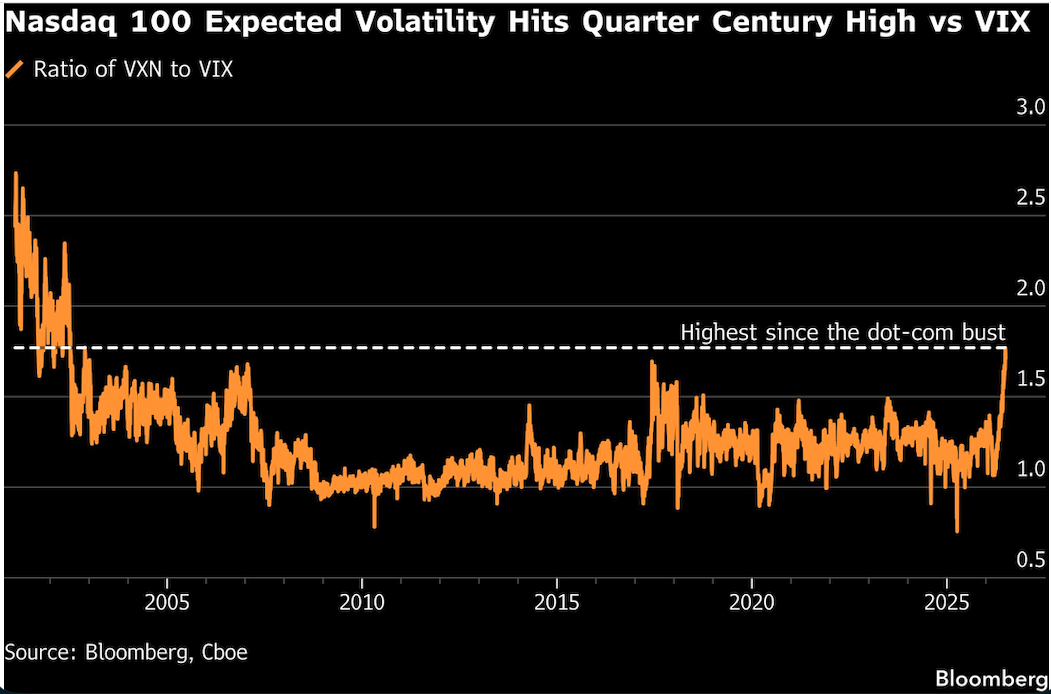
The Cboe NDX Volatility Index, a gauge of contract costs tied to the Nasdaq 100 Index, has been rising steadily this year and is now sitting near 27. The reading represents the highest level since 2002 relative to the Cboe VIX Index, which uses such contracts to measure the expected price swings for the broader S&P 500.
Beneath the relatively placid surface of a broader stock market, concern is growing that its best-performing corner may be experiencing haywire swings. Worries are rising that positioning in the Nasdaq 100 has become excessive and a 30% rally from late March stretched.
“This is pretty astounding,” Maxwell Grinacoff, head of US equity derivatives research at UBS Group AG, said, describing the elevated price swings in technology companies.
Anxiety was on display on Tuesday, when futures on the Nasdaq 100 traded down 1.1% at 7:41 a.m. in New York. Contracts on the S&P 500 were down 0.2%.
The Nasdaq 100 gained 1.3% on Monday, clocking its sixth consecutive session with a move exceeding 1% in either direction, the longest such stretch since August 2024. That’s pushed a measure of the index’s realized 30-day volatility to 29.7, the highest since the aftermath of Donald Trump’s tariff rollout a year ago.
And there could be more price swings ahead: Space Exploration Technologies Corp. joins the 100-member index on Tuesday, potentially adding rocket fuel to a divergence between the top technology stocks and the S&P 500.
“IPOs are inherently more volatile,” Amy Wu Silverman, head of derivatives strategy at RBC Capital Markets, wrote in a note to clients. Given the size and scope of SpaceX, “it is likely that the vol spread between Nasdaq and S&P remains wide until we close in on the inclusion of SpaceX into the S&P as well,” she added.
One investor likely played the SpaceX index inclusion trade directly last week, spending $2 million for the right to buy 1 million shares in the rocket company at $330.
Gyrations in AI and semiconductor stocks have also been exacerbated by the impact of levered exchange-traded funds in the US and Asia.
To Grinacoff, that signals the call he made at the end of last year — that the gyrations in the Nasdaq 100 will exceed those of the S&P 500 — remains intact halfway through the year. Traders can buy puts and calls on the Nasdaq 100 and simultaneously sell similar contracts on the S&P 500 to bet on wider price swings in technology companies, he said.
Over at RBC Capital, clients have been fading the AI trade. The bank’s clients have also been rotating into areas like healthcare and consumer staples, according to a client note by Amy Wu Silverman. The bank’s equity sales team recommends investors buy puts on the Invesco QQQ Trust Series 1 ETF and the VanEck Semiconductor ETF to express their bearish views on the tech sector.
Meanwhile, another area of divergence is in correlation, or the degree to which stocks are moving in sync. Over the past month, stocks in the Nasdaq 100 have been moving more in lockstep than in the S&P 500, according to realized correlation data compiled by Bloomberg.
To Grinacoff, that’s a sign that the high-flying AI trade is becoming more crowded than the overall market. More broadly, he notes that active managers across all types of strategies are becoming more committed to stocks.
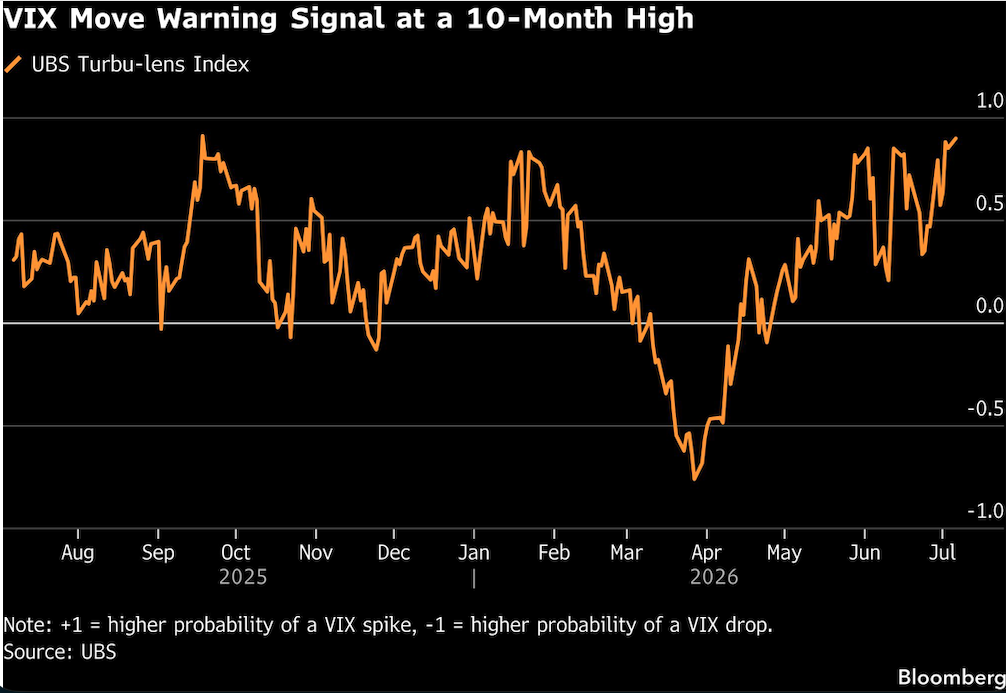
That dynamic could mean there is less institutional firepower around to buy a future dip in stocks if conviction in the AI trade wanes, making Wall Street even more reliant on retail investors to step in in the event of a selloff. A UBS model designed to predict spikes and drops in the VIX Index over the next month is hovering at a 10-month high and just below a threshold that signals the VIX is likely to move higher.
“You’ve seen chasing from active managers, not just like hedge funds and those types of managers and systematics, but also the traditional mutual funds, who basically need to chase their own benchmark,” Grinacoff said.