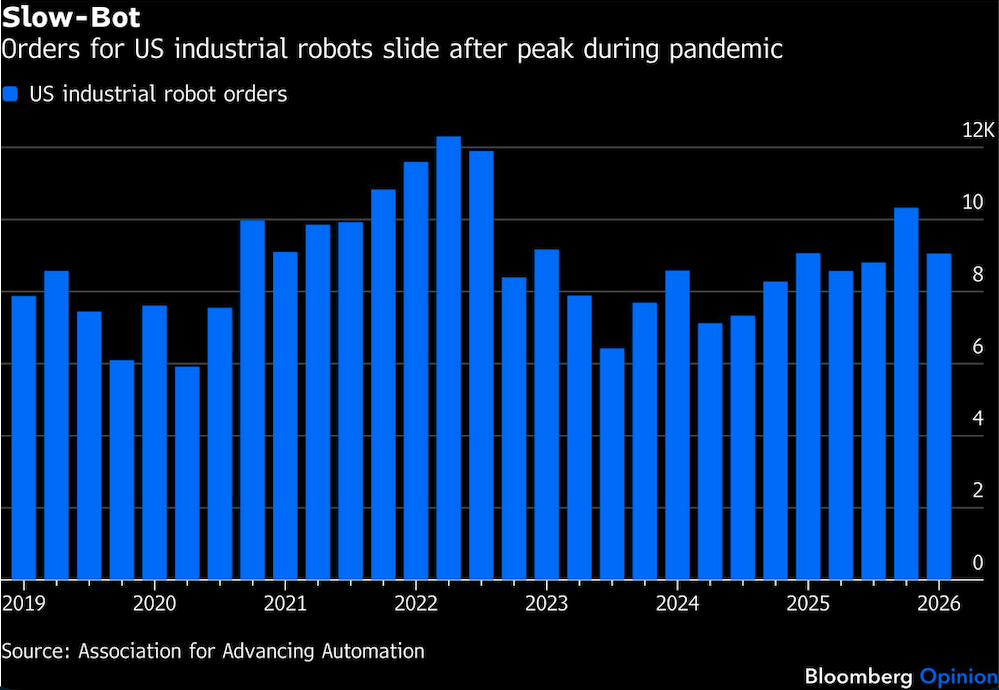
The US industrial robot industry is characterized by low growth and highly customized projects. Artificial intelligence holds out the hope to change that, especially when it comes to robots that can move and work safely around humans.
The mood was optimistic late last month at the Automate Show in Chicago, where robot makers and software providers peddled their wares. The industry is poised for explosive growth, said a top executive from one of Japan’s largest robot makers. The AI companies that are partnering with the robot producers, including Nvidia Corp. and Google’s Intrinsic, are even more giddy about the future of automation. Humanoid robots — which aren’t quite ready for widespread use — have dished up an outsized portion of excitement in general.
The problem is that the hype isn’t matching the reality on the factory floor.
That’s because robotics is complex. A lot can go wrong that can turn a money-saving effort into a money-losing headache. Automation works best on predictable, repetitive, high-volume tasks. That’s why the automotive industry has dominated robot orders for decades. Machines weld, paint, install windshields and perform other tasks that require heavy lifting or mind-numbing repetition to assemble about 10 million vehicles a year in the US.
These automated systems, usually built around robotic arms, are difficult to set up and program. They often need custom-made parts to stitch together different machines and sensors. This complexity gave rise to integrators, or companies that specialize in installing automation systems.
The promise of AI is to reduce the complexity and cost barriers by giving robots an onboard brain that makes programming as easy as a verbal command. The robots will be able to do multiple tasks and teach themselves to become more efficient over time. The technology will open up many more use cases and spur sales to small and medium-sized manufacturers. At this moment, though, these are still just promises.

The US badly trails the automation push by China, whichinstalled 295,000 industrial robots in 2024, the latest year for that data.
To be clear, these numbers don’t include the squatty autonomous mobile robots that exploded on the scene in warehouses and factories and mostly serve to bring goods to humans. Service robots, which are more popular in Asia, also aren’t considered industrial robots.
The ingredients for a robotics boom do exist. There’s a push to manufacture more goods in the US, and robot capabilities continue to improve as the cost of cameras and sensors declines. Software companies are working on solutions to make robots smarter and easier to program.
In addition, Fanuc Corp., Yaskawa Electric Corp. and Teradyne Inc. are building industrial robot plants in the US. Although the industrial robot was first developed in the US in the 1960s, the Japanese and Germans ended up dominating the industry. Chinese robot makers are now growing quickly. Standard Bots, a US startup robot maker, has been expanding production and is feeding optimism around an industry surge.
The primary indicator of this predicted surge will be a rapid expansion of industrial robot orders, especially outside the automotive industry. Demand will rise if the promises of efficiency, savings and ease of operation come true. This isn’t a given. The first big hurdle is a dearth of manufacturing data on which the software models need to train. There are no big, public pools of data like the internet that fed the popular large language models. The robot makers and their software partners must persuade manufacturers to share their data.
The data and foundational models that depict real-world scenarios will help train robots to do multiple tasks within a traditional manufacturing cell, reducing the need for products to travel around the plant. Producers will be able to run smaller batches and change products quicker, said Wendy Tan White, chief executive officer of Intrinsic, a robotics software and AI company at Alphabet Inc.
“If you can use software to make all the hardware interoperable and actually make the new AI skills that are coming also interoperable, you can suddenly do things like build very flexible cells to do multiple tasks even within one single cell,” said Tan White, who has started several companies including the website builder Moonfruit in 1999.
Safety will be a bigger challenge with mobile robots, whether on wheels or two legs. Instead of isolated robots programmed for a specific task on a fixed production line, the future will be software-defined systems that share information and coordinate among many robots.
Automation is the key for the US to reshore manufacturing and remain cost competitive. Robotics also alleviates worker shortages that will only grow more acute as world population peaks and begins to decline, a trend that is well underway in developed nations. Robots will allow economic growth to be decoupled from population growth, creating even more wealth and leisure time for humans.
The next step will be for AI to unlock more automated tasks and expand the use of robots beyond factories and warehouses and into restaurants, stores, hospitals and even unstructured areas like construction sites.
The vision of an expansion of robots into everyday tasks and life is there. The difficult work to make it a reality remains.
A good reality check is the number of US industrial robot orders. They have fallen from a peak of 44,196 in 2022, when companies struggled to hire workers during the pandemic, to 36,766 last year, which is slightly higher than the 10-year average of just less than 35,000 a year, according to the Association for Advancing Automation.
A message from Advisor Perspectives and VettaFi: Discover something new! Click here to register for our upcoming webcasts.
Bloomberg News provided this article. For more articles like this please visit
bloomberg.com.
Read more articles by Thomas Black