A private bond market dating back more than a century is opening a new front in the trillion-dollar AI funding boom, allowing tech borrowers to sell debt directly to deep-pocketed insurance firms.
Borrowers are hunting for capital wherever they can to finance the vast sums needed for the build out of AI. Meanwhile, life insurers facing record demand for annuities are seeking longer-term, high-grade corporate bonds to finance those multi-decade liabilities.
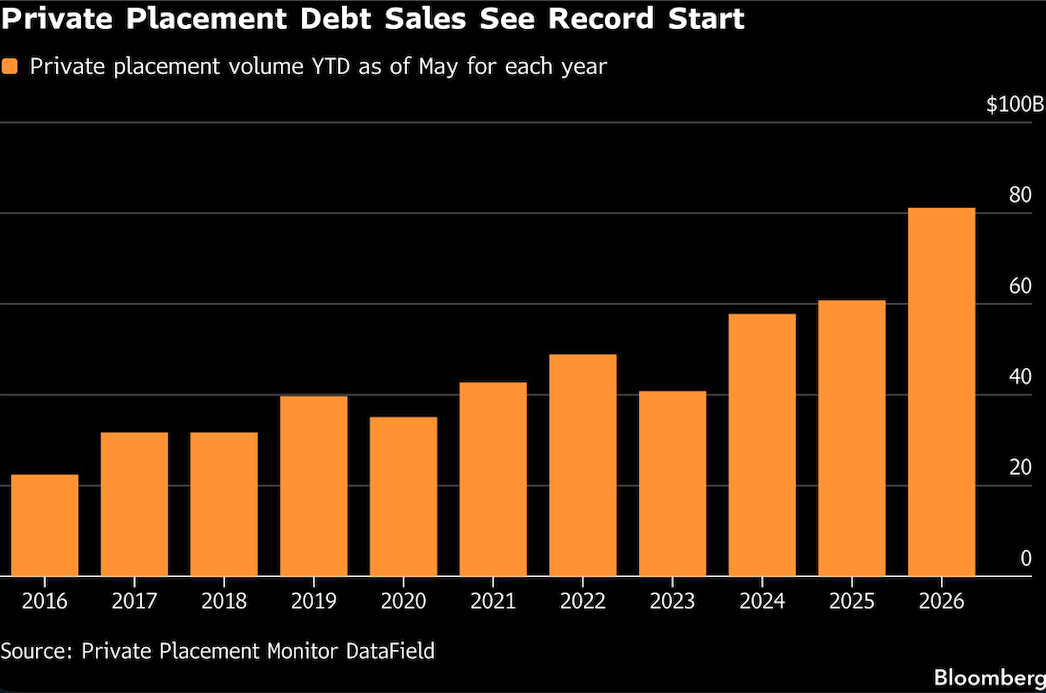
Private bonds, where companies sell securities directly to groups of select institutional investors, are bridging the gap. Issuance hit roughly $81 billion this year through May, the most for the period in data going back to 2016, according to Private Placement Monitor. Industry participants say AI is fueling the surge.
“Especially with AI and data centers, there’s an insatiable need for capital,” said Sheel Patel, head of New York private credit at Mayer Brown. “The borrowers are increasingly more comfortable using the private market for larger financings, especially when they realize that certainty, flexibility and confidentiality are a priority in these transactions.”
In May, IREN Ltd., which builds and operates data centers for training AI models, sold roughly $2.1 billion of bonds in a private placement. Blackstone Inc.-backed QTS has also tapped the US market, with Bloomberg reporting in April that the data center company had recently raised $800 million in the private placement format, with plans for more.

Under Section 4(a)(2) of the Securities Act, companies can issue private placements without Securities and Exchange Commission registration, provided there is no public offering. Because this debt is typically held to maturity by long-term investors, insurance companies are frequent buyers.
However, institutional investors can also trade certain unregistered securities among themselves under Rule 144A. Borrowers have structured transactions that utilize both provisions.
A recent $35 billion financing package for Broadcom Inc. and Anthropic PBC to expand Anthropic’s AI infrastructure was issued as a traditional private placement, but will eventually trade more broadly on a 144A basis, according to a person familiar who asked not to be identified discussing private information.
Representatives for Apollo Global Management Inc. and Blackstone Inc., which arranged the financing, declined to comment.
While it can make private placements harder to track, the additional privacy enables firms to raise billions without publicizing financial statements or competitive growth plans. Because the deals are negotiated between the company and a select group of investors, terms can be flexible on currency, size and tenor, with less onus on external credit ratings.
Investors can command a premium over public bonds because the debt is less liquid. While the illiquidity and limited transparency can pose risks, publicly traded AI-related bonds have been volatile amid skepticism around the technology and fears that debt markets are getting saturated.
“Around 10 years ago, it used to be impressive to see three or four of these deals that were one billion plus in a year. Now you’re seeing a couple a month,” said Akshay Shah, head of UK and Europe for private fixed income at New York Life Investment Management. “The type of deals that are coming through now don’t fit neatly into the mold of fully registered bonds,” he said, adding that deals are getting more structured and complex.
Nuveen LLC’s head of private fixed-income Laura Parrott told Bloomberg recently that there’s so much need for AI-related financing in the private bond market that she could theoretically fill her entire portfolio with data center-related transactions. But she’s looking for opportunities in infrastructure on the outskirts of AI that will benefit regardless of how the technology pans out.
A Stonepeak holding company recently raised $2.5 billion of private bonds tied to an investment in a liquefied natural gas export terminal in Louisiana. Port Arthur LNG, a plant that liquefies and exports natural gas from the Gulf Coast of Texas, sold $2 billion of private debt in March.
Annuity Record
This shift comes as a swelling population of Americans over age 65 drives annuity sales to record levels. In fact, total annuity sales hit an all-time high of roughly $464 billion last year, according to the life insurance trade group LIMRA. To back these expanding long-term liabilities, insurance firms are scaling up their purchases of private corporate bonds.
“The supply of patient and illiquid capital has created a borrower-friendly market,” said Eric Johnson, chief investment officer of CNO Financial Group. “The demand for yield is so significant from so many different types of investors, it’s made it possible for companies to raise money in structured and private ways.”
Danaher, Chick-fil-A
Private placements financed critical infrastructure like railroads, canals and mining operations long before public bond markets existed, according to a report by MetLife Investment Management.
Companies in other industries are tapping the market too. Life sciences firm Danaher Corp. sold roughly $3 billion worth of private bonds in Swiss francs in May, a deal deemed the largest traditional private placement transaction on record.
Fast-food chain Chick-fil-A Inc. issued $650 million of bonds in a private placement in April. Football clubs like Manchester United and FC Barcelona also frequently raise debt in this market.
According to a recent report from Mizuho Financial Group Inc., which cited Private Placement Monitor and LSEG data, the average deal last year was $353 million with a 9.5-year tenor. Demand continues to exceed issuance levels, with portfolio managers “willing to redirect cash flow from public bonds to gain access to a more diversified group of credits and structures,” the bank said.
“We’re seeing clients ask for multi-billion-dollar financings — $2 to $3 billion plus in a single capital raise,” said Keith Canton, global head of private capital advisory and solutions at JPMorgan Chase & Co. “It’s a scale that the private markets haven’t seen before but becoming a defining feature of today’s private markets.”
A message from Advisor Perspectives and VettaFi: Discover something new! Click here to register for our upcoming webcasts.
Bloomberg News provided this article. For more articles like this please visit
bloomberg.com.
Read more articles by Emily Graffeo