Newcleo Ltd., a European startup building novel nuclear reactors that run on recycled waste, has the potential to disrupt clean energy. As with all new technology, the path is not easy.
The Paris-based firm has raised $780 million in private capital since it was founded in 2021 and has yet to turn a profit. So, when Nasdaq-listed acquisition vehicle NewHold Investment Corp. III knocked on the door, it saw an opportunity to list overseas and secure up to $429 million of cash to spend.
It wasn’t just the prospect of a more predictable listing process that convinced Newcleo to merge with a special purpose acquisition company, according to its founder, physicist Stefano Buono. It was the fact that US investors would buy, where Europeans may balk.
“The rationale was straightforward,” Buono said in response to emailed questions. “The US offers a much deeper pool of innovation capital than Europe.”
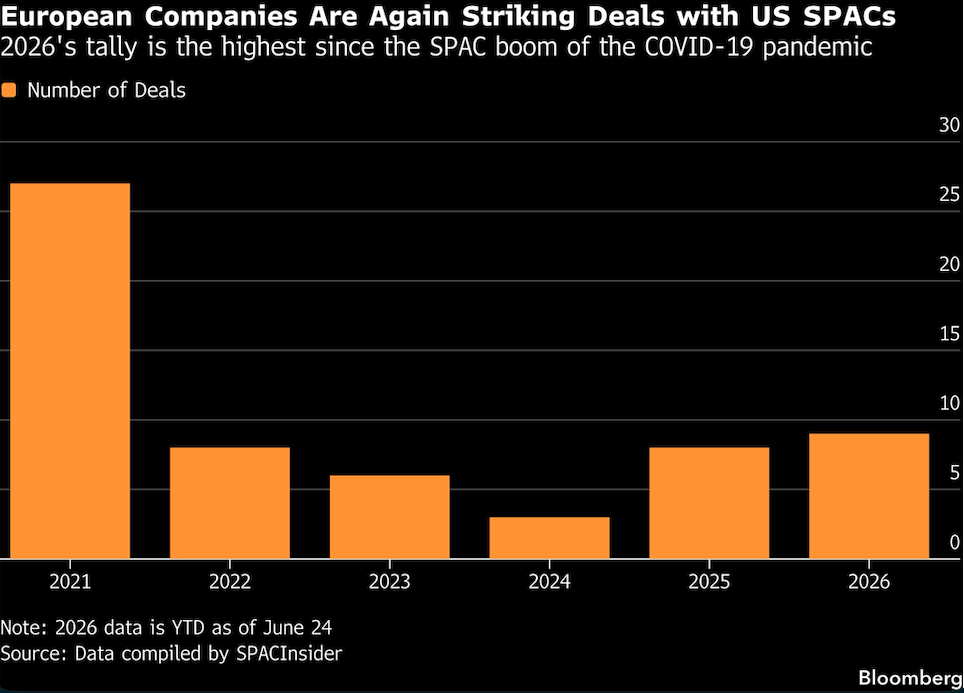
Newcleo is one of nine European startups with a combined value of at least $12.3 billion that have announced plans this year to merge with US-listed SPACs. That’s already the highest annual tally since 2021 in terms of both volume and value, according to data compiled by SPACInsider.
European firms in critical sectors like nuclear energy and quantum computing are flocking to the US, despite efforts by European authorities and bourses to make the region’s markets more appealing and accessible.
“European governments have invested heavily through grants and research in building these companies, and then the economic upside mostly accrues to US public market investors,” said Filip Dames, founding partner at venture capital firm Cherry Ventures GmbH.
While the dynamic raises questions around sovereignty over specialist technology at a time when relations between with the US are strained.
“It’s not necessarily bad, but it does raise questions about governance and control: when a European nuclear technology company is accountable to a US shareholder base, whose strategic interests take priority during a crisis,” Dames noted.
Three of the companies that have struck mergers this year with US-listed SPACs are in quantum computing, an area where the European Union aims to become a global leader within the next four years. Among those is Pasqal Holding SAS, backed by French state-backed lender Bpifrance, which is combining with a New York-listed vehicle and planning to add a Paris listing.
Policymakers in the UK and continental Europe are making efforts to channel more money into homegrown startups and also invigorate the region’s capital markets. The EU has created a €5 billion investment fund that will invest in quantum computing, AI and other deep-tech companies. But the rise in mergers with US-listed SPACs suggest some businesses are still not finding the support they need at home.
“Private capital is clogged right now, with very little liquidity in private equity and venture capital because exits dried up,” said Isabelle Freidheim, CEO of SPAC-sponsor Athena. “So, where does the money come from? The public market — and, specifically, the US public market.”
Back in focus
Once a fringe product, blank-check companies rose in popularity during the coronavirus pandemic as a way for startups to go public without the cumbersome IPO process. A SPAC’s sponsor raises funds from investors and lists a cash shell on a stock exchange — most frequently in the US — with a view to acquiring a target within a set period.
But they soon fell out of fashion as many companies that had gone public through SPACs traded poorly, while other vehicles still looking for targets faced redemptions as interest rates crept up.
Christian Noske, a partner at venture capital firm NGP Capital, cautioned that SPACs often don’t lead to positive outcomes. Two of his past portfolio companies went public through the blank-check vehicles, including used car retailer Shift Technologies Inc., which filed for Chapter 11 bankruptcy and wound down its business in 2023.
Noske said many companies choose the SPAC route because of limited path of fundraising, and companies should weigh the benefits and risks of the path. It’s not seen as a strong signal in the venture capital community, Noske said.
“The regulations around SPACs improved a lot, but the SPAC sponsors, lawyers and investment bankers still detract a lot of cash from SPAC transactions,” Noske said. “That’s not the case for the startup founders and the VC investors.”
Even so, SPACs are regaining traction with Europe’s IPO market still largely shut for midsize, cash-burning startups. Because money is raised upfront — often through a private placement to top up leftover proceeds from the SPAC listing — some companies see blank-check mergers as a way to go public that’s less exposed to market swings.
Those that succeed typically do so with support from retail traders chasing after investment themes like nuclear energy, quantum computing, cryptocurrencies or rare earths.
“The appetite for the stock is there,” Athena’s Freidheim said. “The SPAC is simply how they meet a market that’s already open to them.”