With back-to-back announcements this week, SK Hynix Inc. and Micron Technology Inc. have solidified the memory chip market as the hottest part of the AI industry.
SK Hynix disclosed plans earlier this week for a blockbuster stock listing in the US. The South Korean memory-chip maker is seeking roughly 45.45 trillion won ($29.4 billion) in an offering that will rank among the biggest of all time.
Micron followed with its quarterly report, delivering sales and profit forecasts that shattered analyst estimates. Shares of the largest US memory company soared, helping quell fears that artificial intelligence spending might slow. The reaction in Asian markets Thursday was swift, as SK Hynix, rival Samsung Electronics Co. and Japanese supplier Kioxia Holdings Corp. all added to extraordinary rallies over the past year.
“The memory industry has been structurally transformed by the proliferation of AI,” Micron Chief Executive Officer Sanjay Mehrotra said in a post-earnings conference call late Wednesday. “We are only in the early innings of the significant innovation and productivity that can be unleashed in every part of the global economy over time.”
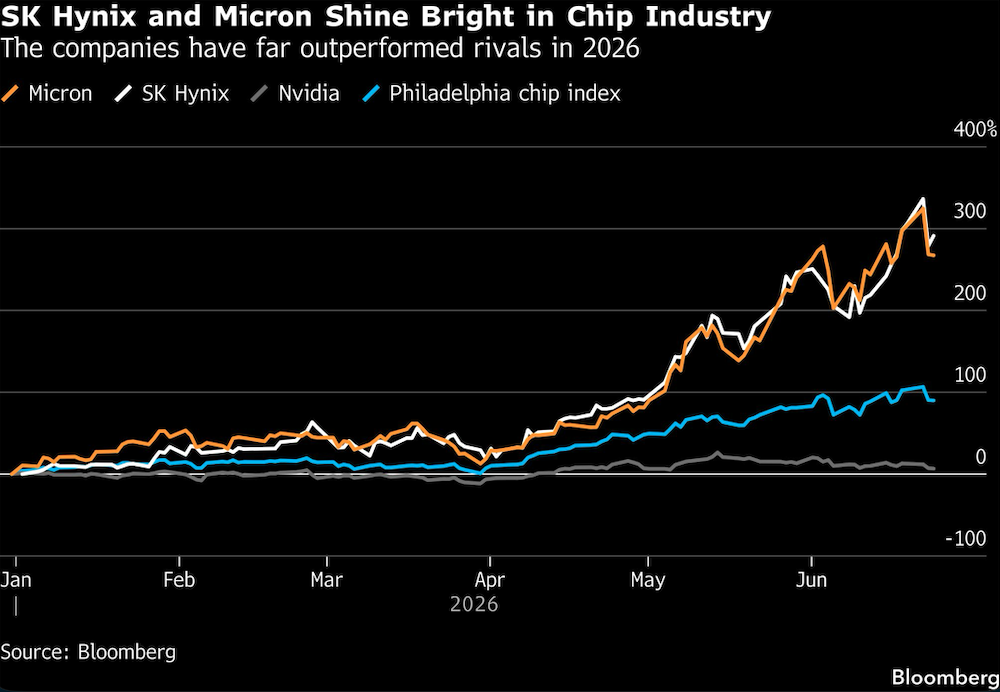
That’s buoyed Micron to be the biggest gainer in the benchmark Philadelphia Stock Exchange Semiconductor Index this year. Its shares have skyrocketed more than 300% this year, putting it on track for their biggest annual rally since 2009. Shares of SK Hynix have more than quadrupled since the start of the year, Samsung has nearly tripled, and Kioxia, which specializes in unglamorous flash storage that’s also seen an AI-driven surge in demand, is up close to 900% and now Japan’s most valuable company.
As recently as 2023, companies like Micron and SK Hynix were struggling with losses from a downturn in demand and would have seemed like improbable heroes. At that time, with markets awash in inventory, Micron alone lost nearly $6 billion in its fiscal year. Producing memory chips, which help computers hold and manage data, is a capital-intensive business famous for its boom-and-bust cycles.
What Bloomberg Intelligence Says
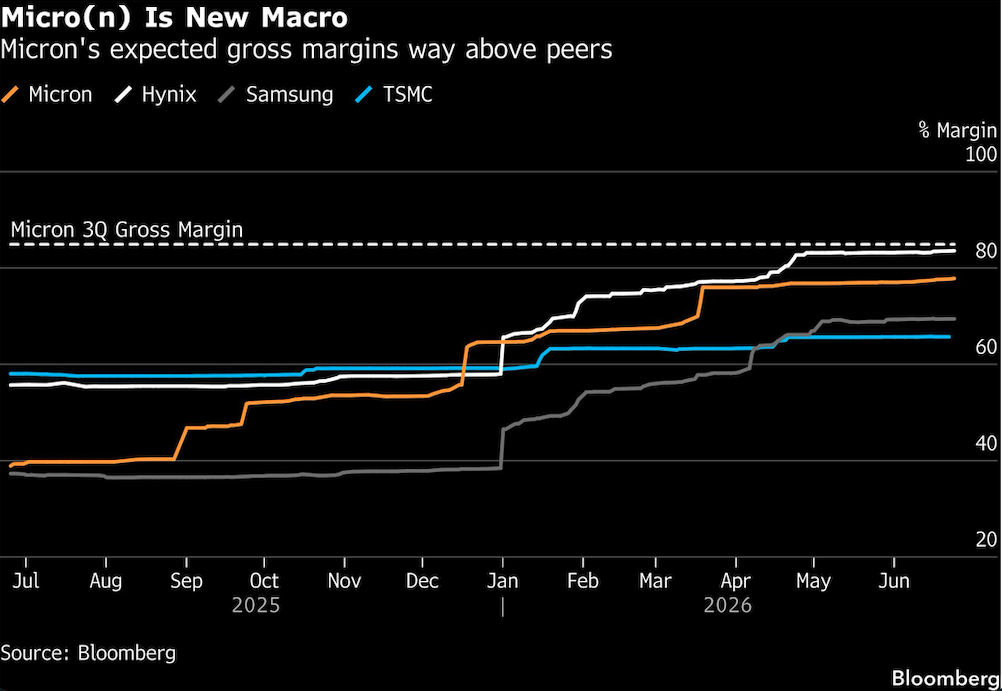
Micron’s 74% sequential revenue growth in its fiscal 3Q ended May implies SK Hynix and Samsung Electronics might achieve similar spikes in revenue for their April-June quarters due to price hikes for DRAM and NAND chips. Since there’s a one-month difference in the fiscal quarters of SK Hynix and Micron, growth rates won’t be identical, but the strength of their revenue and operating-profit growth should be of a similar magnitude. Currently the April-June revenue consensus for SK Hynix is around 56% sequential growth.
— Masahiro Wakasugi nd Jake Silverman, BI analysts
SK Hynix and Kioxia have had an even more perilous history. SK Hynix was born from a government-led bailout in South Korea of its two progenitors, LG Semiconductor and Hyundai Electronics, and struggled for years. Kioxia was spun out from scandal-ridden Toshiba Corp., and then had its public debut delayed multiple times due to lackluster investor demand.
The AI infrastructure boom led by Nvidia Corp. has changed the equation. SK Hynix was a pioneer of high-bandwidth memory, or HBM, components that have proven invaluable when paired with Nvidia AI accelerators. Though SK Hynix still has an edge in that market, Micron and Samsung have raced to catch up in recent years.
Key to the current supply crunch is the issue of capacity expansion. The most recent downturn limited long-term spending from the chipmakers and HBM has consumed capacity at the expense of conventional DRAM and NAND chips. Makers of computers, smartphones and other equipment are all struggling to secure supply at cost-effective pricing.
That’s allowed Micron to outshine companies like its partner Nvidia, the dominant maker of AI processors. Though Nvidia remains the most valuable business in the world, its shares are up just 5.4% this year. Micron said it has already shipped a billion dollars’ worth of HBM4 chips and is ramping up that product at twice the rate of its predecessor last year.
The company is using the supply shortages to sign more clients to longer-term deals, many stretching out five years into the future and giving Micron greater visibility in sales to guide capital spending.
“I’ve been in memory for 25 years,” said Manish Bhatia, executive vice president of Micron’s global operations. “There’s never been a better time to be in memory.”
The industry may ultimately lurch back into one of its legendary gluts — but that’s not likely to happen soon. Mehrotra told analysts that shortages would extend beyond 2027. New opportunities, such as robotics, will increase the appetite for memory and storage, he said.
“We currently do not have line of sight as to when memory supply will be able to catch up with increasing demand,” Mehrotra said.