On the heels of arranging a record $85 billion equity-raise for Alphabet Inc., Goldman Sachs Group Inc. has scored a lesser-known victory for the tech giant in the municipal bond market.
The muni market is best known for borrowings by US states and cities, but a structure known as prepaid energy bonds is allowing companies like Google parent Alphabet and Realty Income Corp., a massive real estate investment trust, to raise financing. As part of the financial engineering of such deals, utilities lock in cheaper natural gas or electricity for decades, while companies like Alphabet that participate in the transaction as financial intermediaries access cheaper funding and a new investor base.
The booming prepaid sector is expected to become another frontier in borrowing for tech firms tapping every inch of credit markets. Although the deal involving Alphabet didn’t specify how the tech giant would use the proceeds that it will be advanced as part of the complex transaction, many tech companies are seeking to finance the buildout of artificial intelligence infrastructure and the rising cost of energy.
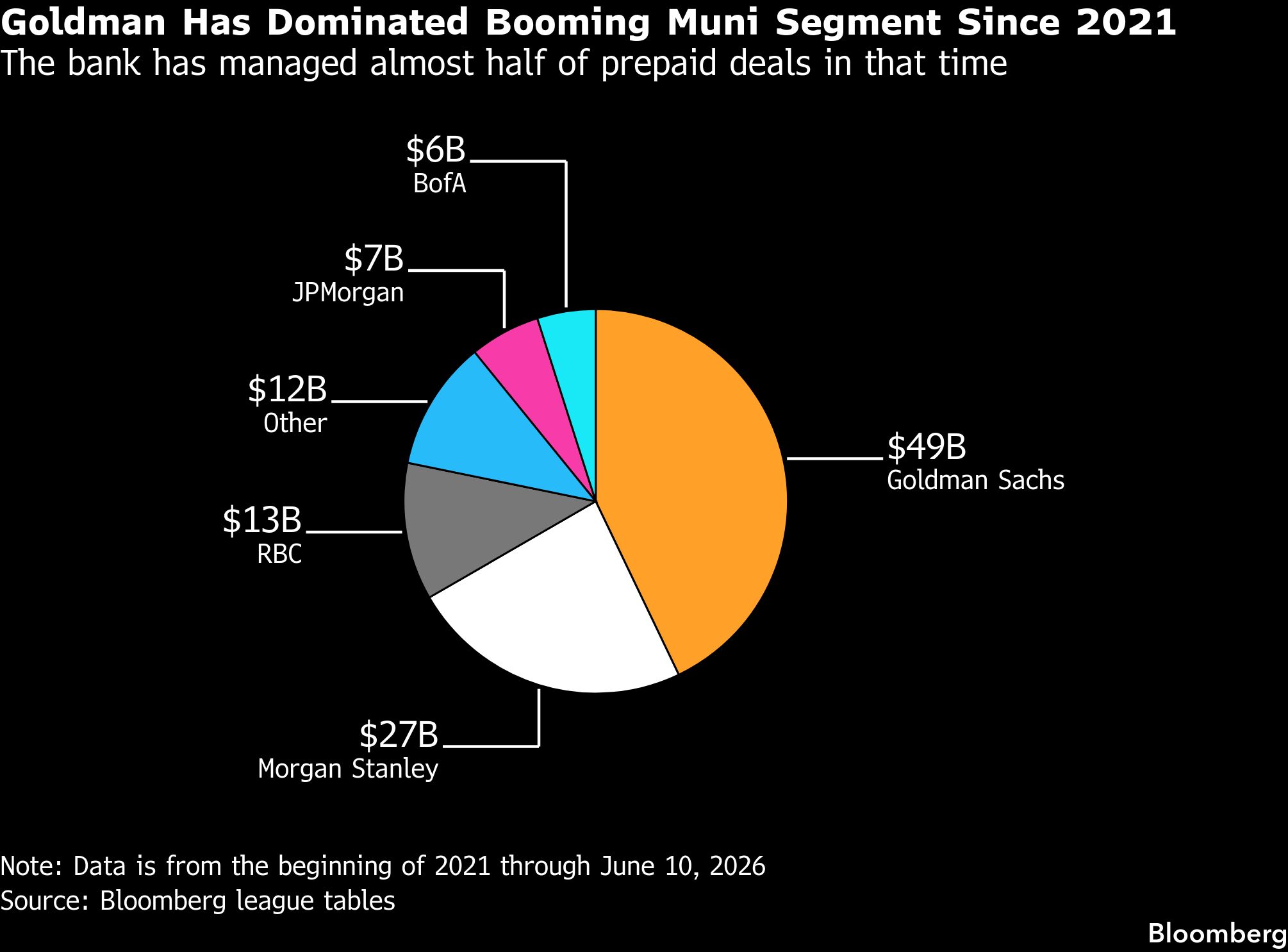
Last year, Goldman underwrote more than 40% of transactions in this fast-growing segment, according to data compiled by Bloomberg. Sales of prepay energy deals are up over 100% year-over-year, with $19 billion of issuance.
In prepaid deals, corporations play the role of a financial middleman using the proceeds of a bond sale at their discretion in exchange for making regular payments to facilitate the delivery of energy to the utility at a discount to prevailing rates. Firms that have been so-called funding recipients include billionaire Ken Griffin’s hedge fund Citadel, as well as foreign banks like Japan’s Nomura Holdings and a number of life insurers.
Proponents say these complex transactions benefit companies as well as consumers — a win given increasing tension across the US as data centers soak up resources.
Goldman is seen as one of the pioneers of the structure, with veteran banker Joseph Natoli focusing on prepay deals for the bank, but other Wall Street players are rushing to build out their ranks. Competitor JPMorgan Chase & Co. recently hired banker May Xing from Goldman to expand its own prepaid energy business.

Representatives from both Goldman and Alphabet declined to comment.
Buzz had been building in the muni market about tech companies participating in prepaid energy bonds, but even some of the largest investors weren’t aware of the Alphabet deal ahead of time, adding to the intrigue.
The roughly $1.2 billion transaction out of California received substantial investor interest, causing the debt to rally after the sale.
“It works well for corporations because they can lower their funding costs by borrowing in the tax-exempt market,” Jeremy Holtz, portfolio manager at Income Research + Management, said of the structure. “It also works really well for utilities and utility customers because they’re essentially prepaying for natural gas over a long term, call it 20 to 30 years, at discounted prices.”
Prepaid energy deals have boomed in popularity in recent years because borrowing costs in the muni market have stayed low compared to the world of corporate bonds. To be sure, sales can be at the whims of the market: when municipal yields climb in comparison to corporate debt, the deals can go away.
Investors are fans of the transactions because they often have strong credit ratings and pay high yields to account for their complex nature.
‘Light Went On’
Earlier this year, Realty Income became the first REIT to use the structure in a nearly $700 million deal with Goldman in March.
Realty’s Chief Financial Officer Jonathan Pong had been searching for ways to diversify funding sources, and Goldman suggested using the prepaid market.
Initially, he said, the thought of his firm taking advantage of a tax exemption usually employed by state and local governments gave him pause. But what ultimately won Pong over was advice by Goldman’s Natoli: This is an opportunity to do well financially while doing good for your community.
“When I heard Joey say San Diego Community Power, the light went on,” Pong said. “We can say, ‘look, we’re partnering with a local San Diego utility, we are indirectly helping to lower the cost of your energy.’”
The deal was about 10 to 15 basis points cheaper than traditional funding costs, Pong said.
Goldman has long dominated underwriting in the prepaid sector, and only about a dozen banks have been credited as managers of such deals, data compiled by Bloomberg shows.
It’s a hard area for smaller firms to enter, given that bankers typically need to have solid relationships with the major companies that usually serve as funding recipients.
That makes Goldman, as well as Wall Street giants like Morgan Stanley and JPMorgan, well-suited to working on the deals. Realty Income also expects to be involved in prepaid deals in the future.
“It’s not meant to be a one-time thing, it’s meant to be programmatic,” Pong said.
A message from Advisor Perspectives and VettaFi: Discover something new! Click here to register for our upcoming webcas
Bloomberg News provided this article. For more articles like this please visit
bloomberg.com.
Read more articles by Erin Hudson, Amanda Albright