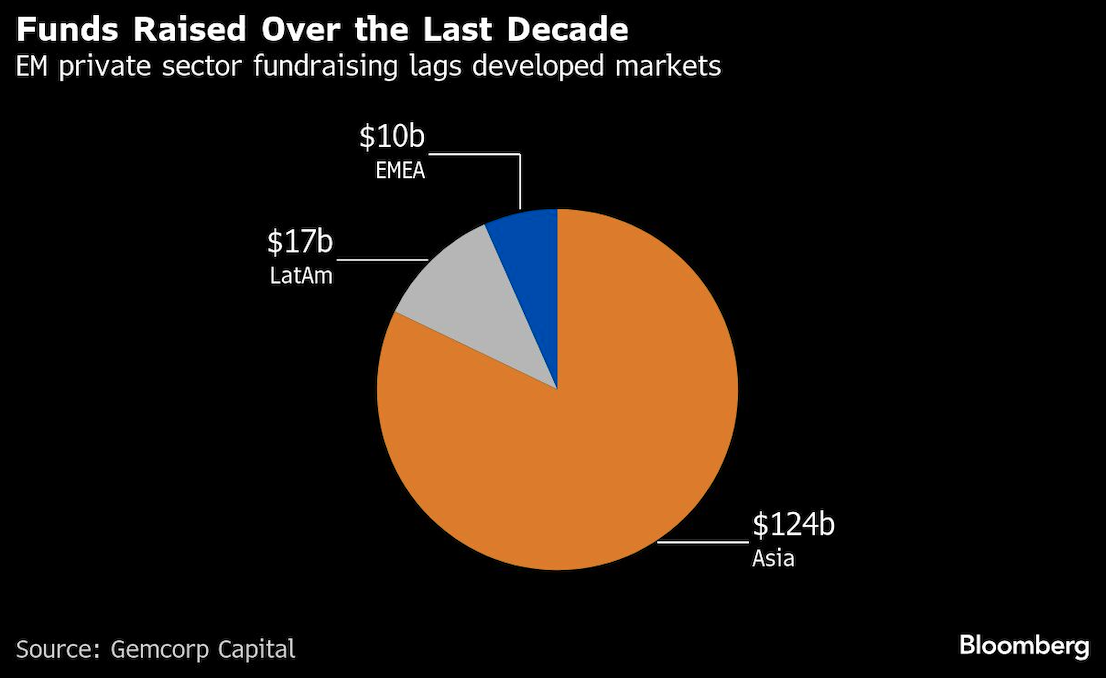
Asset managers are looking to raise new private credit funds aimed at emerging markets to capitalize on an explosion of financing deals in the sector this year.
Ninety One Plc said it’s working to close a $500 million fund in the first quarter of 2026, followed by another one by the end of the year. Gramercy Funds Management has already raised $760 million and is looking to reach $1.5 billion for a new fund, according to people familiar with the matter.
The efforts are picking up as EM funding from private lenders such as Blackstone Inc. and Apollo Global Management Inc. is on course for its biggest year on record. Potential investors are being drawn to the prospect of diversification and double-digit returns, with EM assets rallying this year after a decade of underperformance.
“We definitely are raising more capital, whether that’s into existing funds like emerging-market transition debt or into new strategies that we are in the process of developing,” said Nazmeera Moola, chief commercial officer for private markets at Ninety One, which manages around $8 billion in private credit globally. “It’s an underserved market,” she said.
Emerging markets account for less than 10% of total private credit investments, in an industry that’s now worth around $1.7 trillion globally. Investor allocations have been underweight until now as many lenders have avoided the developing world due to worries over their ability to enforce contracts, currency risks and political instability.

First CLO
The World Bank Group’s private sector arm International Finance Corp. is trying to change this by attracting private capital into emerging markets. It launched a $510 million collateralized loan obligation deal last month — an investment vehicle that slices up loans and turns them into bonds and equity — with the aim of creating a new asset class that meets institutional standards.
That’s partly because the average size of individual EM deals is small, at about $30 million to $50 million, too little for US-based private credit firms, even though their investors are receptive to emerging markets.
“This approach opens the door to the world’s largest pools of capital — pension funds, insurance companies, and asset managers to invest more substantially in emerging markets,” the World Bank said in a statement on the CLO.
Pacific Investment Management Co., which participated to help structure it, said it expects to see further such deals from multilateral institutions, enabling more private lending in emerging markets to make its way through to asset managers. This year, has deployed over $10 billion in the space, up 50% from 2024.
Bigger Than US
“If you aggregate EM alternative credit, it’s larger than the US market. It is too big to ignore and too big not to have a slice of it in your portfolio,” said Pramol Dhawan, who leads the emerging markets portfolio management team at PIMCO. “The number of deals we’re doing is increasing, and the pipeline is very strong and robust. We are seeing flows and there is demand.”
Still, the numbers being raised overall are relatively small so far. In the first half of the year, private credit funds for emerging markets pulled in $3.7 billion, following $11.2 billion for all of of 2024, according to data from the Global Private Capital Association.
The interest in expanding these funds comes as the private credit industry is looking for new opportunities, given its traditional business of lending to riskier junk-rated companies is slowing and facing greater competition from banks. Firms like KKR & Co., Apollo and Ares Management Corp. are also looking to raise money from wealthy retail investors.
“Emerging markets private credit today offers the features investors sought when the private credit wave initially began in the US – uncorrelated, properly secured and with a great focus on governance – but in an uncrowded space with far less systemic leverage,” said Felipe Berliner, co-founder & head of structuring at Gemcorp Capital Management. “Done well, EM private credit is both a portfolio diversifier and a catalyst for real economic growth.”
Missionary Work
Investor confidence is being helped by a surge in public EM markets, where stocks have surged almost 27% this year and hard-currency bonds have returned nearly 9%, according to data compiled by Bloomberg.
“We think that emerging markets are very attractive today as compared to the type of risk that you would need to take in developed markets to obtain the same returns,” said Gustavo Ferraro, who runs Gramercy’s private credit strategy. “Because what we offer, we do it with lower leverage, lower duration, less structural leverage, at the fund level,” he said.
Brazil and Turkey are among the markets that are seeing strong private deal flows as high local lending rates drive companies to seek alternatives.
This year has already seen the biggest private lending deals to date in India, Southeast Asia and eastern Europe, while the Middle East’s strong economic growth makes it another target.
“What we’ve seen is up until a year ago it was missionary work, you had to sell really hard, whereas there’s been growing interest over the course of the last year,” said Ninety One’s Moola. “I think that the attractiveness of diversification and the yield pickup have definitely played into it.”
A message from Advisor Perspectives and VettaFi: Looking for a way to gain exposure to the evolving digital asset landscape? Learn about CoinShares ETFs.
Bloomberg News provided this article. For more articles like this please visit
bloomberg.com.
Read more articles by Selcuk Gokoluk