Beijing has urged local companies to avoid using Nvidia Corp.’s H20 processors, particularly for government-related purposes, complicating the chipmaker’s attempts to recoup billions in lost China revenue after the Trump administration reversed an effective US ban on such sales.
Over the past few weeks, Chinese authorities have sent notices to a range of firms discouraging use of the less-advanced semiconductors, people familiar with the matter said, asking not to be named discussing sensitive information. The guidance was particularly strong against the use of H20s for any government or national security-related work by state enterprises or private companies, the people said.
The letters did not, however, constitute an outright ban on H20 use, according to the people. Industry analysts broadly agree that Chinese companies still covet those chips, which perform quite well in certain crucial AI applications. President Donald Trump said Monday that the processor — which he called “obsolete” — “still has a market” in the Asian country.
Nvidia and Advanced Micro Devices Inc. both recently secured Washington’s approval to resume lower-end AI chip sales to China, on the controversial and legally questionable condition that they give the US government a 15% cut of the related revenue.
But even with Trump’s team on board, the two companies face the challenge that their Chinese customers are under Beijing’s pressure to purchase domestic chips instead. Beijing’s overall push affects AI accelerators from AMD in addition to Nvidia, one of the people said, though it’s unclear whether any letters specifically mentioned AMD’s MI308 chip.
Shares of Chinese AI chip designer Cambricon Technologies Corp. surged to their daily limit of 20% on the news of China’s guidance, leading a rally in peers such as Semiconductor Manufacturing International Corp.
Beijing’s stance could limit Trump’s ability to turn his export control about-face into a windfall for government coffers, a deal that highlighted his administration’s transactional approach to national security policies long treated as non-negotiable.
Still, Chinese companies may not be ready to jump ship to local semiconductors. “Chips from domestic manufacturers are improving dramatically in quality, but they might not be as versatile for specific workloads that China’s domestic AI industry hopes to focus on,” said Homin Lee, a senior macro strategist at Lombard Odier in Singapore. Lee added that he anticipates “strong” demand for the chips the Trump administration is allowing Nvidia and AMD to sell.
Beijing asked companies about that dynamic in some of its letters, according to one of the people, posing questions such as why they buy Nvidia H20 chips over local alternatives, whether that’s a necessary choice given domestic options, and whether they’ve found any security issues in the Nvidia hardware. The notices coincide with state media reports that cast doubt on the security and reliability of H20 processors. Chinese regulators have raised those concerns directly with Nvidia, which has repeatedly denied that its chips contain such vulnerabilities.
Right now, the people said, China’s most stringent chip guidance is limited to sensitive applications, a situation that bears similarities to the way Beijing restricted Tesla Inc. vehicles and Apple Inc. iPhones in certain institutions and locations over security concerns. China’s government also at one point barred the use of Micron Technology Inc. chips in critical infrastructure.
It’s possible that Beijing may extend its heavier-handed Nvidia and AMD guidance to a wider range of settings, according to one person with direct knowledge of the deliberations, who said that those conversations are in early stages.
AMD declined to comment on Beijing’s notices, while Nvidia said in a statement that “the H20 is not a military product or for government infrastructure.” China has ample supplies of domestic chips, Nvidia said, and “won’t and never has relied on American chips for government operations.”
China’s Ministry of Industry and Information Technology and the Cyberspace Administration of China did not respond to faxed requests for comment on this story, which is based on interviews with more than a half-dozen people familiar with Beijing’s policy discussions. The White House did not respond to a request for comment outside normal business hours.
The Chinese government’s posture raises questions about the Trump administration’s explanation for why the US is allowing those exports mere months after effectively banning such sales. Multiple senior US officials have said their policy reversal was the result of trade talks with China, but Beijing has publicly indicated that the resumed H20 shipments were not part of any bilateral deal. China’s recent notices to companies suggest that the Asian country may not have sought such a concession from Washington in the first place.
Beijing’s concerns are twofold. For starters, Chinese officials are worried that Nvidia chips could have location-tracking and remote shutdown capabilities — a suggestion that Nvidia has vehemently denied. Trump officials are actively exploring whether location-tracking could be used to help curtail suspected smuggling of restricted components into China, and lawmakers have introduced a bill that would require location verification for advanced AI chips.
Second, Beijing is intensely focused on developing its domestic chip capabilities, and wants Chinese companies to shift away from Western chips in favor of local offerings. Officials have previously urged Chinese firms to choose domestic semiconductors over Nvidia H20 processors, Bloomberg reported last September, and have introduced energy efficiency standards that the H20 chip does not meet.
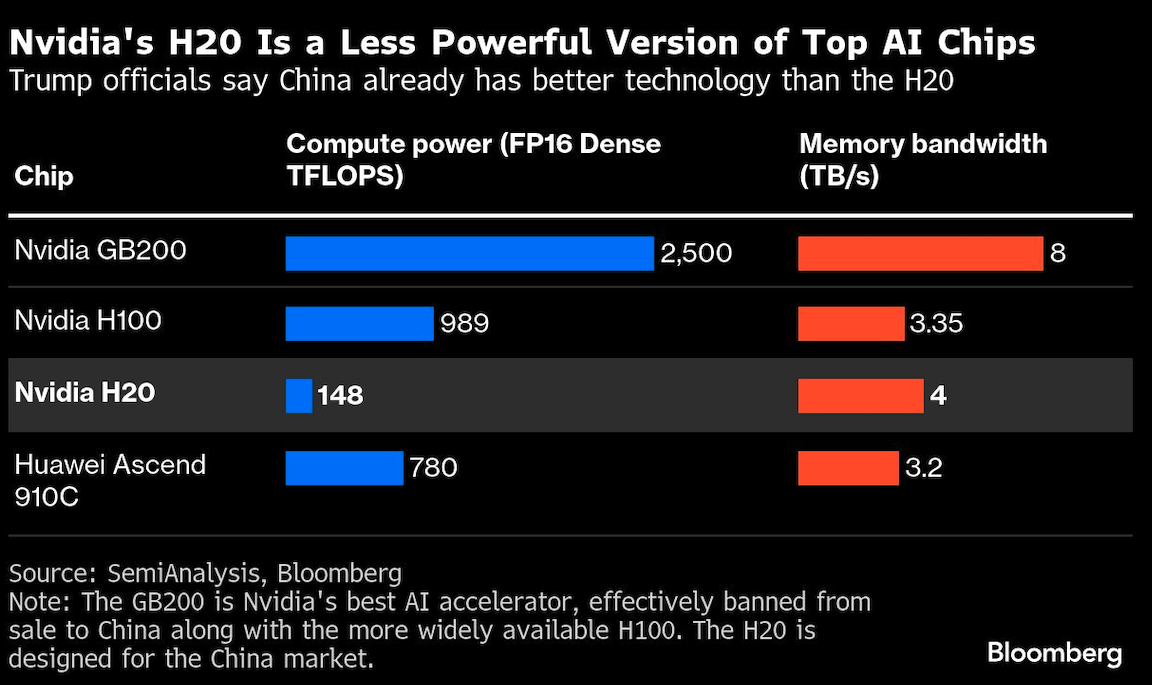
Nvidia designed the H20 chip specifically for Chinese customers to abide by years of US restrictions on sales of its more advanced hardware, curbs designed to limit Beijing’s access to AI that could benefit the Chinese military. The H20 chip has less computational power than Nvidia’s top offerings, but its strong memory bandwidth is quite well suited to the inference stage of AI development, when models recognize patterns and draw conclusions.
That’s made it a desirable product to companies like Alibaba Group Holding Ltd. and Tencent Holdings Ltd. in China, where domestic chip champion Huawei Technologies Co. is struggling to produce enough advanced components to meet market demand. By one estimate from Biden officials — who considered but did not implement controls on H20 sales — losing access to that Nvidia chip would make it three to six times more expensive for Chinese companies to run inference on advanced AI models.
“Beijing appears to be using regulatory uncertainty to create a captive market sufficiently sized to absorb Huawei’s supply, while still allowing purchases of H20s to meet actual demands,” said Lennart Heim, an AI-focused researcher at RAND, of China’s push for companies to avoid American AI chips. “This signals that domestic alternatives remain inadequate even as China pressures foreign suppliers.”
In his remarks Monday, Trump said China’s Huawei already offers chips comparable to the Nvidia H20, echoing previous remarks by officials in his administration who’ve defended the decision to resume H20 exports partly on those grounds. The US should keep the Chinese AI ecosystem reliant on less-advanced American technology for as long as possible, these officials say, in order to deprive Huawei of the revenue and know-how that would come from a broader customer base.
Other administration officials have strongly objected to that logic, Bloomberg has reported, arguing that resuming H20 exports will only embolden China’s tech champions and bolster the country’s overall computing power.

Commerce Secretary Howard Lutnick and other Trump officials have also claimed that the H20 move was part of a deal to improve American access to Chinese rare-earth minerals — despite the Trump team’s previous assertions that such an arrangement was not on the table. “As the Chinese deliver their magnets, then the H20s will come off,” Lutnick said last month. Treasury Secretary Scott Bessent said in late July that the magnet issue had been “solved.”
The first Nvidia H20 and AMD MI308 licenses arrived a bit over a week after Bessent’s declaration — after Nvidia Chief Executive Officer Jensen Huang met with the president and both companies agreed to share their China revenue with the US government.
A message from Advisor Perspectives and VettaFi: To learn more about this and other topics, check out some of our webcasts.
Bloomberg News provided this article. For more articles like this please visit
bloomberg.com.
Read more articles by Mackenzie Hawkins, Ian King