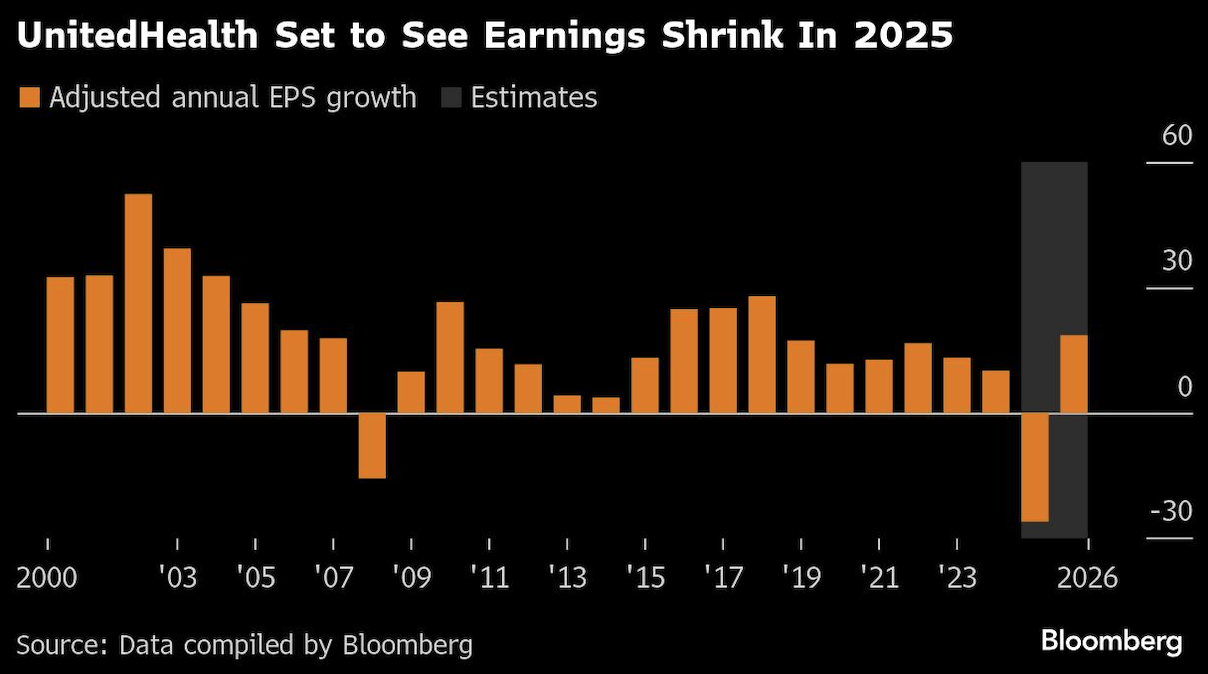
UnitedHealth Group Inc. tumbled after warning its annual profit would be hit harder than Wall Street was expecting, the latest in a series of disappointments from an insurer once known for its reliable growth and predictability.
The health-care giant also lowered its long-term profit margin targets for key businesses and declined to affirm a long-standing growth target for the broader company, a sign that the challenges it’s facing aren’t going away any time soon.
The company said it now expects adjusted earnings for 2025 to reach at least $16 a share, far below the $20.40 average Wall Street estimate and figures it gave earlier this year. Second-quarter earnings also missed expectations.
The company’s stock fell as much as 7.7% at the start of trading in New York on Tuesday. The shares had lost 44% so far this year through Monday’s close.
UnitedHealth is trying to reset investors’ expectations after an unraveling that stunned Wall Street. Though the company’s ability to accurately predict risks has helped it become an industry giant, earlier this year it was caught badly off guard by soaring medical costs. The problem was so severe, it was forced to withdraw its outlook entirely, sending shares plummeting.
Because UnitedHealth only resets the premiums it charges those on its insurance plans once a year, its ability to quickly cope with unanticipated, rising expenses is limited. It won’t return to growth, which Wall Street has come to expect from UnitedHealth, until 2026, it said.
When it does, that growth may also be weaker than UnitedHealth initially forecast. In May, UnitedHealth said it would return to growth in 2026 and get back to its long-term plan to increase annual earnings per share by 13% to 16% on average over time.
Chief Executive Officer Stephen Hemsley declined to affirm those figures in a call with analysts Tuesday, but said: “The framework for our long term growth outlook remains very much intact.”
He said the company will return “to low double digit ranges and continue to advance from there,” but he called the discussion of long-term growth rates “somewhat academic.”
This is unfamiliar territory for the insurer. It’s on track for adjusted earnings per-share to drop this year for the first time in nearly 20 years.

The key problem facing UnitedHealth is that Americans are simply using more medical care than it planned for when it set its premium rates last year. At the same time, some government programs are clamping down on who’s eligible for subsidized coverage, and changing payment formulas in ways that squeeze insurers’ profits.
It’s not a struggle unique to UnitedHealth. Elevance Health Inc., Centene Corp., Molina Healthcare Inc. and Oscar Health Inc. have all lowered or withdrawn their 2025 outlooks, citing problems in government health programs including Medicaid, the Affordable Care Act markets, and Medicare.
The outlook will get more challenging. Tax credits that drove a surge of enrollment into ACA plans expire next year unless Congress extends them. A Republican-backed budget law passed this month cuts almost $1 trillion from Medicaid and is projected to drive up the number of people without health insurance by 10 million over a decade.
The policy shocks, along with insurers’ existing troubles predicting their future expenses, have left stock prices decimated. UnitedHealth, Centene and Molina are all among the five worst performing companies in the S&P 500 so far this year, according to data compiled by Bloomberg.
Management teams suggest the recent meltdown is temporary and express confidence that insurers will resume their historical trajectory of profit growth. The question for Wall Street is whether the reversal of momentum in Washington — toward lowering costs and shrinking insurance coverage — poses a more durable threat to the earnings power of the industry.
Analysts also said UnitedHealth set its fresh 2025 forecast at an especially low level. By doing so, it could more easily avoid disappointing investors once again. The company has already posted adjusted earnings of $11.28 in the first half of the year, nearly three quarters of the way toward its updated guidance.
The new guidance for 2025 looks “extremely conservative, and I think they will end up beating it by a decent amount,” said Jeff Jonas, portfolio manager at Gabelli Funds.
However, it could also be a sign of just how tough the circumstances are facing UnitedHealth.
Recent Results
UnitedHealth said its most recent results reflect problems in the ACA business that others in the industry have experienced as well. The company said it took a charge related to “the acceleration of future losses” from the second half of the year.
In the second quarter, UnitedHealth’s profit of $4.08 a share fell short of analysts’ forecasts of $4.59 a share.
A closely watched gauge of how much premium revenue is paid out for medical care in the second quarter was mostly in line with what analysts expected.
Optum Health, the company’s clinic and home care unit, saw earnings drop significantly in the quarter compared to a year ago. The company cited higher care activity and the impact from pricing errors and Medicare funding cuts. Until this year, Optum Health had been UnitedHealth’s fastest growing source of profit.
The company had forecast adjusted earnings in 2025 of $26 to $26.50 a share in April before withdrawing its outlook entirely the next month. That range was already lowered from its original outlook of adjusted earnings of $29.50 to $30 a share set at the end of last year.
In May, the company replaced its chief executive officer with Hemsley, the former CEO and current board chair.
A message from Advisor Perspectives and VettaFi: To learn more about this and other topics, check out some of our webcasts.
Bloomberg News provided this article. For more articles like this please visit
bloomberg.com.
Read more articles by John Tozzi