Almost everything said about Tesla Inc. these days ranges from bad to worse.
The majority of 61 analysts following the electric vehicle and clean energy company led by Chief Executive Officer Elon Musk say investors should avoid buying the stock. Plummeting sales at home and abroad underscore Bloomberg Intelligence research showing 31% of car buyers -- including 41% of women who identify as Democrats – are less likely to purchase a Tesla after Musk, the unelected leader of the Department of Government Efficiency, became a pariah inside and outside the White House. President Donald Trump accused his biggest campaign donor of being a “big-time drug addict.” Even Musk's artificial intelligence-powered chatbot, Grok, said Tesla is in a “precarious position” with a 15% to 25% risk of a “death spiral.”
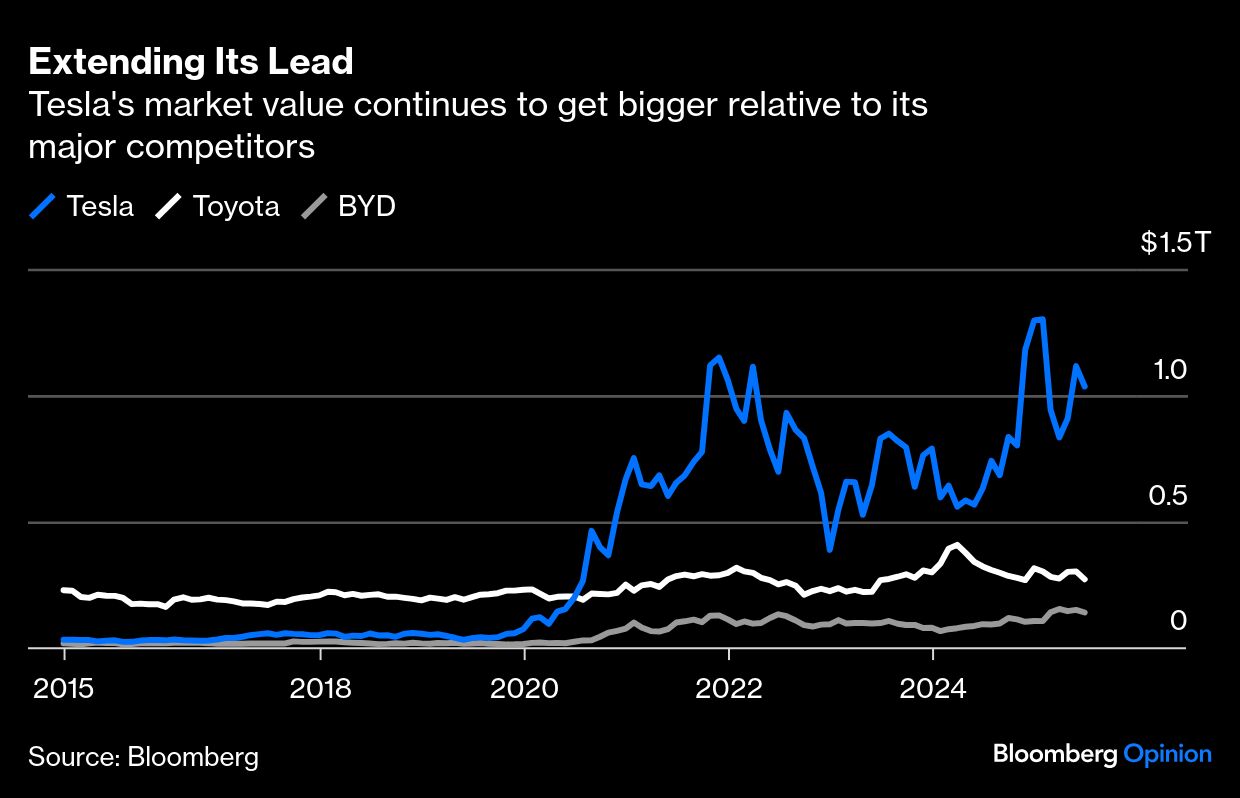
The media take on Tesla omits the unimpaired outlook that data compiled by Bloomberg show: The EV startup founded by engineers Martin Eberhard and Marc Tarpenning in 2003, still is the world's largest automaker, ninth-largest public company and worth more than the gross domestic product of Saudi Arabia. For all its might as the global sales leader, Toyota Motor Corp. is about a quarter of Tesla's $1.04 trillion market capitalization. The top 10 automakers, excluding Tesla, amount to $812 billion, or 78% of Tesla's value.

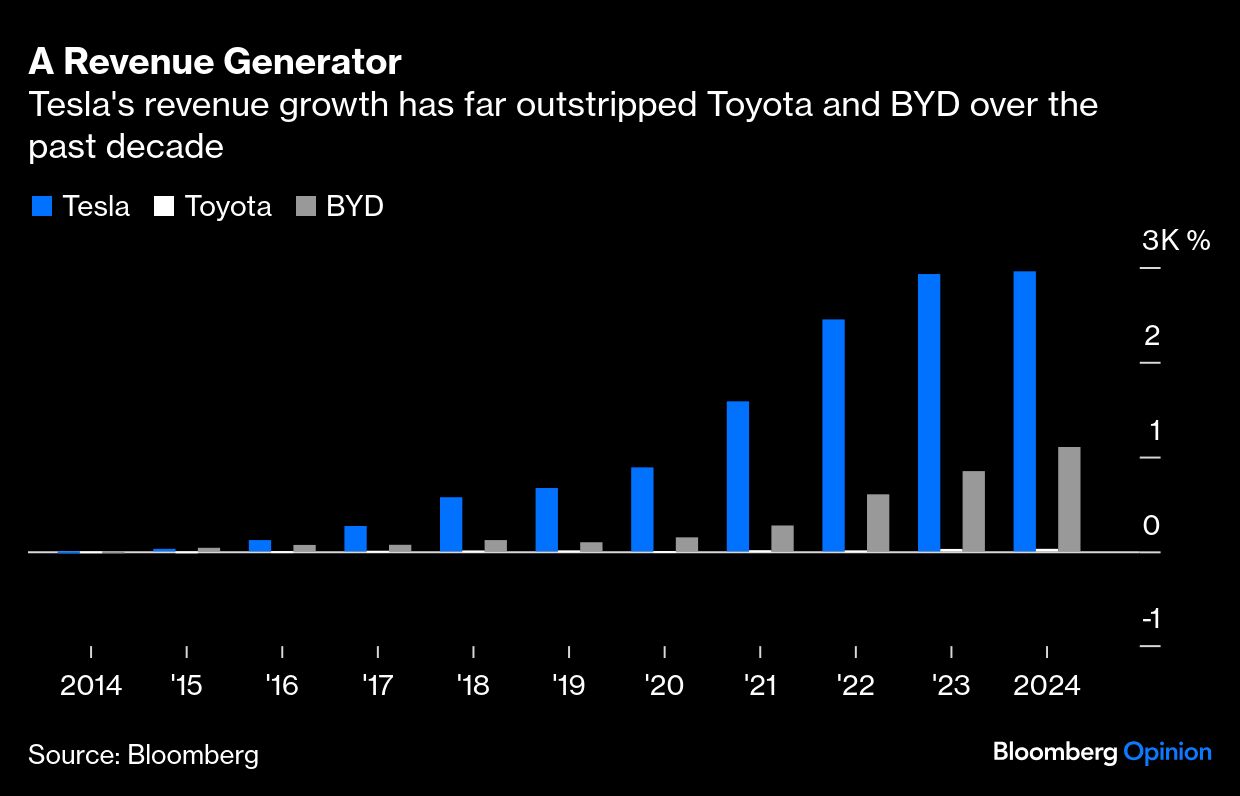
For all the discussion about Tesla's lost cachet and “demand problem,” the Model Y remains the best-selling EV model globally in 2025, which would be the third consecutive year if the trend holds, and shows no signs of losing its sales-leading position over legacy automakers in China, Europe and the US. Shareholders need only look at financial history to be unmoved by the doom mongering. Tesla's $97.7 billion of revenue last year is more than 30 times its sales a decade ago, outperforming the second-fastest growing company, China's BYD Co., whose most recent annual sales are 12 times its 2014 revenue.
Tesla earnings before interest, taxes, depreciation and amortization (EBITDA), totaled $14 billion, more than 300 times the company's profit a decade ago. No. 2 BYD, grew 15 times based on its EBITDA, which measures core business profitability since this item excludes the impact to earnings from financing and tax decisions. Tesla's current market capitalization is 31 times bigger than a decade ago, which is another way of saying none of the top 10 automakers are competitive with Tesla's revenue growth, profit and market value, according to data compiled by Bloomberg.
When Tesla on April 22 announced its biggest earnings disappointment in five years -- 27 cents a share in the first quarter, or 38% lower than the 43-cents-a-share average estimate -- the stock rose 5.37% the next day after Musk told shareholders the financial impact of autonomous driving will become material in the second half of 2025. The Tesla-designed computer chip for autonomous driving uses AI rather than expensive sensors and high-precision maps, and Tesla anticipates significant market share, potentially 99%, or at least 90% in the autonomous car market, according to data compiled by Bloomberg.
So when the question “Why is Tesla's market value four times Toyota's?” was addressed to the Bloomberg Terminal's Document Search and Analysis tool, the AI-driven function accessing news, research and analysis with full attribution and transparency, provided the following perspective:
Tesla's AI and Autonomous Technology Vision
- According to Tesla's Q1 2025 earnings call on April 22, the company is positioning itself primarily as (an) AI and robotics company that will generate value through autonomous vehicles and humanoid robots, not just as a traditional automaker.
- According to news, Tesla's AI and autonomous driving technology alone is valued at $1 trillion, according to Wedbush analyst Dan Ives.
- According to Tesla's Q1 2025 earnings call on April 22, the company expects to achieve full autonomous driving capabilities at scale by mid-2025, which would transform their business model.
Leadership and Future Growth Expectations
- According to news, Tesla's $1 trillion market capitalization is heavily influenced by Elon Musk's leadership and vision.
- According to Tesla's Q1 earnings call on April 22, management believes Tesla could become worth more than the next five largest companies combined with successful execution.
- According to news, analyst Gary Black argues that traditional automotive P/E ratios shouldn't be applied to Tesla due to different growth prospects.
Vertical Integration and Manufacturing Advantages
- According to Tesla's Q1 earnings call on April 22, the company has significant vertical integration advantages, including battery production, lithium refining and manufacturing capabilities.
- According to Tesla's Q1 earnings call on April 22, the company is leading in humanoid robotics development and expects rapid scaling of this technology.
Market Challenges
- According to news, Tesla faces multiple challenges including sales slump, profit declines, brand backlash and stock volatility.
- According to news, there is significant debate among finance experts about whether Tesla's valuation is justified or disconnected from reality.
As much as Tesla depends on 125,665 employees in the US, Europe and Asia, it has been sustained by the original foresight of its founders, Eberhard and Tarpenning and subsequently Musk, who provided the investment that enabled Tesla to disrupt and transform the auto industry.
“People in general, and equity investors in particular, want to see absolute commitment and belief in a vision of a better future,” Nicholas Colas, co-founder of DataTrek Research, who covered the auto industry since the 1980s, wrote in a note to clients last week. “They also want to be part of a winner's story, especially if there is an element of redemption in that narrative. That is something no algo or spreadsheet can understand, which is why hero-led companies are often so valuable.”
A message from Advisor Perspectives and VettaFi: To learn more about this and other topics, check out some of our webcasts.
Bloomberg News provided this article. For more articles like this please visit
bloomberg.com.
Read more articles by Matthew A. Winkler