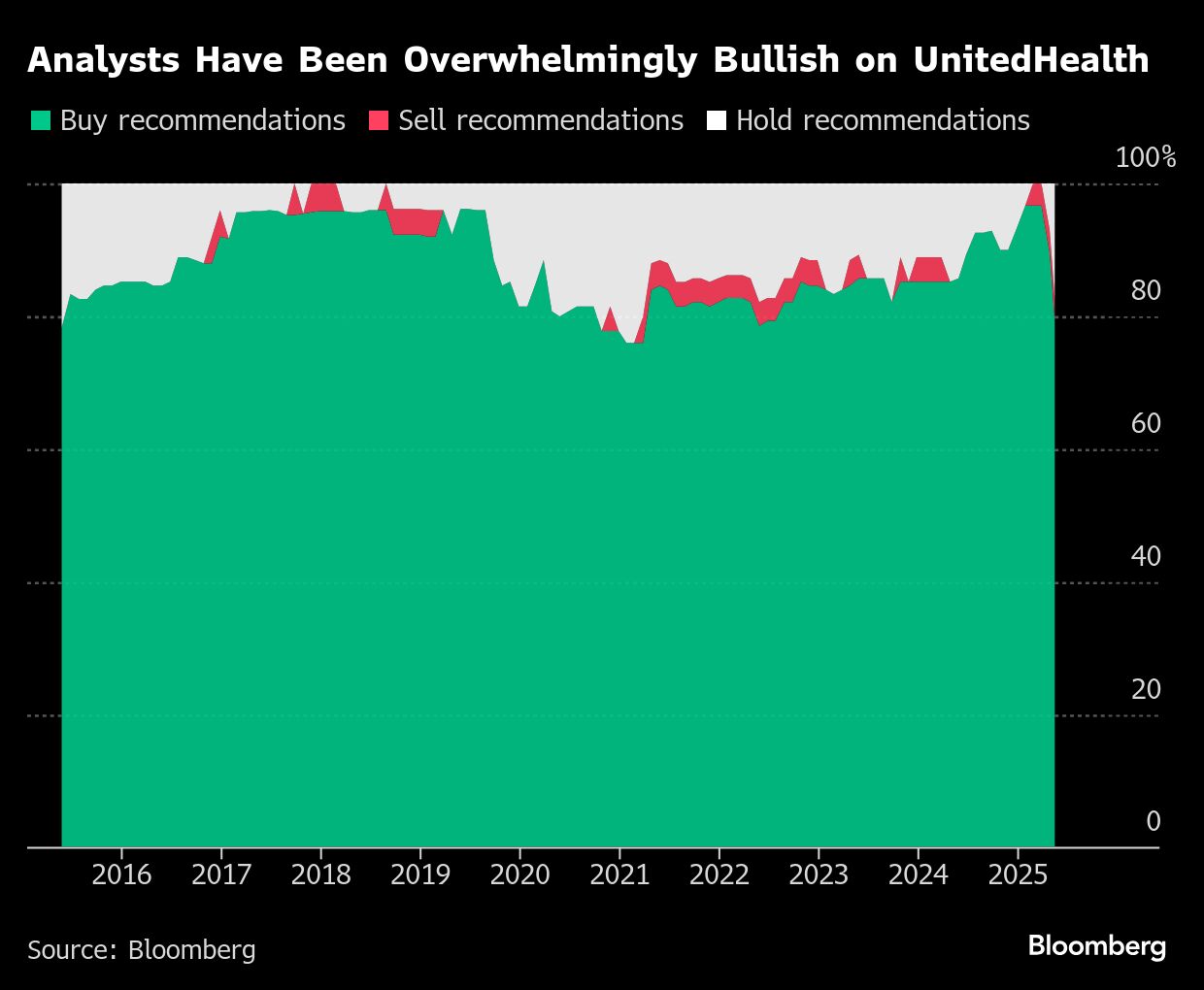
When CFRA’s Paige Meyer slapped a “sell” rating on UnitedHealth Group Inc. in February, she was the lone analyst out of 30 tracked by Bloomberg with a negative view of the company.
Meyer’s price target implying a 22% fall for the shares glared in a sea of optimistic forecasts, while her warnings on regulatory uncertainty and high medical expenses seemed almost alarmist. The health insurance giant was, after all, an industry bellwether that was widely considered a safe bet by Wall Street, even as it faced rising costs and was recovering from the murder of a top executive last year.
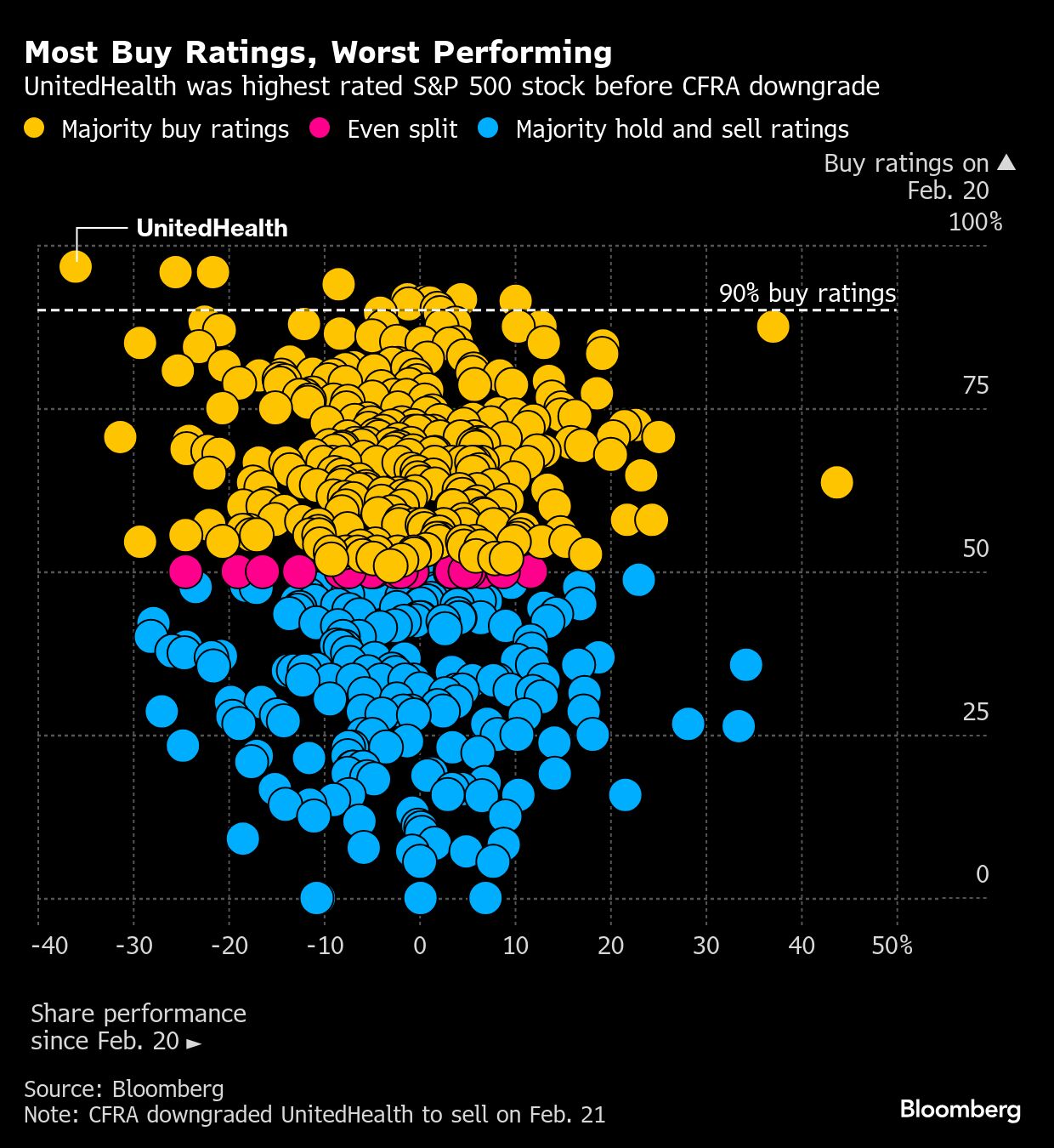
Today, Meyer’s outlook has proved more prescient than she could have imagined. UnitedHealth’s stock has plunged about 36% since her downgrade to Tuesday’s close, losing more than $170 billion in market value and notching a spot as the worst performer in the S&P 500 Index during that period. The tumble came as the company cut — then suspended — its annual forecast, replaced its chief executive officer and is now reportedly facing a criminal investigation for possible Medicare fraud.
“I feel fortunate that I had the courage to make that call,” Meyer said in an interview. “It’s hard to go against the grain.”
More bad news continues to pile up for UnitedHealth. The Guardian reported Wednesday that the insurer secretly paid nursing homes bonuses to cut hospital transfers for sick residents, as part of a series of cost-cutting tactics. Prior to that, HSBC cut the stock to a sell-equivalent rating, becoming the second analyst tracked by Bloomberg to do so. UnitedHealth shares tumbled as much as 6.7% on Wednesday.
The crisis at UnitedHealth is resurfacing an issue that has long plagued Wall Street: The overwhelmingly positive views analysts hold on America’s biggest corporations. Data compiled by Bloomberg show that nearly 60% of ratings on S&P 500 companies are “buys,” and only 5% are “sells.” UnitedHealth was an extreme example of the trend when Meyer slashed her rating, sporting the highest ratio of “buys,” at 97%.

Some of the reasons behind those bullish outlooks have little to do with company fundamentals, market participants said. Analysts may hesitate to be overly critical of a company for fear of hurting their relationship with management, which can mean less face time with executives, said Rhys Williams, chief strategist at Wayve Capital Management LLC and a nearly four-decade veteran of Wall Street.
Many also work at firms that make a hefty chunk of their profits from investment banking — an area that is typically firewalled from its research arm. Still, analysts are wary of being negative on companies that might be current or future clients, said David Miller, co-founder and CIO at Catalyst Funds.
“For the most part, they don’t want to get fired,” he said. “Investment banks aren’t charities, so they want business from these same companies.”
The collapse of Silicon Valley Bank two years ago is a recent example of analysts being blindsided by weakness in a company’s fundamentals.
To what degree such factors played a role in the coverage of UnitedHealth is hard to say. Its proponents, to be sure, often cited the firm’s dominant industry position and its history of stellar performance: The insurer regularly reported quarterly profit that beat estimates, and its stock surged more than 1,800% from its 2008 plunge through the end of 2024.
“The view has been ‘it’s the best-run company, it has the best management and it’s huge in the benchmark, so I’m just gonna set it and forget it’,” said Mike Taylor, lead portfolio manager of Simplify Health Care ETF, which has maintained an underweight position in UnitedHealth shares.
A UnitedHealth spokesperson said the company “strives to be accessible to a wide range of analysts and investors, including those with varying perspectives and ratings.”
‘A complete shock’
UnitedHealth’s issues with rising medical costs began two years ago, as patients who had put off elective procedures during the Covid-19 pandemic started seeking care. The company reassured investors in January, saying it had adequately prepared to cover medical costs trends for 2025.
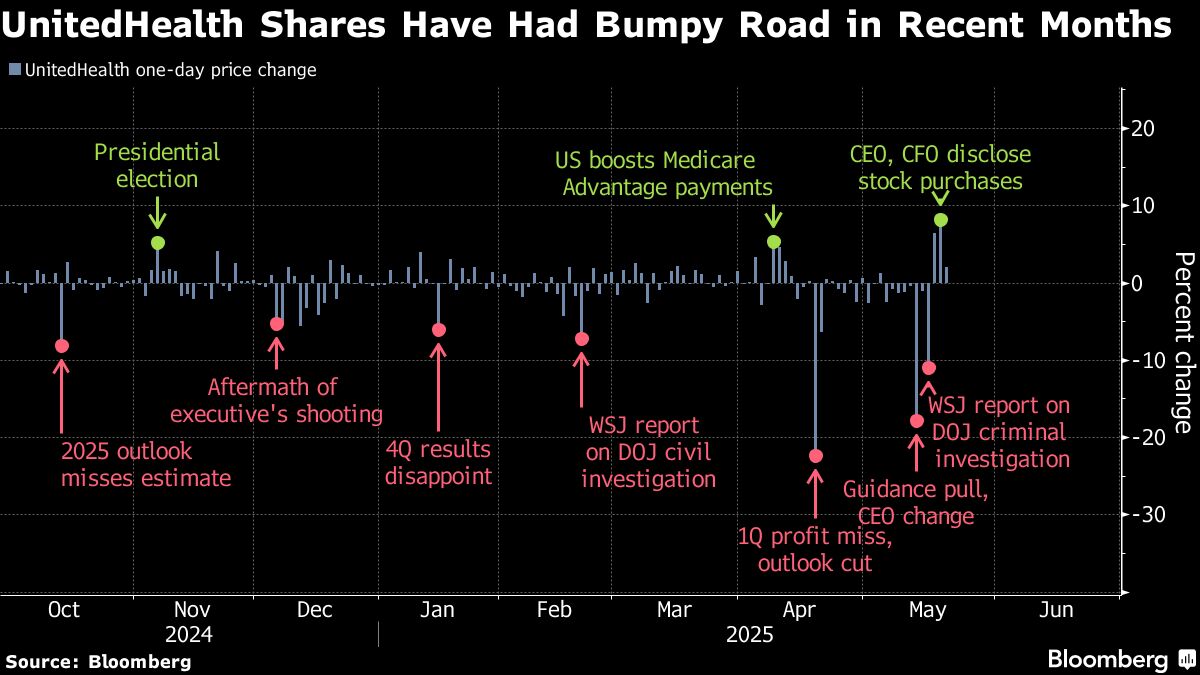
CFRA’s Meyer wasn’t convinced. Besides the threat posed by rising costs, she was alarmed by reports of a US Justice Department civil investigation into UnitedHealth’s Medicare billing practices, as well as concerns over plans by the Trump administration to cut costs in federal insurance programs. She downgraded the company to “sell” on February 21.
Other analysts were sanguine. A bevy of Wall Street banks, from JPMorgan Chase & Co. to Wells Fargo & Co., maintained positive ratings on the health insurer going into its April 17 earnings report. The stock rose 25% in the nearly two-month span between Meyer’s downgrade and the company’s first-quarter earnings. JPMorgan analyst did not respond to a request for comment on this story. Wells Fargo analyst declined to comment.
What happened next stunned analysts and investors. Medical costs were rising faster than it had anticipated, the company said. UnitedHealth reported its first profit shortfall since 2008 and cut its annual forecast as a result.
“We did speak to the company and all signs were pointing to 1Q being a solid setup,” said Michael Ha, an analyst at Baird. “It’s a complete shock and I just don’t see how anyone could have foreseen all of this happening.”
More surprises followed. CEO Andrew Witty stepped down earlier this month, to be replaced by former CEO and long-time board chair Stephen Hemsley. The company also suspended its 2025 guidance, further shaking investor confidence.
The next day, the Wall Street journal reported the company faced a criminal investigation by the Justice Department into its Medicare business. UnitedHealth has refuted the report and said it hadn’t been notified about the investigation.
Nevertheless, 23 of the 29 analysts Bloomberg tracks maintained buy-equivalent recommendations as of Tuesday’s close.
KeyBanc Capital Markets analyst Matthew Gillmor, like many others, said investors should continue buying the stock because “the issues that are negatively impacting 2025 should be fixable for 2026” as a result of the annual cycle of policy pricings for health insurers. His firm has kept its “overweight” rating.
Baird’s Ha said UnitedHealth’s stock is currently too cheap to downgrade. However, any sign of structural weakness in the company’s health-care services business could spur a ratings change, he said.
A rare bit of good news has bolstered the case for holding UnitedHealth: At least four insiders, including the newly appointed CEO, together bought some $31 million worth of its stock last week. Bargain-hunting investors appear to have joined in, sending shares up 17% from their recent lows.
Don’t count CFRA’s Meyer among the buyers, however. She sees the Justice Department investigations continuing to weigh on UnitedHealth shares and says there’s little clarity on when medical costs might peak.
“Cheap stocks,” she said, “can always get cheaper.”
A message from Advisor Perspectives and VettaFi: To learn more about this and other topics, check out some of our webcasts.
Bloomberg News provided this article. For more articles like this please visit
bloomberg.com.
Read more articles by Angel Adegbesan