Jerome Powell’s determination to ensure any jump in prices stemming from Donald Trump’s tariffs don’t spread through the economy has earned him the moniker “Mr. Too Late” from the president. For the Federal Reserve chair, that’s better than being Mr. Wrong.
Only a few months ago, Powell was steering his colleagues and the economy toward a so-called soft landing, a scenario where inflation and interest rates glide lower while unemployment remains low. Trump’s sweeping tariffs have upended the outlook, raising expectations for weaker economic growth and higher inflation this year.
That has prompted Fed officials to shift their strategy to one that might best be described as plotting a late rescue for the economy — hold rates steady for long enough to keep inflation contained, but be ready to lower them just in time to keep the labor market from crashing.
“They prefer to be late than wrong,” said Aditya Bhave, senior US economist at BofA Securities. “They’re going to wait and see how things play out on both mandates.”
Fed officials are expected to leave rates unchanged when they next meet for their two-day policy meeting May 6-7 in Washington.
In recent weeks, Powell and his colleagues have warned that the inflationary impact of the president’s import duties could be more persistent than expected, and emphasized the Fed’s job is to make sure that any pickup in prices is limited. That means maintaining a tight posture on interest rates to keep expectations about prices under control, and holding rates steady absent a substantial rise in unemployment.
“Our obligation is to keep longer-term inflation expectations well anchored and to make certain that a one-time increase in the price level does not become an ongoing inflation problem,” Powell said at the Economic Club of Chicago on April 16.
Those remarks prompted swift criticism from the White House, with Trump urging Powell to lower interest rates now to head off an economic slowdown.
Waiting comes with risks: Once the jobless rate starts to rise, it typically moves up quickly and the economy tips into recession. But lowering interest rates too soon could allow price pressures to build again, something officials are unwilling to do after the post-pandemic inflation surge.
Pulling off a late rescue, say some Fed watchers, could be the ultimate test of Powell’s policy leadership, economic insight and timing.
“This is a new test for him,” said Claudia Sahm, chief economist at New Century Advisors. “You have both sides of the mandate going off track in a way where they will have to make a choice.”
Personal Mission
Securing a soft landing after a burst of post-pandemic inflation became a personal mission for Powell. He called the peak of the Fed’s rate-hiking cycle in December 2023, having cooled but not crashed the expansion. Inflation at that time was less than a percentage point above the Fed’s 2% goal, down from a four-decade high of 7.2% in 2022.
When it came time to lower rates in September, Powell persuaded his colleagues on the Federal Open Market Committee to join him in an aggressive half-point cut to keep the labor market strong. They ended up cutting rates by a percentage point over three meetings before holding this year as inflation seemed to settle above their target.
Trump had reclaimed the White House by then, and at the Fed’s March meeting, it was clear that the threat of tariffs would keep prices elevated — leading officials to signal expectations for higher inflation and slower growth.

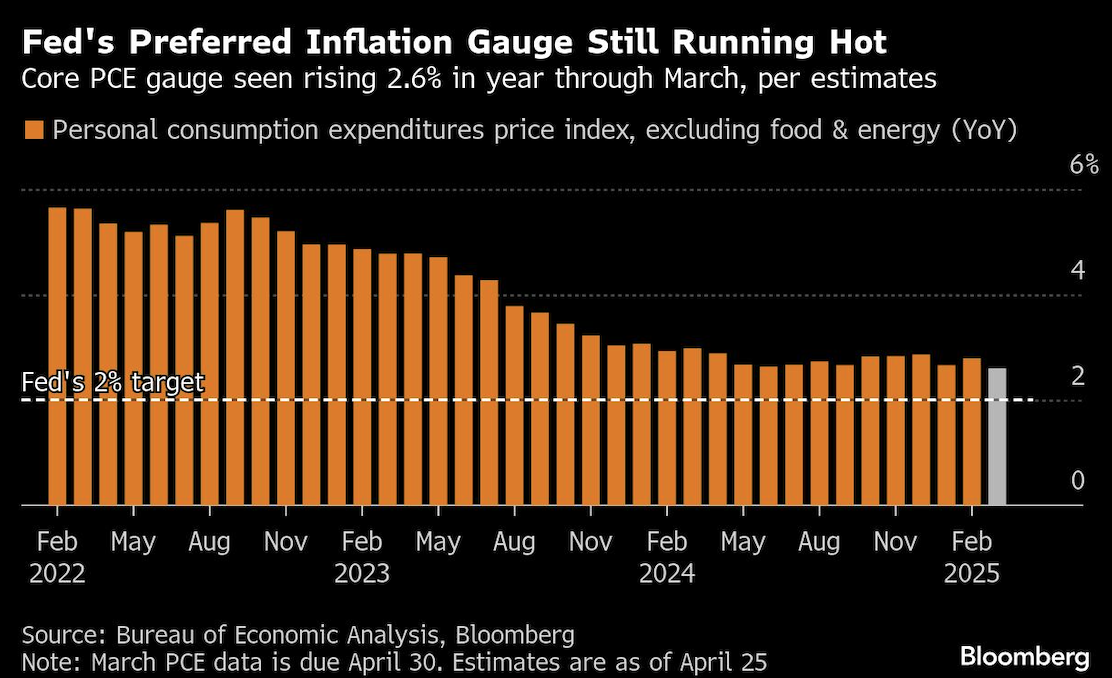
Trump’s tariff plans arrived at a sensitive time, with the previous five readings on core inflation coming in surprisingly hot. The Fed’s preferred gauge of underlying inflation stood at 2.8% in February, and economists expect it eased to 2.6% in March — still well above the central bank’s target.
“They did not reinstate price stability,” and may have eased too aggressively, said Lindsey Piegza, chief economist at Stifel Financial Corp. “I am concerned about inflation stability with or without the tariffs. We are at risk.”
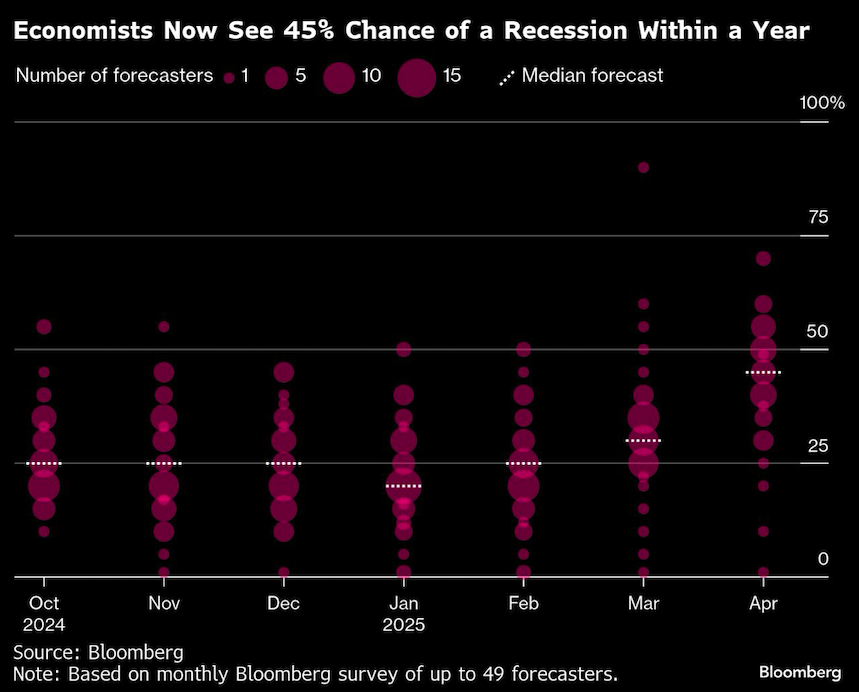
Those fears extend beyond Fed watchers. Consumer inflation expectations surged in April, according to a report earlier Friday from the University of Michigan, and economists surveyed by Bloomberg this month contend that the trade war makes the odds of a US recession a coin flip.
A downturn would undoubtedly provoke even greater hostility from the White House. Trump has already hinted at firing Powell, though subsequently backed away from the threat when it roiled financial markets.
But a central bank that fails again to control inflation after being above target for four years could, indeed, lose credibility.
“We were so close to nailing the soft landing,” said Diane Swonk, chief economist at KPMG. “The biggest mistake the Fed could make would be to instill additional inflation as the economy weakens.”
A message from Advisor Perspectives and VettaFi: To learn more about this and other topics, check out some of our webcasts.
Bloomberg News provided this article. For more articles like this please visit
bloomberg.com.
Read more articles by Craig Torres