Social Security is at the center of the fiscal emergency that threatens the US. Yet Washington is always reluctant to grapple with it honestly, partly because the issue is misunderstood.
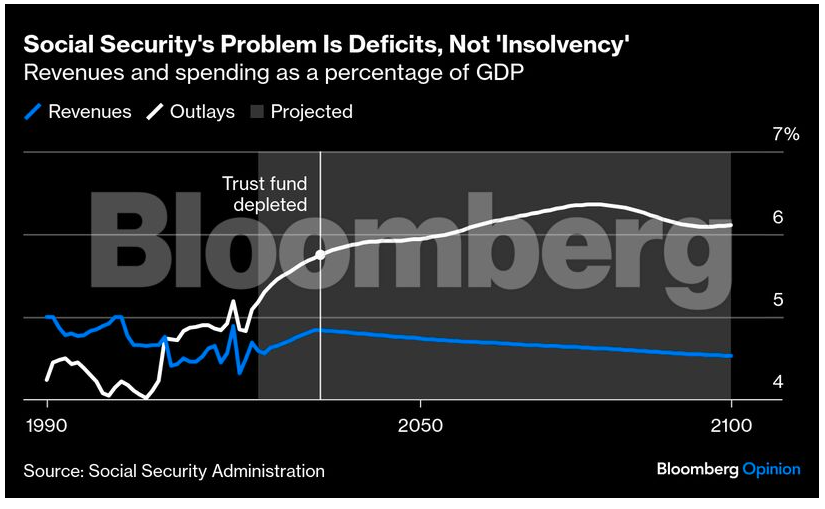
Although the system’s looming “insolvency,” now penciled in for 2035, has long been agonized over, this threat disguises the real problem. It suggests that for the next 10 years, the government still has a fund with assets to draw down, and time to put things right. In truth, the fiscal danger is here and now.
Social Security is a pay-as-you-go pension scheme disguised as a national savings plan. Its shrinking “trust fund” is an intragovernmental bookkeeping convention. There’s no pool of assets for the government to tap. The system’s deficits are growing because the population is aging and outlays are rising faster than payroll-tax revenue. In 10 years, when deficits cancel out the system’s accumulated surpluses, benefits must be cut (by about one-fifth on current estimates) to match what’s coming in. In the meantime, fund or no fund, the government must borrow to finance the deficits.
If endless borrowing were no cause for concern, Washington would have an easy way to deal with the approaching deadline: Just change the rules and keep on borrowing. But, to state what should be obvious, ever-mounting public debt is very much a cause for concern. Investors could lose their appetite for US Treasuries long before 2035, with dire economic results. Social Security needs urgent reform — not to replenish its illusory assets, but to help curb government borrowing and bring the system into closer alignment with its proper goals.

One way to cut deficits is to bundle various adjustments to outlays and receipts while preserving the system’s basic design. The other, even more challenging politically, is to reshape it, combining a more effective anti-poverty measure with a government-backed savings plan. In either case, changes would need to be phased in gradually to avoid affecting people in sight of retirement.
The first approach has been laid out many times — remember Simpson-Bowles? — and offers many options. Outlays could be reduced by slowing the growth of benefits for high earners, gradually raising the retirement age and indexing it to longevity, raising future benefits in line with an adjusted inflation metric (so-called chained CPI) or limiting cost-of-living adjustments for retirees with high incomes. Revenue could be increased by raising the wage cap on payroll taxes or taxing benefits fully, not partially.
A deeper reform makes better sense. The system is meant to assure the elderly that they’re financially secure. It currently gives benefits to people who don’t need them while failing to guarantee that the least well-off won’t be poor. Muddling the discussion is the idea that payroll taxes are “contributions” that entitle people to a certain level of benefits. This is part of Social Security’s mythology: A pay-as-you-go system stretches the link between taxes paid and benefits received beyond the breaking point.
It would be better to face this reality and follow the logic through. Pay a flat means-tested benefit sufficient to guarantee that no elderly person is poor. Combine this with an auto-enrollment savings plan that pools contributions from workers, employers and taxpayers — in effect, a system of universal, government-supported, defined-contribution pension plans.
Earlier controversies about “privatizing” Social Security have tainted this approach. That’s a shame. In such a scheme, the government’s role is still central, and taxes pay for the basic benefit and savings-plan subsidies. The distinction that matters isn’t public versus private, but real assets versus fictitious ones. Countries that have adopted plans like this (Australia and Sweden are favorite examples) have seen good results.
As a practical matter, repairing the existing system might be the best the US can hope for. But at least be clear about this: As it stands, Social Security is failing by its own lights and burdening the economy with insupportable public debt. Business as usual won’t cut it.
A message from Advisor Perspectives and VettaFi: To learn more about this and other topics, check out some of our webcasts.
Bloomberg News provided this article. For more articles like this please visit
bloomberg.com.
Read more articles by The Editors