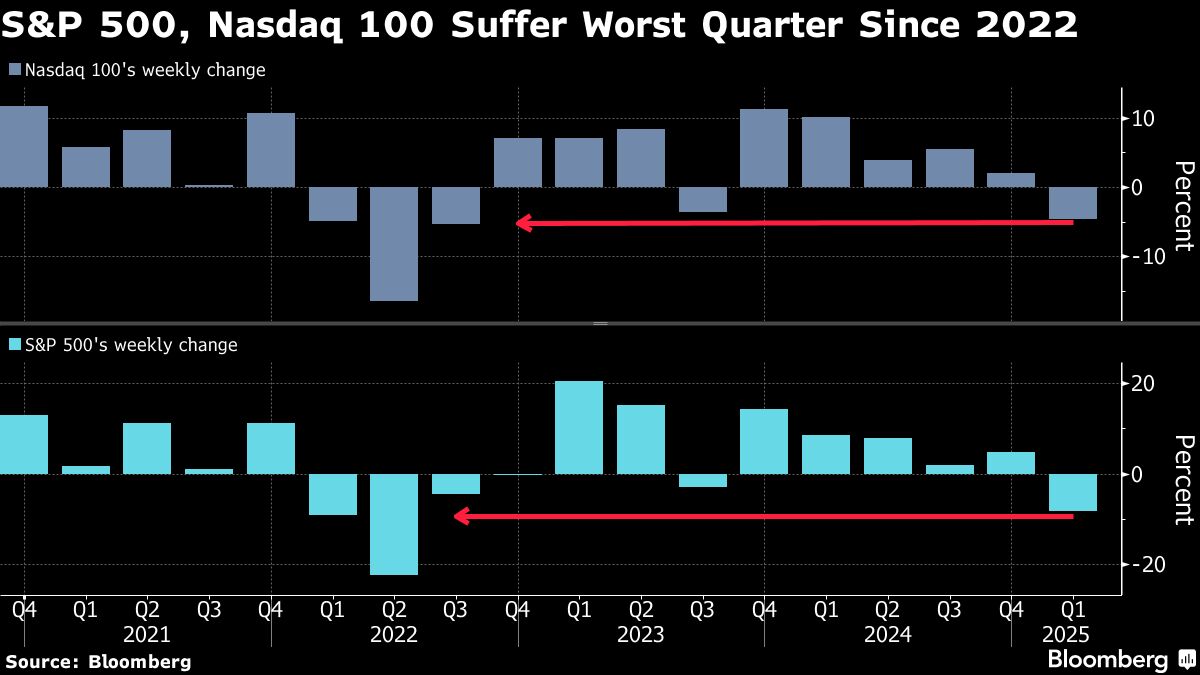
US stocks flipped between small gains and losses following the opening bell on Tuesday after closing out their worst quarter in nearly three years, as traders await President Donald Trump’s next tariff deadline on Wednesday.
The S&P 500 Index was down 0.1% after suffering its worst quarter since 2022, which exposed weakness in the artificial-intelligence boom that has underpinned the two-year bull market. The Nasdaq 100 Index fell 0.1% after Monday’s tech shakeout eased toward the end of the session. Tesla Inc. climbed 2.1% following a 36% tumble in the first three months of the year ahead of its quarter deliveries data. Nvidia Corp. slipped while other Magnificent Seven stocks including Meta Platforms Inc. and Apple Inc. rose.
It’s been a dizzying three months for US equity markets amid uncertainty about what Trump will do with tariffs, and by how much his policies will worsen inflation and hurt economic growth. On Wednesday, Trump is set to reveal what he calls “reciprocal” levies on US trading partners, but details remain scarce. The Washington Post on Tuesday reported that the Trump administration is considering implementing tariffs of about 20% on most US imports.
“Buyers are afraid to step in right now with max uncertainty,” said Jeff Buchbinder, chief equity strategist at LPL Financial. “We really hope cooler heads will prevail and a full-blown trade war will be avoided, but the risk is more volatility is coming for stocks until we know more about the size and scope of tariffs and the subsequent impact on corporate profits.”

The market faces a string of tests in the coming days. Fresh data on the state of the US economy could offer more clues about whether the Federal Reserve may cut interest rates this year, starting with the February Job Openings and Labor Turnover Survey, or JOLTS report, later this morning.
The S&P 500 is now sitting nearly 9% below its Feb. 19 all-time closing high, teetering on the cusp of a correction. Traders see more big swings coming, given the Cboe Volatility Index has climbed to 22, topping the level around 20 that usually indicates growing concern among traders. The options market is pricing in a 1.2% swing in either direction for the index on Wednesday, according to Piper Sandler data.
As the calendar flips to a fresh quarter, investors will be paying close attention to big technology companies after the Magnificent Seven stocks shed over $2 trillion in market value in the past quarter. Their dominance has faded after steep pullbacks in Tesla and Nvidia shares. With the S&P 500 coming off its poorest quarterly performance relative to the rest of the world since the aftermath of the global financial crisis in 2009, traders are looking for signs that the worst may be over, or if more pain is ahead.
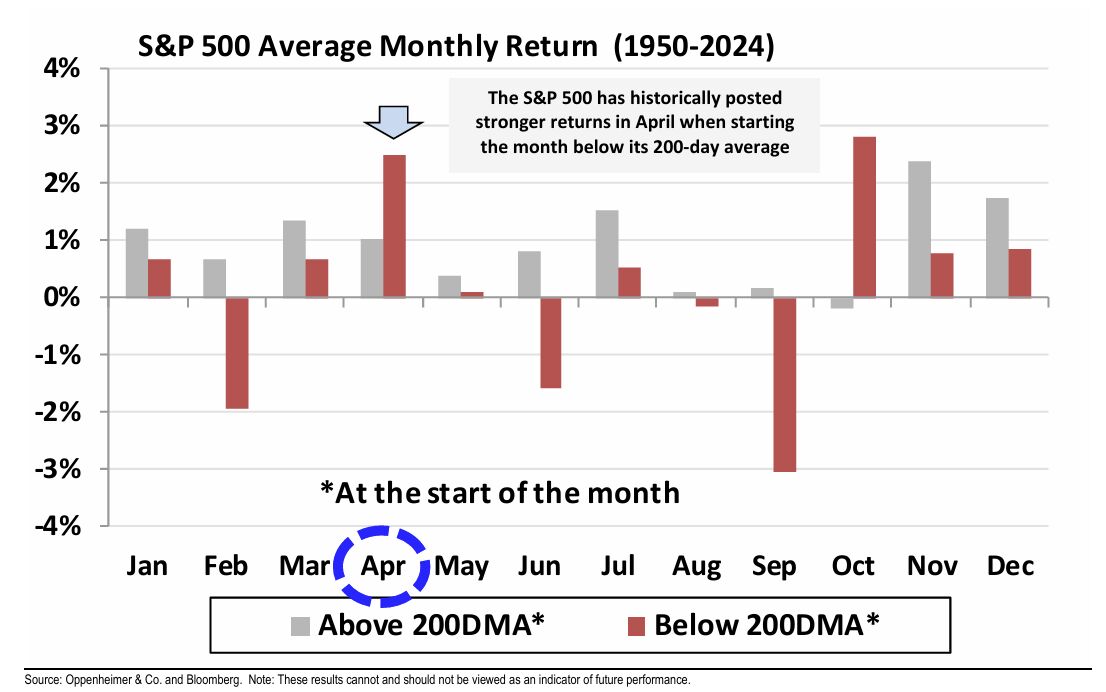
Historically, April tends to be one of the best months of the year when the S&P 500 starts below its 200-day moving average, averaging a gain of more than 2% since the 1950s, according to Ari Wald, a senior analyst at Oppenheimer.
Wall Street is likely to get a clearer reading on the markets and the economy is headed over the next six weeks. There are two crucial jobs reports coming, the first on Friday, as well as a blitz of earnings reports from some of America’s biggest companies, starting with JPMorgan Chase & Co. on April 11, and then the Fed’s next interest-rate decision on May 7.
Growth appears to be slowing. The Atlanta Fed’s GDPNow model sees real gross domestic product contracting at a 2.8% annualized rate in the first quarter. That makes the Trump administration’s goal of achieving economic growth of 3% or better per year look increasingly remote. GDP growth has now topped 2% in nine of the past ten quarters through the October to December period.
While investors have been hoping for a narrow approach toward administering tariffs, the risk is that businesses may become fearful, leading them to start cutting jobs, which could pressure stocks even further. If the tariff announcement on Wednesday ends up being not as bad as investors fear, stocks could rally, according to Matt Lloyd, chief investment strategist at Advisors Asset Management.
“The policy changing pace is what is catching investors off guard,” Lloyd said. “While the concern is real and should always exist, we should also be vigilant on the negative feedback loop that can turn into a capitulating moment.”
A message from Advisor Perspectives and VettaFi: To learn more about this and other topics, check out some of our webcasts.
Bloomberg News provided this article. For more articles like this please visit
bloomberg.com.
Read more articles by Jessica Menton